
About the series “What Makes Christian Gen Z in Germany Tick?”
Gen Z is on everyone’s lips, in the media and in Christian youth ministry too. If you want to know more about this generation based on data, you look to the US or the UK. Surveys often don’t focus specifically on the Christian world. What really makes Christian Gen Z in Germany tick? Thorsten Attendorn took part in the Barna Church CoLab “Discipling Gen Z” and ran his own survey of almost 1,000 young Gen Z Christians in Germany. In this series he shares insights and ideas from the CoLab and puts the results of his survey up for discussion.
- Episode 1: The Christian Gen Z in Germany: The Most Open Generation Ever
- Episode 2: The Christian Gen Z in Germany: A Vulnerable Generation
- Episode 3: The Christian Gen Z in Germany: Where Do They Stand on Culture, the Gospel and Justice?
- Episode 4: The Christian Gen Z in Germany: Honesty Is Everything
- Episode 5: The Christian Gen Z in Germany: Between Zeal and Guilt
Christian Gen Z is committed to Jesus and very Bible-centered. How do these Gen Zers live out their firm grounding in the Bible and their devotion, and how does it affect them inwardly and in their relationships?
How often do Gen Zers around the world read the Bible?
Only a few Europeans take part in the Barna Church CoLab. The survey data make us aware of how far apart the worlds are drifting when it comes to faith, the Bible and Jesus. In its surveys, Barna measured how “Bible-engaged”¹ or “Bible-open”² Gen Z is: while in countries like the Philippines, Kenya or Brazil up to 20% of Gen Z are Bible-engaged, and in South Africa and Nigeria even around 30%, in the Western world it’s only a few: 9% in the US, between 1% and 5% in Europe; many are at least “open.”
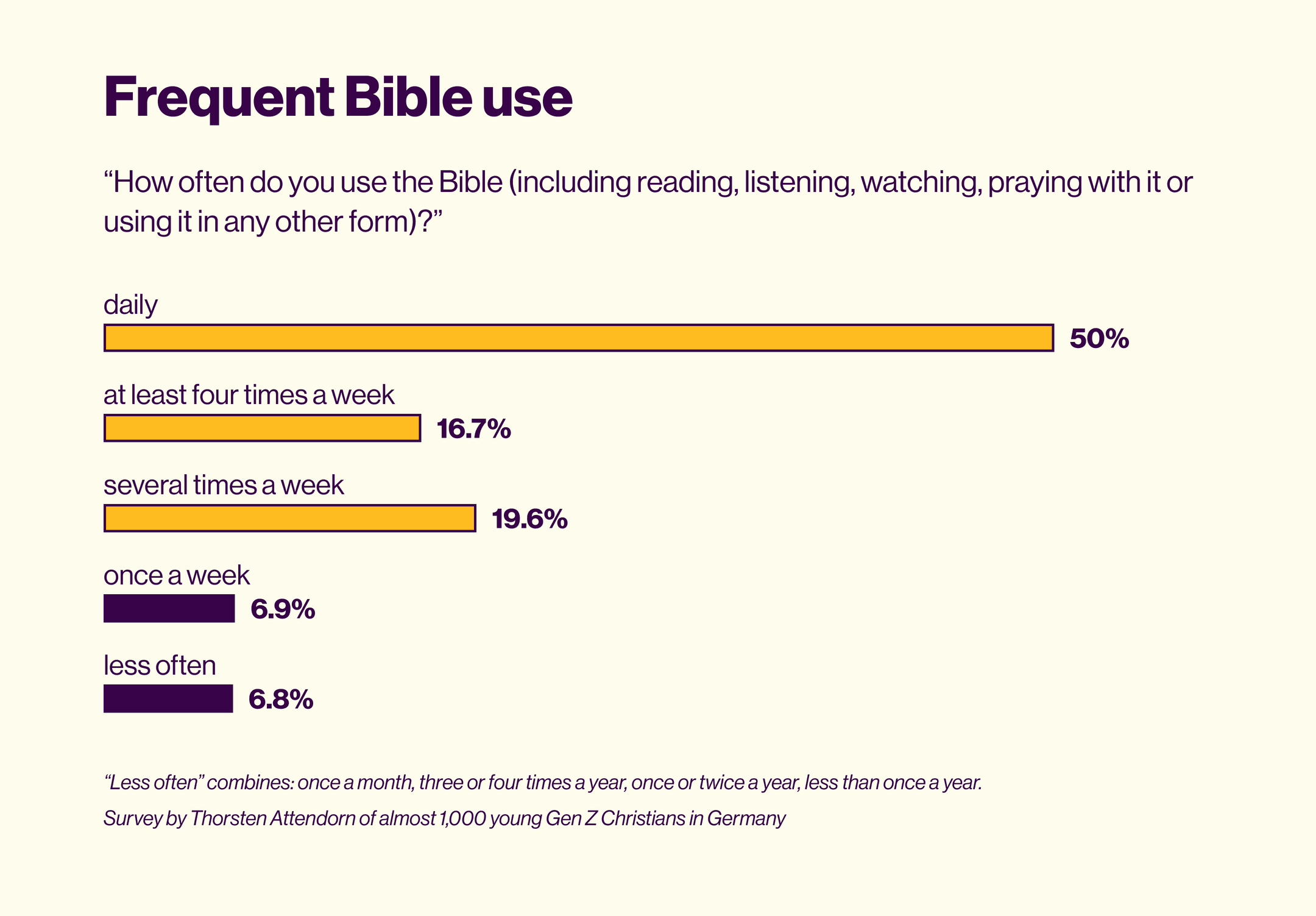
As teens grow into young adults, Bible use then falls considerably further. In the US, however, Bible reading among Gen Z has recently revived: 56% of teenagers are curious about the Bible or about Jesus, and 21% of Gen Z read the Bible more often than in 2023. More teenagers and young adults there (over 50%, in fact) also affirm that the message of the Bible has changed their life.
With only 1% of its Gen Z Bible-engaged, Germany comes in last; 55% are Bible-open, and 44% have a negative view of the Bible and/or (almost) never read it. Christian teenagers and young adults also read the Bible fairly rarely: three-quarters of nominal Christian Gen Z in Germany don’t read the Bible at all or read it only up to once or twice a year; among committed Christians it’s 40%. Only just under a third of committed Christian Gen Z in Germany read the Bible at least once a week.³
Bible engagement makes a difference
People who read the Bible intensively are (statistically) better off in many ways?! A remarkable finding of Barna’s research is that Bible engagement correlates very strongly with positive figures (much more positive, in fact, than among Gen Zers who are merely Bible-open or Bible-unengaged⁴), for example on self-worth and self-efficacy (about 50% compared with about 30%), significance to others (about 50% vs. 30%), sense of belonging to their church (77% vs. 20 to 40%) and meaning and purpose in life (84% compared with 25 to 40%). Caring for the environment and for the poor, and generosity, are also part of the value system of the Bible-engaged (around 50%, compared with 20 to 30%, have actively made these a priority). 60 to 80% of the Bible-engaged believe they can make an “impact” (in various forms), compared with 30 to 60% for Gen Z on average. On a flourishing index, “resilient disciples”⁵ score significantly higher than the Gen Z average.
My survey of Christian Gen Z in Germany doesn’t show this correlation to the same degree. Instead, the respondents’ figures are in some cases well below those of Bible-engaged Gen Z globally, for example: self-worth (12% compared with 53%), significance to others (15% compared with 48%), sense of belonging to their church and practical wisdom from their church (50%/30% vs. about 80%), meaning and purpose in life (44% compared with 84%).⁶ Is it fair to conclude that the Bible, though used intensively, isn’t getting through enough to the soul, to relationships and into “life”? What other reasons could there be?
Christian Gen Z in Germany: drawn to the Bible, alive and motivated, but also struggling with guilt, confusion and problems.
Bible-engaged Gen Z and the tension around “truth”
As for Christian Gen Z in Germany, the respondents are highly “Bible-engaged”⁷:
- They read the Bible regularly (over 50% read it daily, 88% at least several times a week).
- They also have a high view of the Bible: in their view, it is “a source of truth” (93%),⁸ “totally accurate in all of the principles it teaches” (84%)⁹ and has teachings “relevant to the world today” (97%).¹⁰
The topic of “truth” is hugely significant: Jesus is the truth, the Father’s word is truth, the Spirit of truth guides into the truth. That much is clear from Jesus’ last words in John 14-17 alone. At the same time, it is contested: On top of the philosophical problem of absolute truth, with the Bible there is also the question of how far it needs interpreting and how far it is bound to its time.
The respondents find themselves in this tension: They have a high view of the truth, accuracy and relevance of the Bible. Truth also comes first among the things they have or are looking for in their faith. In Jesus’ teaching, they prefer what is “true/trustworthy” over what is “good.” At the same time, they give clearly less weight to being correct and informed in their faith than to being honest. Many say they have a firm and mature faith; some are also uncertain and doubting.
How does the Bible make them feel?
I was curious to see how the Bible makes the respondents feel.¹¹ The good news: Almost all of them enjoy reading the Bible, 60% of them “a lot.” It moves me that three-quarters or more of the participants name positive feelings such as being loved (87%), peaceful (79%), motivated and alive (75% each). For many, the Bible also makes them feel “excited” and “empowered” (55% and 50% respectively). These figures are impressive: they are mostly at least twice as high as those of the Christians in the Open Generation survey, and also significantly higher than those of the comparison group of US practicing Christians. Do these results show “traces of blessing” left by God’s word in the inner person, when you open yourself to it and use it intensively? These are strengths worth building on!
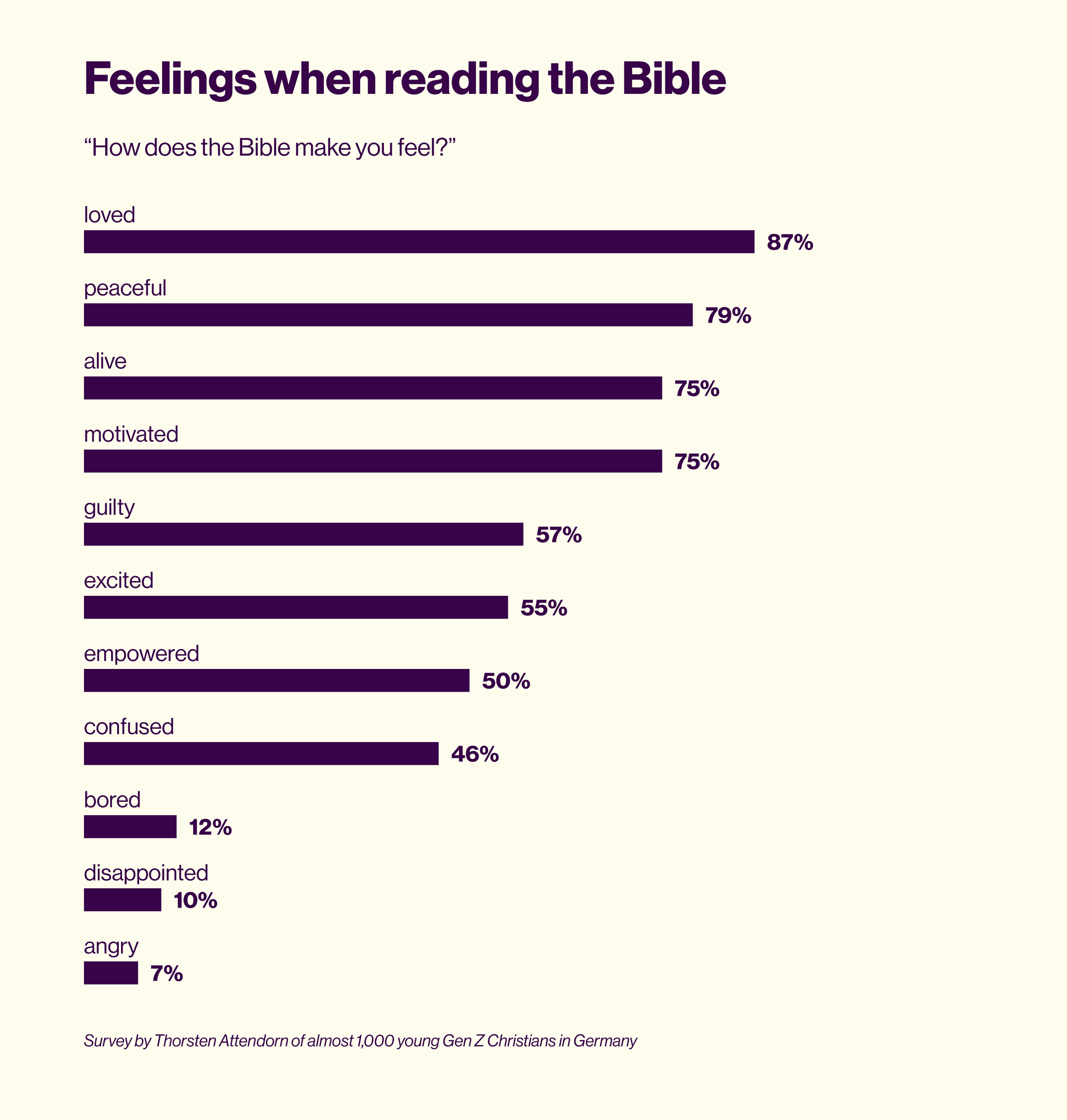
The picture is mixed, however, as already shown on the topic of “emotional health”¹² and as other feelings when reading the Bible also show: A striking number of respondents report that the Bible makes them feel guilty (57%) and confused (46%). These figures are high not only in absolute but also in relative terms: all the comparison groups stay consistently in the low single digits (!) here.¹³
I wonder where such feelings of guilt might come from. Surely it also varies from person to person. You might feel “guilty” because …
- … you fall short of the amount of Bible study you supposedly “owe” (how often, how intensely, how long …), you don’t understand some things (see below), and so on. This is similar to the pressure to be perfect.¹⁴ Yet fellowship with God, expressed in the Bible, prayer and silence, is not a competition; grace can’t be earned by performance.
- … you notice a gap between ideal and reality, between faith at church and faith in everyday life, or between the Bible and the world around you. This may also contribute to the widespread feeling of “confusion.” Being gentle with yourself when you fall short of your ideals, and continuing to grow and work on your weak spots with healthy motivation and without guilt, is surely a learning process.
- … in a particular moment, while reading the Bible, hearing a sermon and so on, you are personally convicted of sin, because the Bible, God’s word, is “alive and active” (Hebrews 4:12). Shouldn’t the forgiveness the respondents receive (1 John 1:9; Micah 7:18-19; Ephesians 1) be allowed to “outvote” the feeling of guilt?¹⁵ Psalm 32:1 calls “blessed” the one “whose transgressions are forgiven.”
- … the Bible is heavily “loaded with guilt” in its themes or atmosphere, or a self-image of the believer is taught, perhaps also anchored in the liturgy, in which guilt is in the foreground. After all, the high figures for both “loved” and “guilty” at the same time stand out. Could this reflect a teaching along the lines of “I am loved, but …” (or “I am guilty, but …”)? Some beliefs could fit with such feelings of guilt,¹⁶ for example the widespread fear of sinning, the belief that God wouldn’t go along with you if you were unfaithful, that you are a failure, and so on.
Problems with reading the Bible
The participants use their Bible intensively, but at the same time they have considerable problems with reading it, and many more than the comparison groups: among both the less Bible-oriented US practicing Christians and the Bible-engaged, the comparison figures for these “problem questions” are consistently below 20% and 15% respectively, and in some cases below 10%.
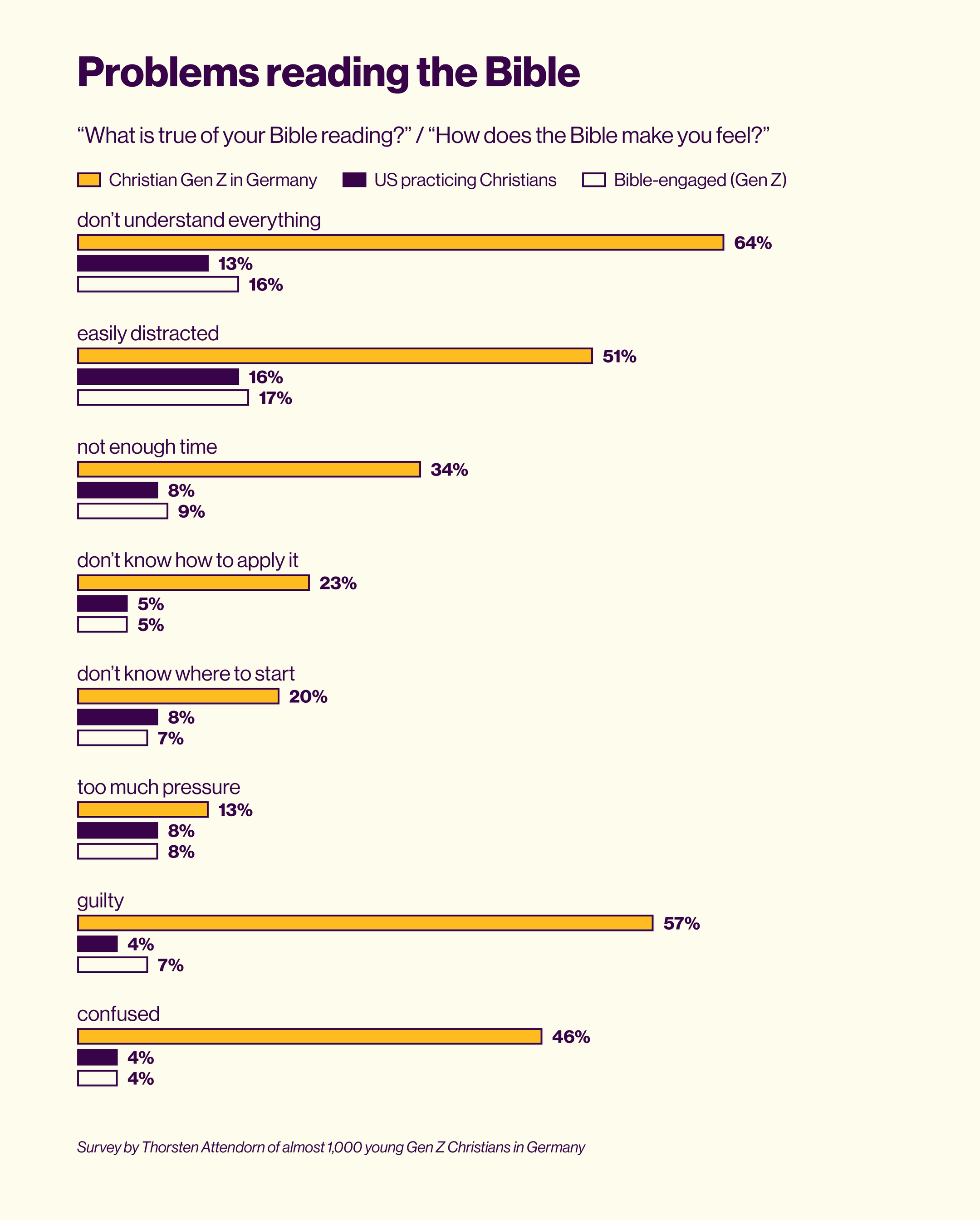
At the top of the list of problems is that they don’t understand everything (64%). Those who don’t know where to start or how to apply what they read are not isolated cases either (about 20% each). Almost 10% have no one to help them; about 75% had mentors who taught them to read the Bible. That is clearly fewer than in the comparison groups, where almost all respondents had mentors, usually several. These problems with understanding may be one reason for the feeling of confusion that almost half of the respondents know from reading the Bible (see above). For just under 20%, confusion is also a trait of their faith.¹⁷
Other problems often named are above all, and not surprisingly, distraction (51%) and not enough time (34%). What comes to mind here is distraction and competition for time, especially from heavy media use, but also the common problem of setting priorities. 10% explicitly name “too much pressure,” though some of the other problem areas also seem to reveal a certain pressure of expectations.
What is a good way to approach the Bible?
At the Barna Church CoLab there is intense discussion about what a good approach can look like, given how central the Bible is. There is agreement that the Bible (and God) wants not only to be understood but also to be experienced: the “knowledge” in which believers grow (2 Peter 1) isn’t limited to the head. Lisette Fraser (a coach at the Fuller Youth Institute and Tenx10) stresses that connecting the Bible with practical life is essential: with the needs, expectations and hopes, and also the “agendas,” that drive this generation.
There may be some catching up to do here. “Strong in teaching, not so much in living”? That the Bible, Jesus and faith do good is not on many people’s radar, and yet it is a factor that can motivate and engage.
Shane Sanchez (Director of High School Content at the Christian publisher Orange) raises the question of whether the way Gen Z answers, putting the holiness and truth of the Bible ahead of its relevance and joy, is also a result of the conflicts previous generations focused on.
Lisette and Shane also advise aiming teaching not only at “what” people think, but more at “how”. That gives us pause: we live in a time of questions, doubts and crises. The help may not lie in one-sided preaching of “unquestionable” positions (the “what”).
All the more important, then, that young Christians can answer the questions they have anyway on their own and convincingly from the Bible (that is, the “how”).
If Bible study is also about more than content, more than understanding, then a fitting method is needed, with more dialogue than monologue, safe spaces for questions and doubts, and personal conversations about faith and the Bible.
What does Gen Z think of Jesus?
Where does this generation stand on Jesus? Savannah Kimberlin surprises us with her survey results: global Gen Z’s view of Jesus is very positive. On the other hand, the answers show little Christological substance, even among Christian Gen Z.
Shaky knowledge about Jesus
Just over half of teens worldwide are Christians (52%): 30% of teens are nominal Christians and 22% are committed Christians.¹⁸ In Germany, 41% of teens are nominal Christians and 10% committed Christians.
Conviction about important biblical truths about Jesus is shaky, even among Christians: only about 50% of nominally Christian teens in the US, and about 60% globally, believe that Jesus was crucified; 44 to 49% of Christian teens in the US believe in Jesus’ resurrection or his return; only a third of Christian teenagers worldwide think it’s possible to communicate with him. In Germany, the corresponding figures are below the global level in each case: among committed Christians, 40 to 60% affirm these essential statements of the creed. The figures for nominal Christians are lower still (for example, “He was a real person”: committed Christians 48% (!), nominal Christians 32%; “He was raised from the dead”: 53%/26%; “He can be communicated with”: 32%/12%).
Jesus has a positive image, even among non-Christians
Savannah offers a surprising and motivating insight when she shows that Jesus has a positive image, and not only among Christians. His reputation is better than that of Christianity, the churches or Christians. That’s food for thought! On the one hand: what opportunities this offers to put Jesus where he belongs, at the center! On the other hand: what unnecessary, counterproductive “fronts” do I as a Christian, and do the churches, open up with people of other beliefs?¹⁹
When asked what they believe about Jesus, every one of the positive answer options scores at least twice as high as the highest-rated negative one: “He offers hope to people,” “He cares about people,” “He is trustworthy”; about 40 to 45% of respondents give these answers. All the negative statements, on the other hand, are in the single digits: “He is known for the things he is against,” “He is judgmental,” “He is irrelevant” and so on. When respondents are asked about Jesus’ five most important traits, forgiveness takes the top two places (he offers forgiveness, and he forgave those who wronged him), while the “harder” traits (he is authoritative, King, Lord) or the more “difficult” ones (servant, friend of sinners, rejected by religious leaders) fall to the lower places.
A survey of 12- to 17-year-olds in the UK also found that God’s love, and then also his power, are attractive. However, people agreed with this more on an abstract level. The concrete (Christian) form his love took in Jesus, especially in his weakness and his death, and also the idea that God wants to be with us or in us, the respondents found less attractive or even off-putting; they had similar difficulty with God’s justice, their own need for salvation or the idea of personal change.
The good news: it seems easy to build on existing, and admittedly superficial, interest; what seems more demanding is to dig further and deeper from there to the Christian gospel.
Christian Gen Z in Germany: Jesus stands for truth and joy
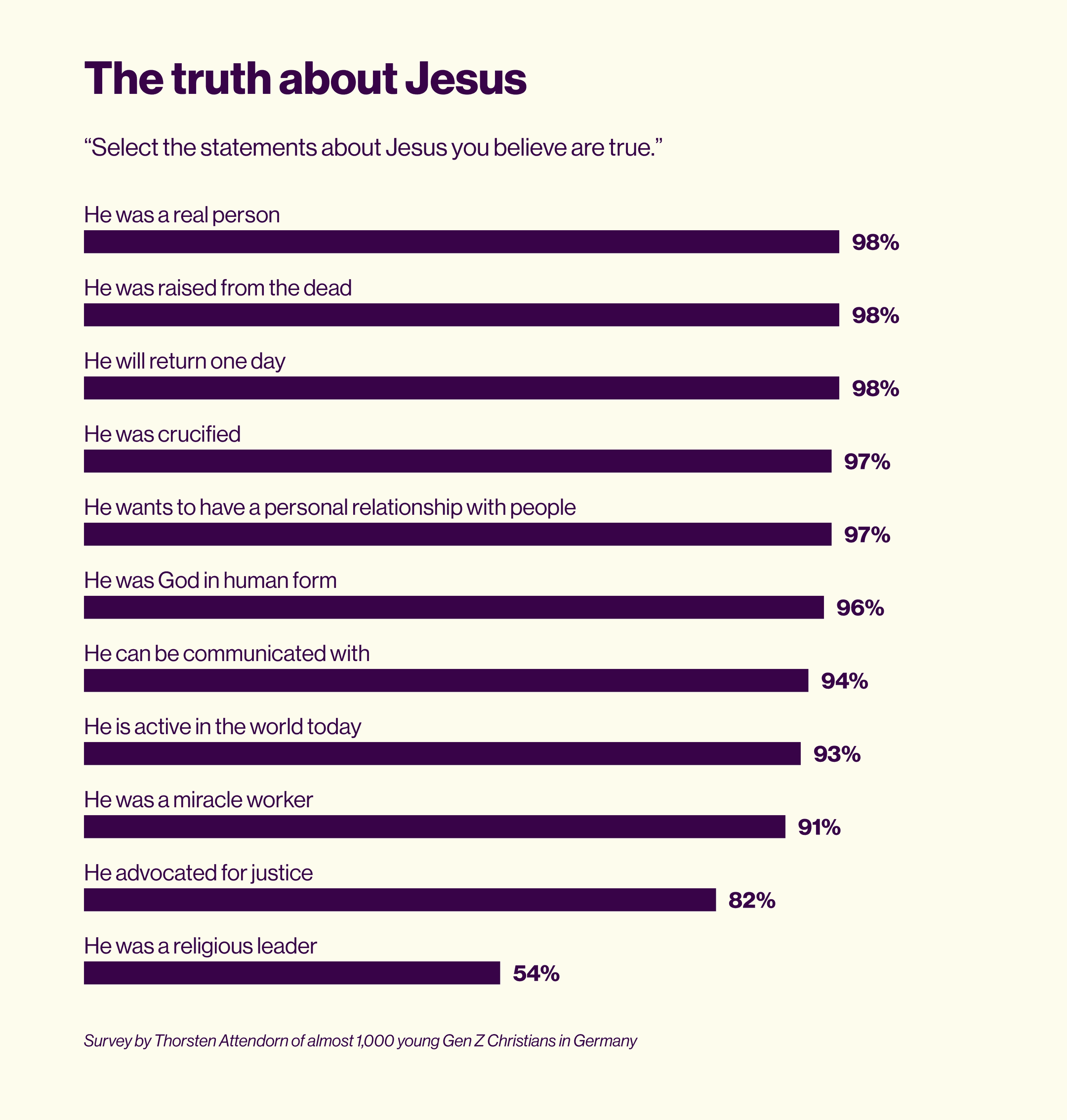
On the basic Christological statements of the Bible, the respondents show very high levels of agreement: that Jesus was a real person, God in human form, that he was crucified, was raised from the dead and will return each score close to 100%. The respondents are just as convinced that he wants to have a personal relationship with people, that he is active in the world today and that he can be communicated with. Only 54%, on the other hand, see him as a religious leader; 91% think he was a miracle worker, and 82% that he advocated for justice. When choosing whether it matters more to them that Jesus’ teaching is true and trustworthy or that it does good in the world, over 80% choose the former.
This doctrinal conviction “fits” the participants’ strong orientation toward the Bible. But what about their personal relationship with Jesus?
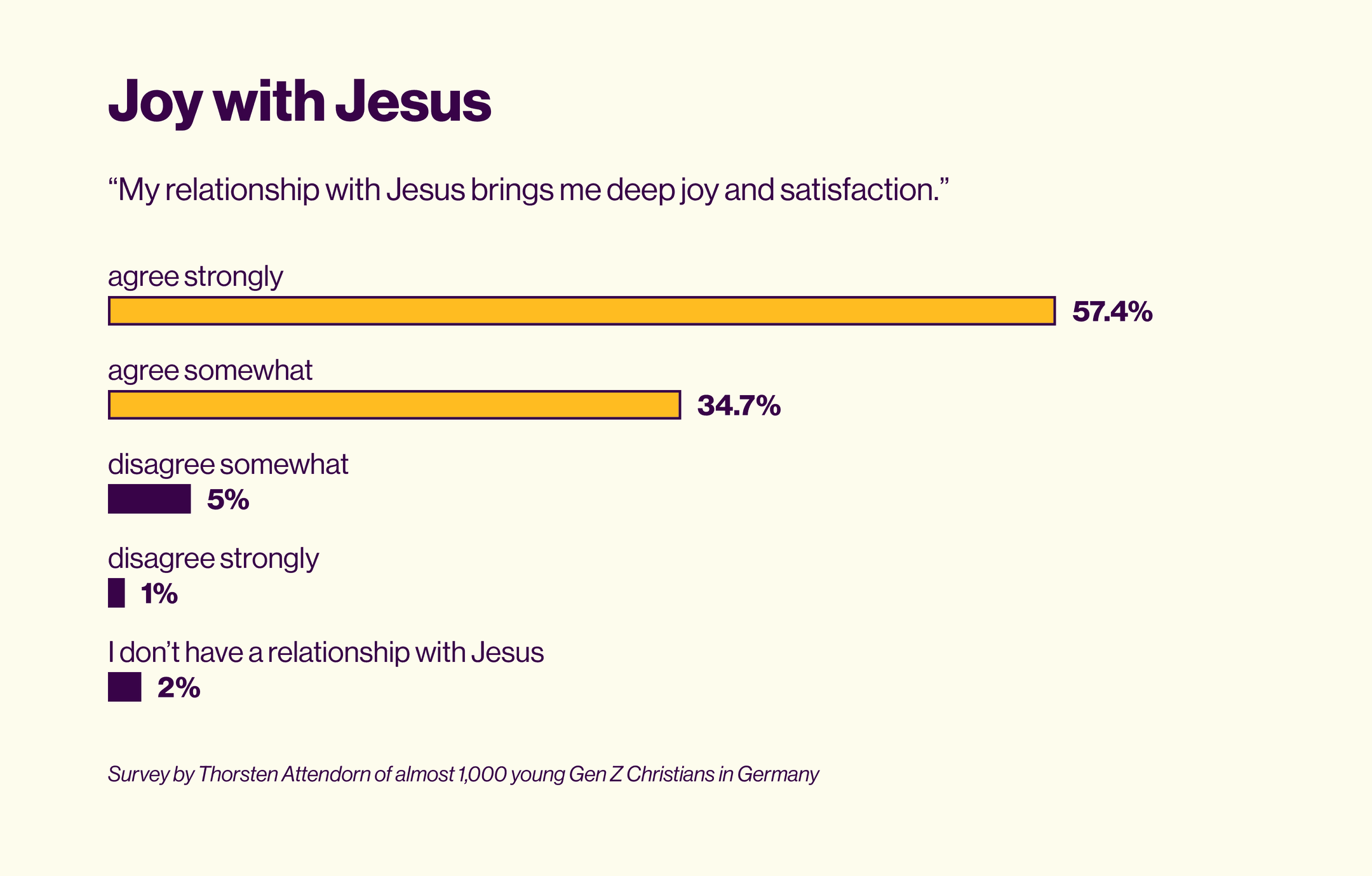
In the survey of Christian Gen Z in Germany, 87% of respondents have made a personal decision for Jesus. 58% “strongly” and 35% “somewhat” agree that this relationship with Jesus brings them “deep joy and satisfaction.” Given the ambitious wording (“deep” joy and satisfaction), this is an impressive figure, one that should also tell us something about meaning²⁰ and happiness in life. There also seem to be cultural differences or differences in mentality, however: compared with both committed Christians and Bible-engaged Gen Z, the respondents score lower here than their global counterparts (75%/83%), but higher than their counterparts among Gen Z in Germany (46%/38%).
A comparison with US practicing Christians is especially interesting on the topics of the Bible and Jesus, because both groups have a similar profile, in particular a similarly high level of commitment to Jesus; the US group, however, is much less Bible-engaged.²¹ The US practicing Christians …
• … use the Bible less regularly (45% read the Bible more than once a week, compared with about 90%) and rate its truth and relevance lower (70% compared with 90 to 100%);
• … have fewer positive feelings from the Bible (figures between 30 and 70%, compared with 50 to 90%), but also far fewer negative ones (5% at most, compared with, for example, 46%/57% “confused”/“guilty”);
• … have problems reading the Bible far less often (figures at most in the low double digits, compared with 20% for “don’t know how to apply it”/“don’t know where to start,” 51% for “easily distracted,” 64% for “don’t understand everything” and so on);
• … are much less certain about what the Bible says about Jesus (figures for “real person,” “raised from the dead,” “can be communicated with” and so on are 40 to 50%, compared with about 100%);
• … find the truth and trustworthiness of Jesus’ teaching only slightly more important than the good it does (52% truth, 48% good, compared with 83% truth to 17% good among Christian Gen Z in Germany);
• … more often experience deep joy and satisfaction in their relationship with Jesus (76% compared with 58% strong answers);
• … are in some respects stronger inwardly and in their relationships, but in others (pressure to be perfect, loneliness) also weaker.²²
How can we connect this generation with Jesus?
What can it look like with this generation when Jesus is at the center? Keithen Schwahn, youth pastor at Church for the City New York, impresses us with his simple and heartfelt message: “Come … and you will see” (John 1:39). Introduce Jesus as the person who is the answer to my longings, instead of taking a “used car salesman” attitude, as if you felt pressured to push an unwanted item nobody buys.
“First relational, then transformational”: Clark Giansanti (a junior at Biola University in California and a member of the Global Leadership Summit’s NextGen Ministry) also stresses this order: build relationships and then pass on Jesus’ changing, transforming power, including the role young people themselves play in it. What moves me most is how Keithen highlights the importance of prayer: not as a “warm-up act” for an event, but as a valuable, authentic witness of faith in its own right, one that can show those present what devotion and connection with God can look like.
Conclusion and next steps
In short: characteristics of Christian Gen Z in Germany, Episode 5
- A very strong foundation (reading and teaching) in the Bible and about Jesus
- Strong positive emotions when reading the Bible
- A striking amount of guilt, confusion and problems when reading the Bible; comparatively few mentors for Bible reading
- Strong commitment to Jesus, and joy and satisfaction through him
- A clear view of the importance of truth/trustworthiness and of justice in Jesus’ teaching, while the “good” lags behind
- Weaker inwardly and in relationships than other Christian teenagers and young adults worldwide (both Bible-oriented and more pragmatically committed young Christians)
Springboard for your own youth ministry
The following questions can help you check the survey results in your own youth group and talk about the topics in more depth:
- What would you say to someone who asks you why you think the Bible is relevant for today?
- Can you explain why young people who have a high view of the Bible and read it intensively get more out of their church, believe more strongly that prayer works, have a stronger sense of calling, are more satisfied with their lives and feel more that they matter to other people?
- Which Bible passages help you feel loved, motivated, alive?
- What might be the reason many people feel guilty when they read the Bible?
- Where, for example, do you find it hard to understand the Bible or to apply what you read?
- What helps against distraction when you read the Bible?
- Describe to someone who doesn’t have a personal relationship of faith with Jesus, concretely and vividly, why Jesus’ teaching is good for the world and what about Jesus gives you joy and satisfaction!
Resources
- Barna, The Open Generation
- The American Bible Society, State of the Bible, 2023
- The American Bible Society, State of the Bible, 2024
- Youthscape, Translating God, 2023/2024
¹ Bible-engaged: have a high view of the Bible (that is, see it as God’s word with no errors, or at most a few) and read it several times a week. On average, a Bible-engaged teenager has (had) four different people who taught them to read and study the Bible (usually parents, pastors, mentors, children’s or youth leaders, other family members or members of a small group).
² Bible-open: have a high view of the Bible and also read it (though less often than the Bible-engaged), or have a neutral view of the Bible (that is, not a high view, but not a negative one either). Bible-unengaged are all the rest, that is, the group that has a negative view of the Bible and/or (practically) never reads it.
³ Committed Christians, by Barna’s definition, are those who identify as Christians and have made a personal commitment to follow Jesus Christ. Nominal Christians are those who identify as Christians but have not made a personal commitment to follow Jesus Christ.
⁴ The (merely) “Bible-open” Gen Zers have almost the same figures as the “unengaged”: their attitudes on the questions mentioned differ in each case by only a few percentage points, mostly in the low single digits.
⁵ Resilient disciples: attend church at least monthly and are involved beyond worship services; trust firmly in the authority of the Bible; are personally committed to Jesus and believe in his death and resurrection; want to change society as an outcome of their faith.
⁶ See Episode 2.
⁷ And this is in the range of the “highly religious” group in the 2018 empirica youth study: there, frequency of Bible reading once a week 16.8%; more than once a week 30.9%; daily (once or several times) 27.8%.
⁸ Question: “Is this statement true of you? ‘I believe the Bible is a source of truth.’”
⁹ Question: “Is this statement true of you? ‘I believe the Bible is totally accurate in all of the principles it teaches.’”
¹⁰ Question: “Is this statement true of you? ‘I believe the Bible has teachings that are relevant to the world today.’”
¹¹ Question: “How does the Bible make you feel? Select all that apply.”
¹² See Episode 2.
¹³ Among the “highly religious” in the 2018 empirica youth study, positive and negative feelings on a scale of 1 to 5 were distributed as follows: gratitude (4.5), love (4.2), security (3.9), forgiveness (3.2) / guilt (3.2), disappointment (2.5), anger at God (2.2), fear (1.9).
¹⁴ See Episode 2.
¹⁵ Compare the 2018 empirica youth study, in which forgiveness and guilt were level (see above).
¹⁶ See Episode 4.
¹⁷ See Episode 4.
¹⁸ Committed Christians, by Barna’s definition, are those who identify as Christians and have made a personal commitment to follow Jesus Christ. Nominal Christians are those who identify as Christians but have not made a personal commitment to follow Jesus Christ.
¹⁹ On the dos and don’ts of the gospel, see Episode 3.
²⁰ More on this in Episode 4.
²¹ See Episode 1.
²² See Episode 1.
Unless otherwise indicated, Scripture quotations are taken from The Holy Bible, New International Version® NIV®, Copyright © 1973, 1978, 1984, 2011 by Biblica, Inc. Used with permission. All rights reserved worldwide.