About the series “What Makes Christian Gen Z in Germany Tick?”
Gen Z is on everyone’s lips, in the media and in Christian youth ministry too. If you want to know more about this generation based on data, you look to the US or the UK. Surveys often don’t focus specifically on the Christian world. What really makes Christian Gen Z in Germany tick? Thorsten Attendorn took part in the Barna Church CoLab “Discipling Gen Z” and ran his own survey of almost 1,000 young Gen Z Christians in Germany. In this series he shares insights and ideas from the CoLab and puts the results of his survey up for discussion.
- Episode 1: The Christian Gen Z in Germany: The Most Open Generation Ever
- Episode 2: The Christian Gen Z in Germany: A Vulnerable Generation
- Episode 3: The Christian Gen Z in Germany: Where Do They Stand on Culture, the Gospel and Justice?
- Episode 4: The Christian Gen Z in Germany: Honesty Is Everything
- Episode 5: The Christian Gen Z in Germany: Between Zeal and Guilt
Christian Gen Z in Germany: fragile emotional health, good personal networks, mixed relationships with family and church
How is the emotional health of Christian Gen Z in Germany? Can the marks of this “vulnerable generation” also be seen in young Christians? Relationships are an important stabilizing factor. Does Christian Gen Z have healthy relationships with friends, with family, with church?
Mental health: a topic for Gen Z, and for us too?
“Mental health is a topic for Gen Z, and mental health has to be a topic for us too,” insists Kara Powell (executive director of the Fuller Youth Institute), who joins us by video at the Church CoLab. (Kara’s words here and below are paraphrased, not a verbatim transcript.) In her view, this generation has greater awareness, greater concern and a greater ability to talk about mental health. You may find that annoying or overwhelming, but you can also make a decision: “This language may not be my language, but I want to speak it.” You may regret the social developments that led to this mental health crisis. But on a purely practical level: if you want to be in relationship and in conversation, there’s no getting around this predominant topic.
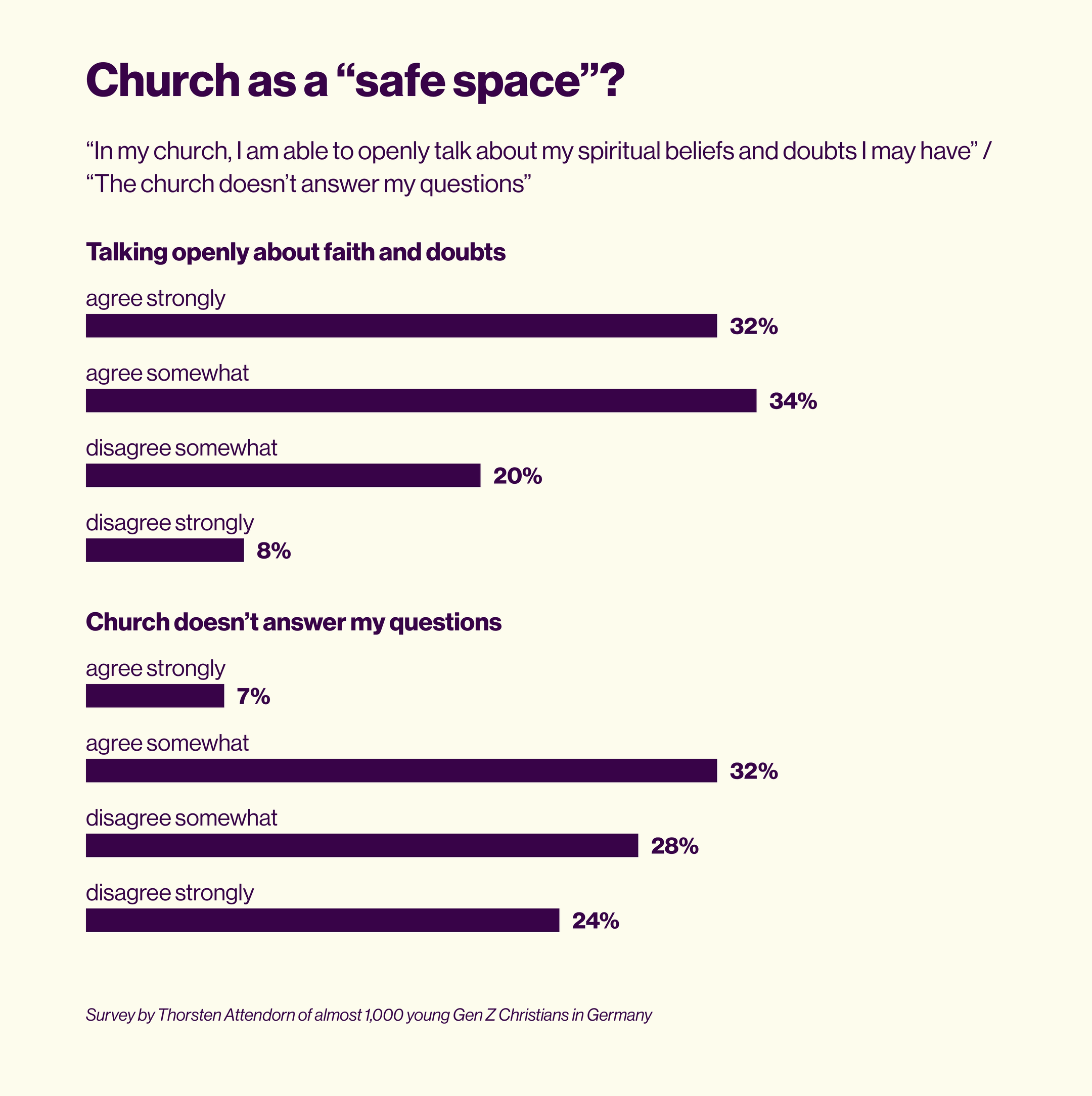
Kara considers it essential to make room in churches for questions, opinions and doubts; there should be a safe environment where people are listened to and helped. She warns against simple answers like “Jesus is the answer” (while affirming at the same time: “He is!”) and instead recommends starting conversations with serious questions, like an honest, listening “How are you?”, “What’s on your mind right now?” or, prompted by surveys like this one: “What do you think about this survey data?”
In her research, Kara Powell has identified three existential questions of this generation (and written books about them), all of which find a compelling answer in Jesus:
- Who am I? The question of identity: God’s child. Accepted in Christ.
- Where do I fit? The question of belonging: God’s people. Part of God’s family.
- What difference can I make, what can I change? The question of purpose: God’s story and work. Gifted and commissioned in God’s kingdom.
Discipleship: digital natives vs. “embodied life”
Matt Manno, who is responsible for developing a course for teenagers at Pete Scazzero’s ministry Emotionally Healthy Discipleship, points to the importance of social media when it comes to discipleship. “Social media is all the time discipling,” and it competes strongly with “real-life” relationships. He sees the challenge in bringing the “digital natives” into real, physical life: the “embodied life.” Fitting formats of youth ministry and discipleship training can play an important role here:
- One-on-one mentoring
- Input in small groups
- Workshop or seminar formats instead of “school-like” ones, depending on the number of participants, target group and context
- An approach to personal conversations that listens more than it answers, analyzes or follows an agenda
Gen Z: a generation under pressure
From the data Savannah Kimberlin presented to us at the Church CoLab, we learn that Gen Z is a “generation under pressure,” and more from within than from outside: 31% say they put pressure on themselves to be successful and perfect; 25% report external pressure in the form of parental expectations or the judgment of the older generation (in each case “always” or “usually”). If you break Gen Z down by age group, teens feel more insecurity, while for young adults, who often already have their first work experience or career prospects, it’s the fear of failure.
Where does the pressure to succeed come from? Looking deeper, 51% name “happiness” as the ultimate goal of their lives. And 43% define happiness as “success”; far behind come education (23%), then family (20%); spiritual life and health trail with 8% and 6%. The “internal” pressure doesn’t come from nowhere either; it is fueled by social media, for example.
Mental health of Gen Z in Germany
Gen Z really is a battered generation: it is estimated that currently about 20% of children and teenagers in Germany develop a mental disorder each year. In Germany, according to surveys, stress (46%), exhaustion (35%), self-doubt (33%) and lack of motivation (31%) among 14- to 29-year-olds are in some cases well above the figures for the older generation. Young women are more affected than young men: 53% of Gen Z women feel anxiety and stress “always” or “most of the time”; that is 12 percentage points higher than among millennial women and 14 percentage points higher than among Gen Z men. 41% of younger women say they suffer from a mental illness.
Is the mental health crisis just imagined or exaggerated?
Is the mental health crisis a subjective phenomenon, just imagined, talked into being? It’s true that the influence of social media on how people perceive their own mental health, for example, should not be underestimated, as we have known since Tumblr and as has also been researched with TikTok (sources below): social media really is an “incubator” of personality-related and behavioral mental disorders; social media makes incorrect self-diagnoses more likely. Gen Z also shows a greater ability and willingness to talk about mental health, freeing the topic from the taboo or stigma that sometimes surrounds it (including in some Christian circles), which, however, comes with the risk of overemphasis and imitation (the “prevalence inflation hypothesis”).
Still, for two reasons I believe churches should take up the topic of mental health knowledgeably, empathetically and in a spiritually constructive way. First, the medical data show that this generation (and especially girls) really is struggling more mentally:
- In Germany, in mid-2020, the prevalence of clinically relevant depressive symptoms among young people was 25.3%, compared with 10.4% in 2018/19.
- From 2019 to 2022, inpatient treatment of girls aged 15 to 17 increased by 24% for depression diagnoses, by 35% for anxiety disorders and by more than 50% for eating disorders.
And second, I agree with Kara Powell that this topic should matter to churches too: because it is very important to this generation, it matters to God, and churches share responsibility for the past and future development of the mental health of this generation too. So it’s not only about consciously countering this generation’s “disconnection.” Jesus Christ, the “Savior” and Shepherd, cares not only about eternal salvation; as Peter puts it, he is also the “Shepherd and Overseer of your souls” (1 Peter 2:25). And we older people have a spiritual responsibility for what has been and what is to come: do we share responsibility for the state this generation is in? We can and will contribute to the mental and emotional well-being of the young generation in the future too, for better or for worse.
Mental health diagnoses among the young generation had already risen sharply in the previous decade, but especially since COVID:
• In the US, the share of 18- to 44-year-olds who received mental health treatment rose from 18.5% to 23.2% between 2019 and 2021.
• In the UK, the share of 16- to 17-year-olds with a “high level of mental distress” rose from 23% (2007) to 44% (2021). Hospital admissions for self-harm (ages 10 to 19) doubled in ten years, and those for eating disorders doubled in six years, with a sharp jump from 2019 to 2020 (90% of them female).
• In Germany, almost one in three people say they suffer from a mental illness. 41% of women aged 18 to 34 say they suffer from depression, anxiety disorders, eating disorders or other mental illnesses.
Emotional health is fragile
Anxiety and depression
I was curious whether believers from Gen Z show better mental health. 45% and 20% of respondents from Christian Gen Z in Germany say they struggle with anxiety and with depression respectively.¹ For lack of exactly matching questions, these data can’t be reliably compared with other surveys. Looking at various surveys and studies, for example on anxiety and stress (over 50%, depending on the survey) and on depression diagnoses (around 25%), the figures for Christian Gen Z in Germany seem to be slightly below average, but they still clearly bear the marks of this generation.
Inner stability and self-worth
The mixed impression of respondents’ mental health is reinforced when you look at other questions that can say something about emotional health. For example:
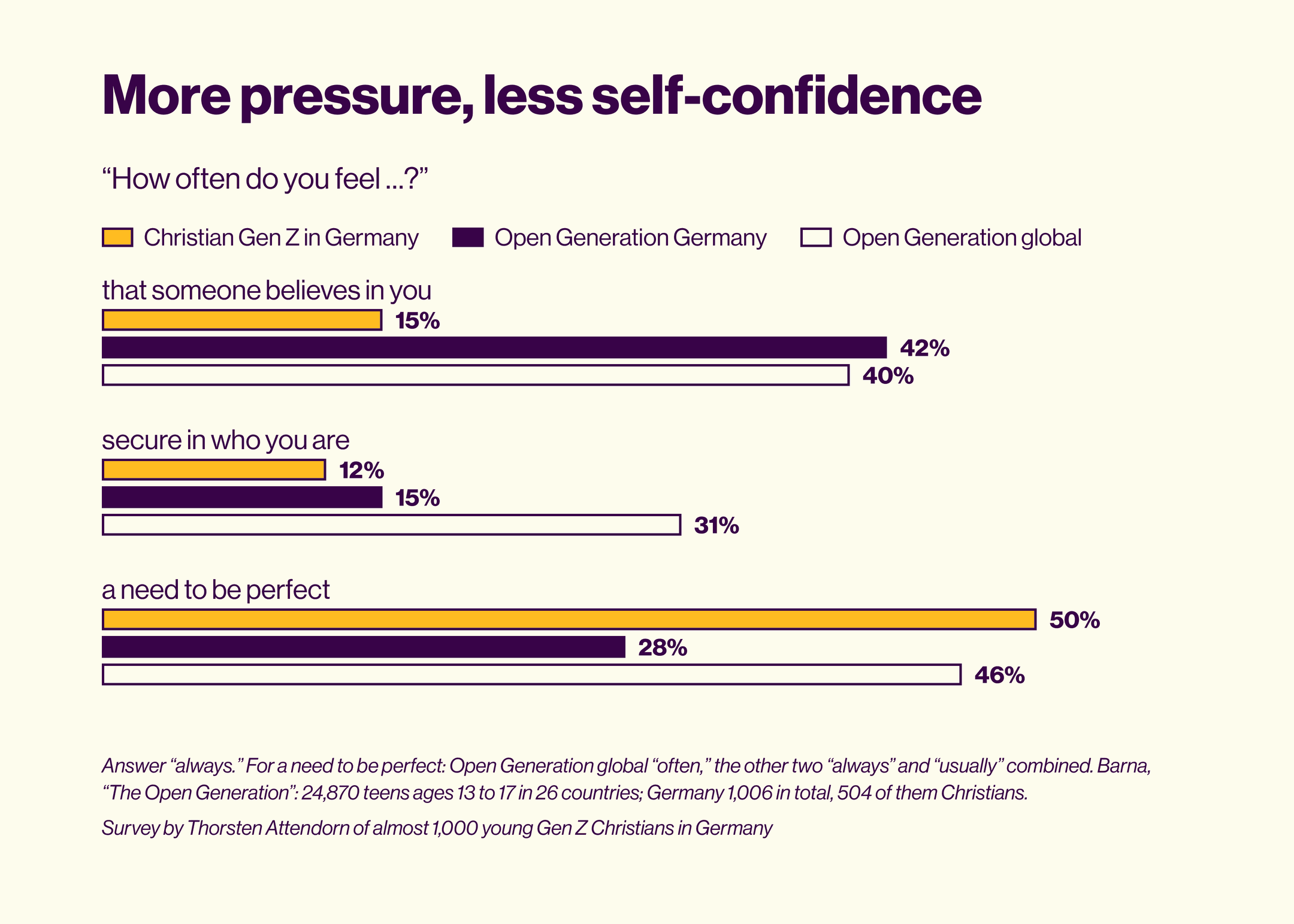
- 15% feel “strongly” (35% “somewhat”) under pressure to be perfect;² this is higher than the figures from the Open Generation survey, especially for Gen Z in Germany (11%/17%; globally 20%/26%);
- only 12% feel “strongly” (52% “somewhat”) secure in who they are;³ the comparison data from the Open Generation study are similar for Gen Z in Germany (15%/47%), while Gen Z globally is more self-assured (31%/37%);
- social relationships are mixed (see below).
In other topic areas of the survey,⁴ it emerged that “self-worth” and “self-efficacy” need attention:
- Self-worth / pressure to be perfect: about 50% affirm that they are “worthy of being loved”; a third are afraid of sinning, a third think it possible that God could ask more of them than they can handle, a quarter see themselves as failures, a fifth need other people’s approval to be happy.
- Self-efficacy: when asked about their personal beliefs, 35% affirmed that they can make their own decisions. In the context of “hope,” there was a strong trust in God, while taking personal responsibility was much less pronounced.
I find these data worrying; I want to take them very seriously, but also to invite you to ask around in your own setting. Of course I ask myself: why doesn’t the “strength of faith” of these respondents show more clearly in their mental health? If you are sure (in the sense of Kara Powell’s three questions) of your identity in Christ, your belonging to God’s family and your calling into his work, aren’t the conditions in place to live and act out of a healthy self-confidence anchored in God? It is and remains clear: regardless of their understanding of faith, they are part of a battered generation and are dealing with external factors such as crises, social media, upheavals and so on. Some respondents’ “beliefs” also seem to tilt toward fear, pressure and perfection; and it looks as if their faith culture comes at the expense of self-worth and self-efficacy. How important it is to know you are accepted in God, an acceptance that stabilizes, feels familiar and gives strength!
Mixed relationships with parents, friends and churches
Social relationships
The relationships of Christian Gen Z in Germany are ambivalent:
- About 40% and 50% respectively strongly affirm that they are happy with their friendships and with people who encourage them spiritually.⁵ Friendships and help from other people are also named more often than average as strengthening hope.
- Yet about 60% feel lonely at least sometimes (2% “always,” 17% “usually” and 42% “sometimes”),⁶ almost twice as many as the average for Gen Z in Germany (4%/10%/20%; globally 9%/14%/28%).
- About 80% have someone they can confide in;⁷ conversely, one in five has no one with whom they can share personal feelings or experiences.
- Only 15% “always” (42% “usually”) feel that someone believes in them; this is a very low figure, because for Gen Z in Germany in the Open Generation survey it is 42%/38%, and for Gen Z globally 40%/37%.
- Only 15% clearly affirm (41% “mostly”) that they feel understood by their parents;⁸ this apparently isn’t only a generational matter, because the figure is just under half as high as among the German respondents in Barna’s Open Generation study (42%/38%, for Gen Z globally 40%/37%).
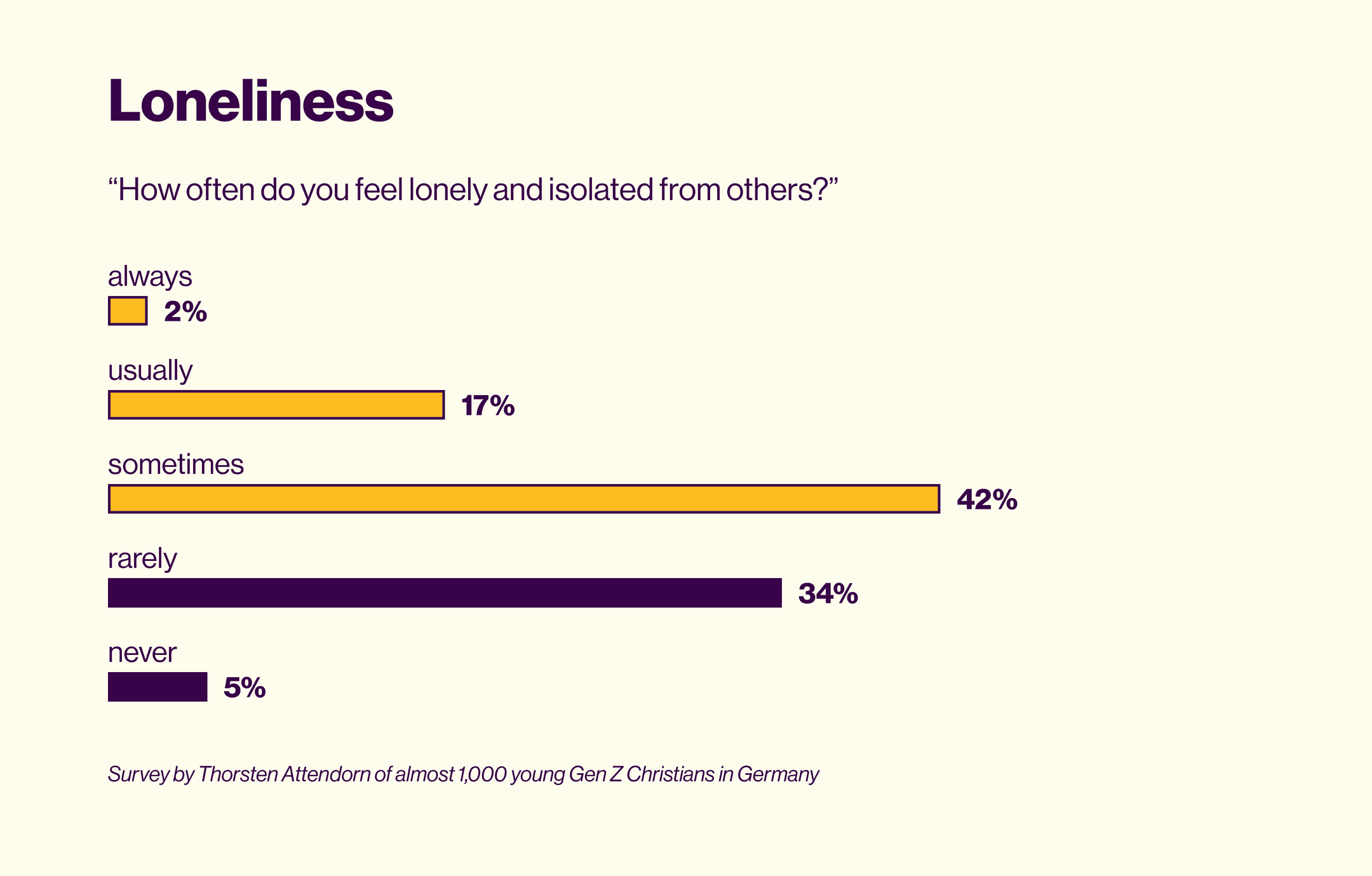
Looking at relationships shows good friendships and valuable individual relationships with confidants and mentors. But the percentages shouldn’t hide the fact that around 200 respondents with no confidant and no encourager are left by the wayside. How many young Christians know the feeling of loneliness shows that this modern disease of civilization doesn’t stop at believers; and yet we are called to community in God’s family!
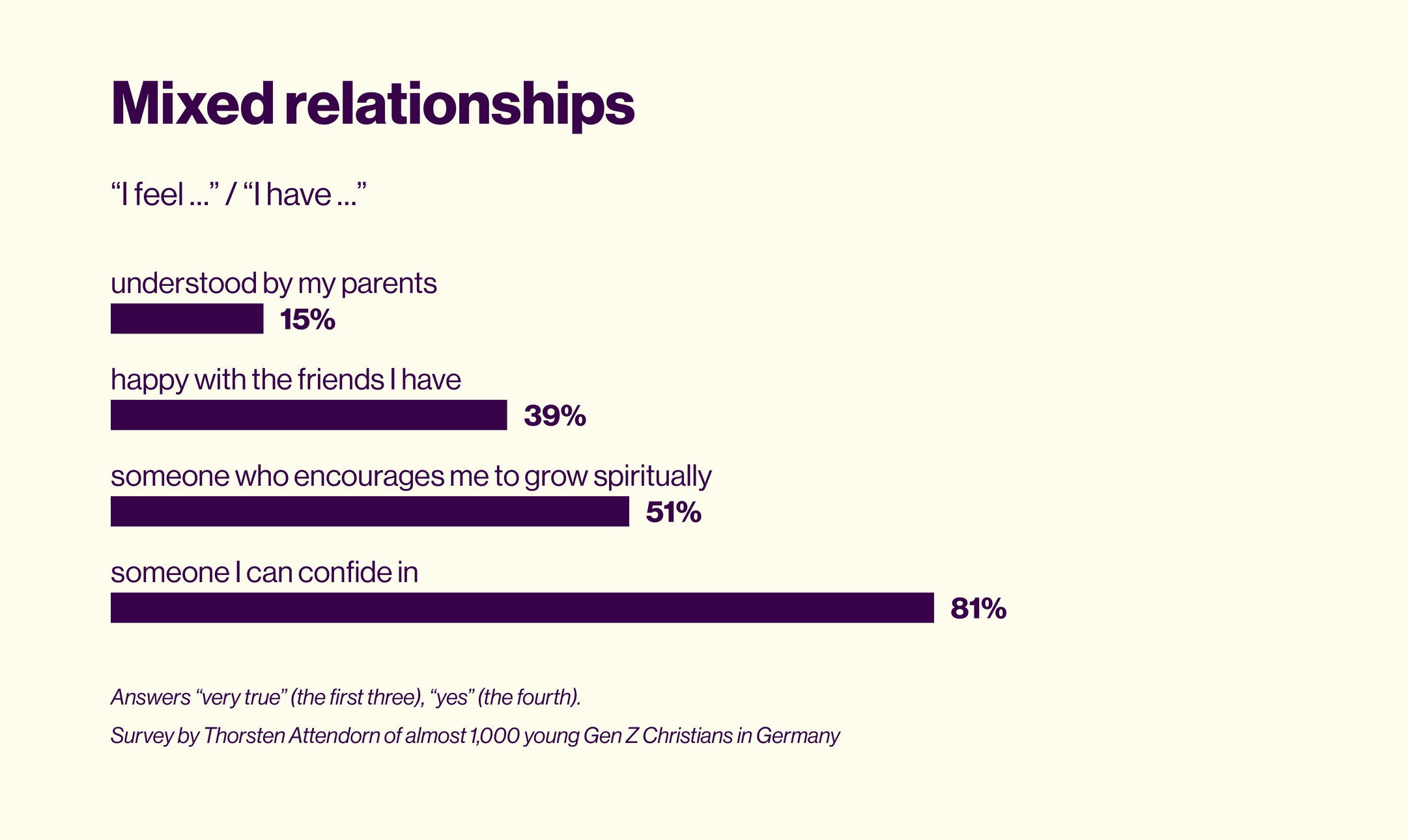
What saddens me most are the weak numbers for (perceived) understanding from parents and “that someone believes in me.” The comparison data show that this can’t be dismissed as the usual generational conflict. So what is behind it? Is it a question of perception? Is there a lack of encouragement, of openness, of communication in general? Do parents have higher demands; is it more about “being right” than about acceptance, letting go and trust? Or, conversely, could one factor also be the “disruptive” side of the younger generation, which sometimes can’t and won’t relate to the older generations anymore, something that may have a stronger effect in the faith setting than in “normal life”?
Relationships with church
Participants attend church services very regularly (mostly at least weekly⁹), but their relationships with their church are also ambivalent:
- Half feel a “strong” sense of belonging in their church.¹⁰
- About 25 to 35% of participants clearly affirm that in church they find room for doubt, get their questions answered or are equipped to live faithfully in a secular world.¹¹ About as many disagree in each case.
- One in five respondents strongly trusts that Christian leaders are honest and fair.¹²
It’s important for churches to create a sense of belonging. That includes creating spaces where unsettling topics can be discussed openly and with trust, as well as providing suitable formats for discipleship and working together. The survey data show that quite a few are well looked after, but that there is still room for improvement in all of this.
Comparison with US practicing Christians and Bible-engaged Gen Z¹³
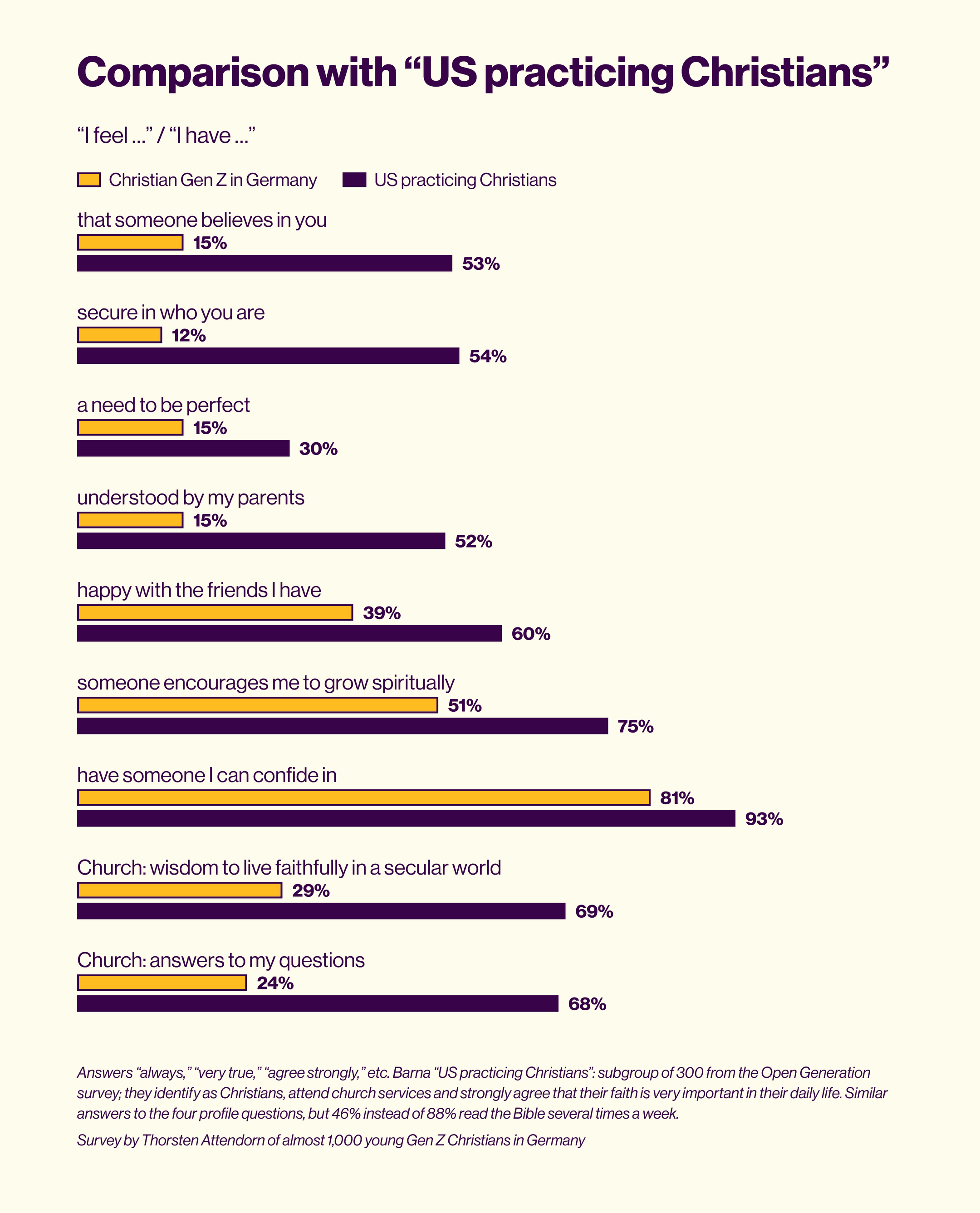
If you add as comparison groups the equally Bible-oriented international “Bible-engaged” cohort and the less Bible-literate, more pragmatic group of “US practicing Christians” (data below in the box), the strengths of Christian Gen Z are confirmed, for example in friendships, confidants and mentors or the importance of church; at the same time, the pressure to be perfect and a certain loneliness turn out to be sore spots.
But the comparison groups also prove that the weaknesses of Christian Gen Z in Germany in the emotional and relational area are not set in stone. On the contrary, a balanced, devoted Christian life can clearly show its strengths precisely in healthy relationships, in church life and in a healthy, confident sense of self-worth. It seems that this potential has not yet been tapped among Christian Gen Z in Germany. The areas that need work seem to be the image of God and the self-image,¹⁴ as well as the culture of relationships and of church life.
The comparison group of US practicing Christians that Barna drew on shows mixed results on inner stability and on relationships:
• Over 50% of them (compared with 12 to 15% of Christian Gen Z in Germany) give strongly positive answers on “someone believes in me,” “I feel understood by my parents” and on self-assurance.
• But they are also twice as likely as the respondents in Germany to feel pressure to be perfect (over 30% compared with 15%).
• They have even higher loneliness figures (15% compared with 2% “always”), but at 60%, almost twice as many as among Christian Gen Z in Germany answer “rarely” or “never.”
• They score highly on relationships: US practicing Christians have much better friendships and spiritual encouragers, as well as mentors who taught them to read the Bible (60%, 75%, 95% compared with 40%, 50%, 75%).
• The same goes for most church-related questions (belonging, answers and everyday wisdom at 70% compared with 35 to 50%; room for questions and doubts, however, at a similar level).
Comparison with Bible-engaged Gen Z
On health, it stands out that the “Bible-engaged” subgroup of Barna’s Open Generation survey shows much higher figures than Christian Gen Z in Germany:
• Self-worth and self-efficacy (53%/81% compared with 12%/13%),
• Significance to others (48% to 15%),
• Sense of belonging and practical wisdom from church (almost 80% to 50% and 30% respectively).
Conclusion and next steps
In short: marks of Christian Gen Z in Germany
- Possibly slightly better, but still fragile emotional health
- Pressure to be perfect, weak self-worth and self-efficacy
- Good friendships, confidants and spiritual encouragers, but in some cases poor relationships with parents and family, and lonely at times
- Mixed church culture (strong: belonging; weak: answers to questions, room for doubt)
Springboard questions
- How do you feel about the fact that 45% and 20% of your generation struggle with anxiety and depression respectively? What role does social media play in this? Is it a topic in your church?
- What stresses you out, and who or what puts you under pressure: you yourself, or the people around you (society, family, school, church)? How do you deal with it?
- What might be a reason a young Christian doesn’t feel understood by their parents? Do you have tips for parents?
- How do you experience (or how would you like to experience) friendship and encouragement to grow in faith?
- What does “self-assurance” mean to you? What role does faith play in it? What are you worth to God and to the people around you?
- Do you feel you belong in your church? Who (in your church) can you talk to openly about your faith and your doubts?
⬅️ Back to Episode 1
➡️ Continue to Episode 3
Resources
Studies and statistics
- AXA, Mental Health Report (in German), 2022
- BPtK (German Federal Chamber of Psychotherapists), Mental illness in children and adolescents (fact sheet, in German)
- Deutschland-Barometer Depression (German Depression Barometer), 2022
- DAK, Kinder- und Jugendreport (children and youth report, in German), 2023
- Foulkes/Andrews, Are mental health awareness efforts contributing to the rise in reported mental health problems? A call to test the prevalence inflation hypothesis, New Ideas in Psychology 69 (2023) 101010
- Haltigan/Pringsheim/Rajkumar, Social media as an incubator of personality and behavioral psychopathology: Symptom and disorder authenticity or psychosomatic social contagion?, Comprehensive Psychiatry 121 (2023) 152362, doi.org/10.1016/j.comppsych.2022.152362
- Naumann/von den Driesch/Schumann/Thönnissen, Increase of depressive symptoms among adolescents during the first COVID-19 lockdown in Germany (in German, with an English abstract)
- NCHS, Mental Health Treatment Among Adults Aged 18-44: United States, 2019-2021, NCHS Data Brief No. 444, September 2022
- pronova BKK, Generation Z & Health: young adults and health in the COVID pandemic (in German), 2022
- RKI (Robert Koch Institute), Mental health of the adult population in Germany during the COVID-19 pandemic, 2021
- Zukunftsinstitut, Mental Imbalance Youth: The wounded Gen Z (in German), 2021
Resources from a Christian perspective
- Youthscape, Translating God, 2023
- Feed/OneHope, What We Know About Gen Z, 2020
- Kara Powell, 3 Big Questions That Shape Your Future, 2022
- Kara Powell, 3 Big Questions That Change Every Teenager, 2021
¹ Questions: “Do you struggle with anxiety?” and “Do you struggle with depression?”; answer “Yes” in each case; another 4%/6% answered “Prefer not to say.”
² Question: “How often do you feel a need to be perfect?”; answers “always” and “usually.”
³ Question: “How often do you feel secure in who you are?”; answers “always” and “usually.”
⁴ More on this in Episode 4.
⁵ Questions: “Is this statement true of you? ‘I am happy with the friends I have’”; “There is someone in my life who encourages me to grow spiritually”; answers “very true” / “agree strongly.”
⁶ Question: “How often do you feel lonely and isolated from others?”; answers “always” / “usually” / “sometimes.”
⁷ Question: “Do you have someone you can confide in (not including your partner or spouse)? This is someone who you would feel comfortable sharing your feelings or personal stories with.”
⁸ Question: “Is this statement true of you? ‘I feel understood by my parents or guardians’”; answer “very true.”
⁹ See Episode 1.
¹⁰ Question: “The church is a place where I feel I belong”; answer “agree strongly.”
¹¹ Questions: “In my church, I am able to openly talk about my spiritual beliefs and doubts I may have,” “In my church, I regularly receive wisdom for how to live faithfully in a secular world”; answer “agree strongly” in each case; “The church is a place where I feel I belong”; answer “disagree strongly.”
¹² Question: “How much do you trust Christian leaders to be fair and honest?”; answer “Strongly trust.”
¹³ For further comparisons, see Episode 5.
¹⁴ More on this in Episode 4.
Unless otherwise indicated, Scripture quotations are taken from The Holy Bible, New International Version® NIV®, Copyright © 1973, 1978, 1984, 2011 by Biblica, Inc. Used with permission. All rights reserved worldwide.