About the series “What Makes Christian Gen Z in Germany Tick?”
Gen Z is on everyone’s lips, in the media and in Christian youth ministry too. If you want to know more about this generation based on data, you look to the US or the UK. Surveys often don’t focus specifically on the Christian world. What really makes Christian Gen Z in Germany tick? Thorsten Attendorn took part in the Barna Church CoLab “Discipling Gen Z” and ran his own survey of almost 1,000 young Gen Z Christians in Germany. In this series he shares insights and ideas from the CoLab and puts the results of his survey up for discussion.
- Episode 1: The Christian Gen Z in Germany: The Most Open Generation Ever
- Episode 2: The Christian Gen Z in Germany: A Vulnerable Generation
- Episode 3: The Christian Gen Z in Germany: Where Do They Stand on Culture, the Gospel and Justice?
- Episode 4: The Christian Gen Z in Germany: Honesty Is Everything
- Episode 5: The Christian Gen Z in Germany: Between Zeal and Guilt
The faith of Christian Gen Z in Germany: honest, growing, firm, hopeful, but also weak and problematic.
“Christian Gen Z in Germany” has a strong faith, against the trend in society and in their generation. What does this faith look like? What matters to these young Christians themselves about their faith?
A generation in (and often after) a crisis of faith
In Western society, and especially in the younger generations, Christian faith is eroding. Many members of Gen Z go through crises of faith. When they then look for help in their faith community but don’t find it, for example because questions go unanswered and doubts are taboo, their distress grows. Some deliberately deconstruct their faith, which isn’t necessarily negative in itself, but often means that active faith is lost, at least for a time.
The data Savannah Kimberlin presented at the Church CoLab¹ show the share of US Gen Z who identify with “no faith” rising to 25%. In Germany, about 40% of Gen Z are “no faithers.” Gen Z’s faith is also in distress in that 50% of global Gen Z say they have gone through an extended period in which they doubted their faith to a greater or lesser degree. At the same time, about 70% overall long for a community in which they can talk openly about their faith.
How can faith become relevant and powerful?
How can the church help in this predicament? Like Kara Powell before him,² Matt Manno (student pastor at New Life Fellowship and responsible for Next Gen Ministries at Emotionally Healthy Discipleship) points out:
If you want to communicate in a relevant way with this generation, you shouldn’t impose foreign terms and concepts on them, but connect with their own terms and ways of thinking: if, for example, they don’t talk about deconstruction to any relevant extent themselves, there’s no need to address this concept explicitly. (Matt Manno, paraphrased)
At the same time, especially when it comes to questions and doubts, a safe environment with suitable conversation partners and formats is needed. If you take Gen Z’s own view, they describe their spirituality as growing, open, motivated and so on; these concepts offer good points of connection for helping faith get on its feet and move forward.
When you think about the importance and power of faith, access to the Bible and to Jesus also plays a key role, in my view:³
Lisette Fraser (coach at the Fuller Youth Institute and Tenx10) and Shane Sanchez (Director of High School Content at Orange, a Christian publisher focused on the next generation) make the case that people want not only to “understand” the Bible but to “experience” it (and Jesus in particular). Connecting the Bible with practical life, with the needs, expectations and hopes of this generation, is important.
Keithen Schwahn, youth pastor at Church for the City New York, puts Jesus at the center, following the motto “Come … and you will see” (John 1:39): introducing Jesus as the person who is the answer to their longings; building relationships and then conveying Jesus’ changing, transforming power, including the role young people themselves play in it. In his view, these are proven approaches that give Jesus the central role and persuasive power.
Christian Gen Z in Germany: a growing faith with strengths and weaknesses
Against the prevailing trend in this generation, the survey of Christian Gen Z in Germany shows that faith has recently become more important for over 80% of them. 80 to 90% of respondents are believers, have made a lasting life decision for Jesus, are regular and intensive Bible readers and loyal churchgoers.⁴
So what does this faith look like in concrete terms? How does this especially devout segment of Christian Gen Z in Germany “believe”?
Honesty comes first; correctness isn’t that important
For participants, the most important thing about their faith is “being honest” (64%).⁵ This swing of the “compass needle” toward the much-sought-after authenticity is compelling. Given the choice, respondents clearly put being honest ahead of being correct and being knowledgeable or informed (about 15% each) and of being open to new ideas and being curious (5% each). That honesty comes first is even more pronounced in this survey than in Barna’s Open Generation survey: being honest comes out on top there too, but scores only half as strongly.
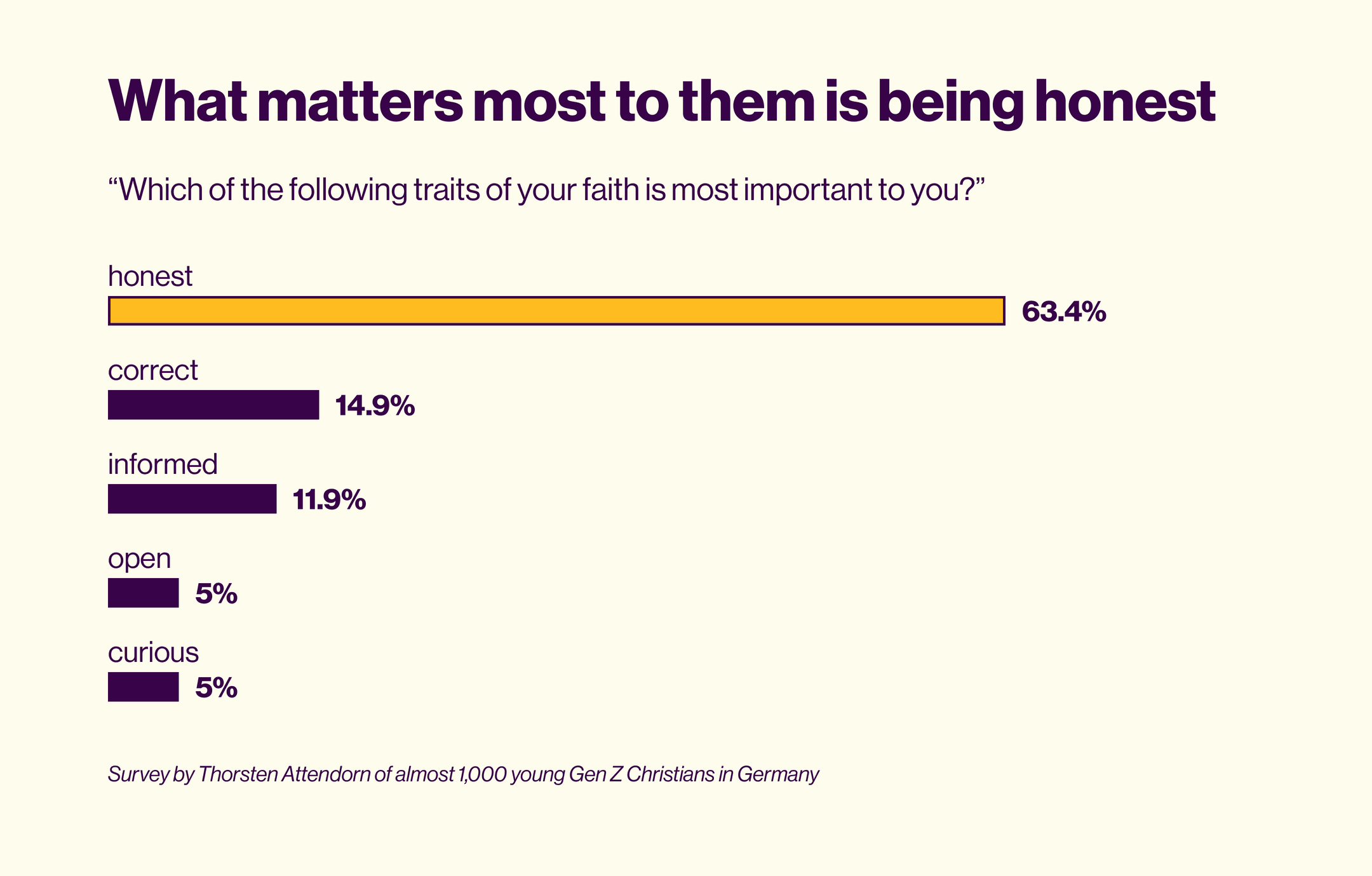
Attitudes toward openness are ambivalent: being open matters a great deal in this generation (more on this below). Asked whether certainty or openness in faith is more important, most participants (55%) choose “being certain about my own religious beliefs,” but for 45%, “being open to where my faith leads me” is more important (in the Open Generation: 70% openness to 30% certainty).⁶ Interestingly, when push comes to shove and they have to choose between openness and honesty, honesty matters more to them. This is a point of connection for strengthening young believers in the honest convictions they already hold.
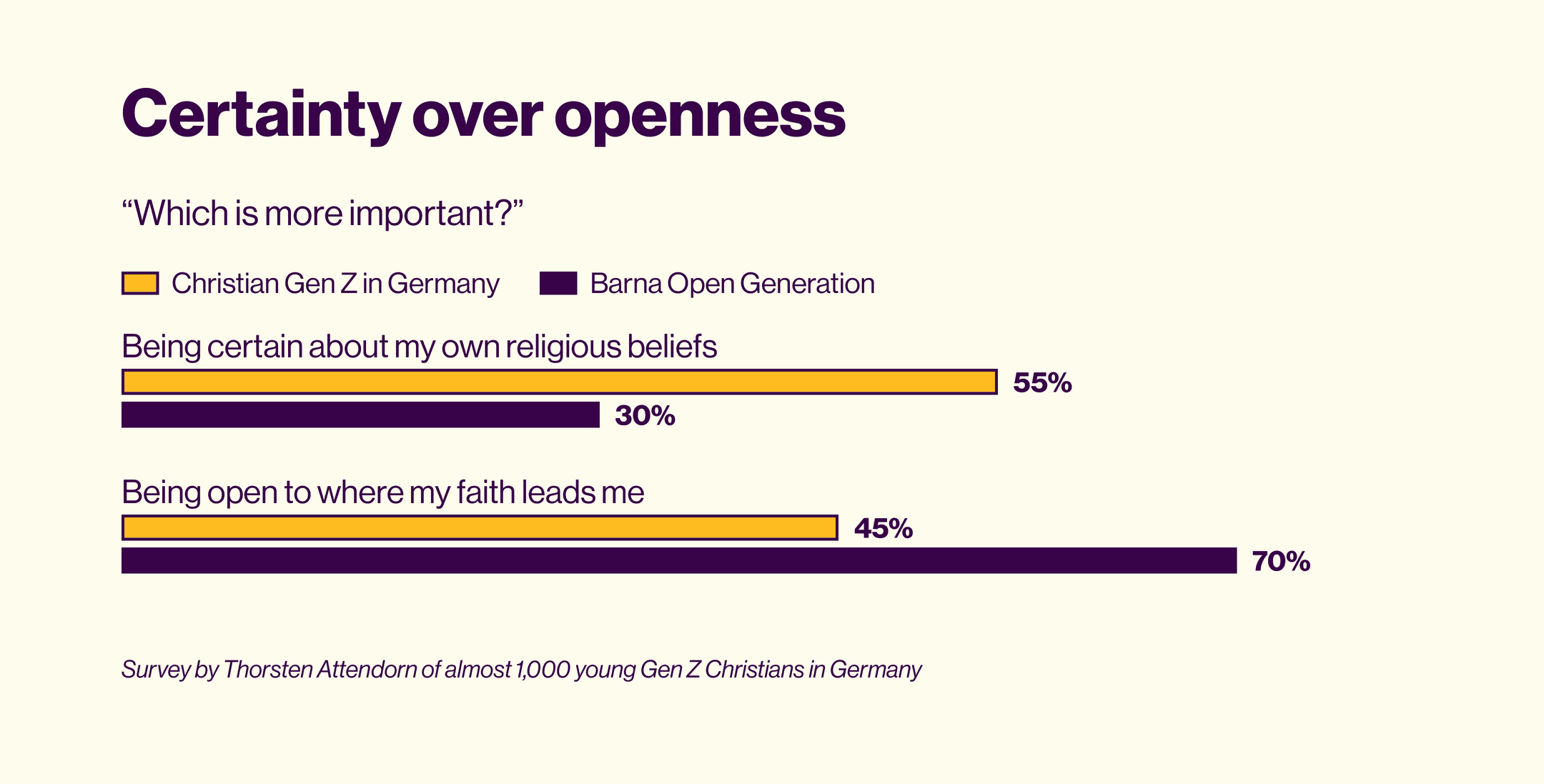
What gives me pause, however, is the comparatively low importance of their faith being right (correct and informed). Admittedly, truth ranks quite high among the things respondents are looking for or have in their faith (85%, see below). So you can’t conclude that the content of faith is arbitrary, but you can conclude that, when in doubt, the honest version wins out over the (supposedly) right or informed one.
Now, truth is central to the Christian faith; it is meant to be known, lived and passed on. What does Gen Z’s mindset mean for preaching and teaching that is oriented toward truth? If we broadcast on the frequency of rightness and truth, but the receivers’ antennas are tuned not to correctness and being informed but to honesty, should the “transmitter” recalibrate?
Clearly, a ministry focused exclusively on doctrinal “rightness” that left no room for sincere questions and doubts would miss people’s needs (and, in my view, would miss the mark of a ministry that is useful by biblical standards anyway). Just as important is an honest engagement with other well-founded views, especially on “sensitive” topics; just as healthy is the experience of genuineness (including when mistakes happen) instead of hypocrisy.
If you think faith is mainly about meaning …
… you’re (sadly) mistaken. The good news: 44% of respondents “strongly” affirm that their life has meaning and significance. But this figure falls far short of the figures for US practicing Christians (69%) and Bible-engaged Gen Z (84%). Asked elsewhere what they have or are looking for in their faith,⁷ survey participants name first of all (around 85% each) truth, hope, forgiveness and inner peace, then growth and salvation (around 80%); only after that come purpose and guidance (around 70%), meaning and healing (about 65%).
On every answer, respondents score much higher (two to four times as high) than adult US Christians, which shows that they connect extensive expectations or experiences with their faith. But I’m surprised by how weakly “meaning” performs. I’m one of those Christians for whom the coherence of the Christian faith, the experience of meaning, is essential: the meaning found in faith is one of the most convincing arguments, an answer that brings peace in the face of unsolvable questions or adverse experiences, and also a strong motivation for personal happiness in life. Seen from this vantage point, I wonder: Is “meaning” simply no longer in demand? Has this existential concept of human life been completely relativized or subjectivized away? Are apologetic arguments missing? Do people miss the personal experience of meaning? “More meaning” is, as we know, also a contribution to better mental health and greater happiness in life.
Faith is above all one thing: “growing”
For me, one of the most exciting questions in this survey was this one: “Which of the following words would you use to describe your spirituality?” I had expected “open” to score high in this generation, but I was curious whether and how respondents’ strong anchoring in the Bible and their high loyalty to their church might have an effect. When I first looked at the results, I was amazed: above all, they characterize their faith as “growing” (82%); the rest of the top 5 are “exploring” (50%), “open” (37%), “curious” (34%) and “certain” (32%).⁸ Compared with the nominal Christians in the Open Generation, two things stand out: Christian Gen Z in Germany scores much higher on “growing” and “exploring,” and considerably lower on “spiritual” and “religious.”
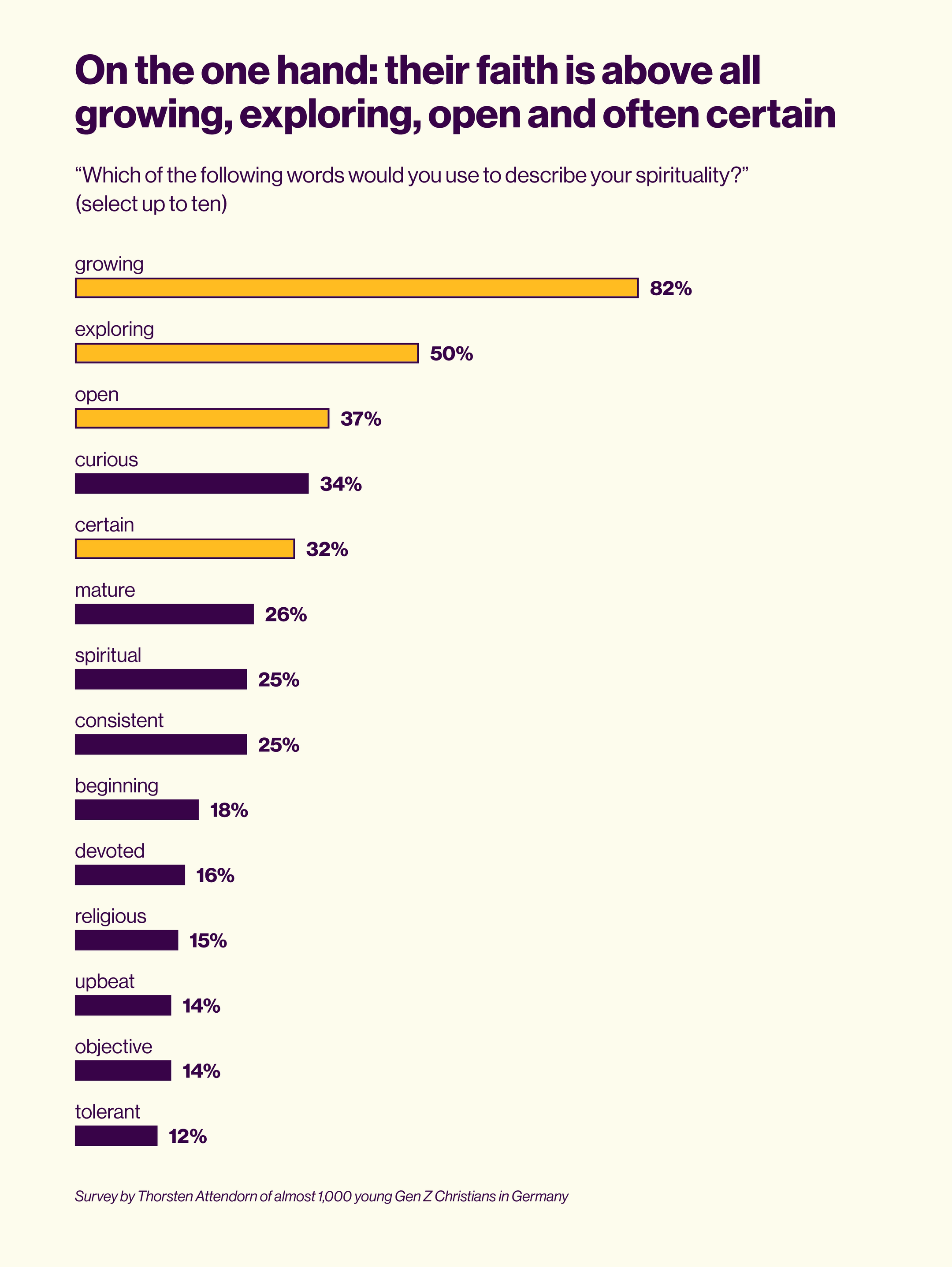
I’m glad that many characterize their faith as “growing”: anyone who is growing is in a positively oriented process of development. You have a goal, but you haven’t reached it yet. Imperfections, shortcomings and mistakes are a given, and you can work on them with purpose. This process takes time, patience and care. You can’t demand perfection from someone who is still growing. What’s needed is an encouraging, constructive, hopeful approach, just as Paul was confident about the Philippians that God, who had begun a good work in them, would carry it on to completion (Philippians 1:6). This understanding can bring relief from problematic pressure, whether self-imposed or imposed by others, and from unhealthy images of God and of oneself. In Bible studies and sermons, the metaphor of “growth” can also be explored very well through biblical concepts:
- the tree with its roots, leaves and fruit (among others, Jeremiah 17) or the vine with its “mechanism” of bearing fruit by remaining in Jesus and multiplying through pruning (John 15);
- the building site with its foundation, its stones, its builders and the purpose of the building (Philippians 1; with reference to the church, for example, Ephesians 2; 1 Peter 2);
- the path on which progress is made and experiences are gained (for example, Philippians 3; 1 Peter 2; Hebrews 12);
- the believer as part of God’s family, in which everyone is in a process of maturing, through the stages from child to adult to “father” (1 John 2);
- the gradual process, aspect by aspect and step by step, of becoming more like Jesus (among others, 2 Corinthians 4; Romans 8).
Interestingly, respondents’ self-description differs, in some cases considerably, from how they think others probably see them:⁹ for the (assumed) view of others, they most often choose “committed” (38%), while words like “exploring” or “open” come up much less often than in their self-description. Is there a tension here, in that respondents don’t live out their faith as openly as they think they do? Or do they see themselves as more open than they actually are toward others?
Firm, but still weak
Given the crisis of faith that, according to Barna data, about 50% of Gen Z have already experienced, it’s encouraging how often respondents from Christian Gen Z in Germany describe their faith (more often than average, compared with nominal Christians of the Open Generation) as “certain” (31%), and as “mature” or “consistent” (about 25% each). It looks as if the faith profile of a conscious relationship with Jesus, a strong connection to the Bible, the growing relevance of faith and church attendance gives many young Christians a greater sense of certainty. Still, it has to be said that each of these positive descriptions is affirmed by only a quarter to a third of respondents. Nor should we overlook the up to 10 to 15% of respondents who said their faith is “confused,” “uncertain,” “skeptical” or “directionless,” and, more often than average, “doubting.” Only 4% of respondents (still 43 people) are pursuing or going through what they themselves call a deconstruction of their faith.
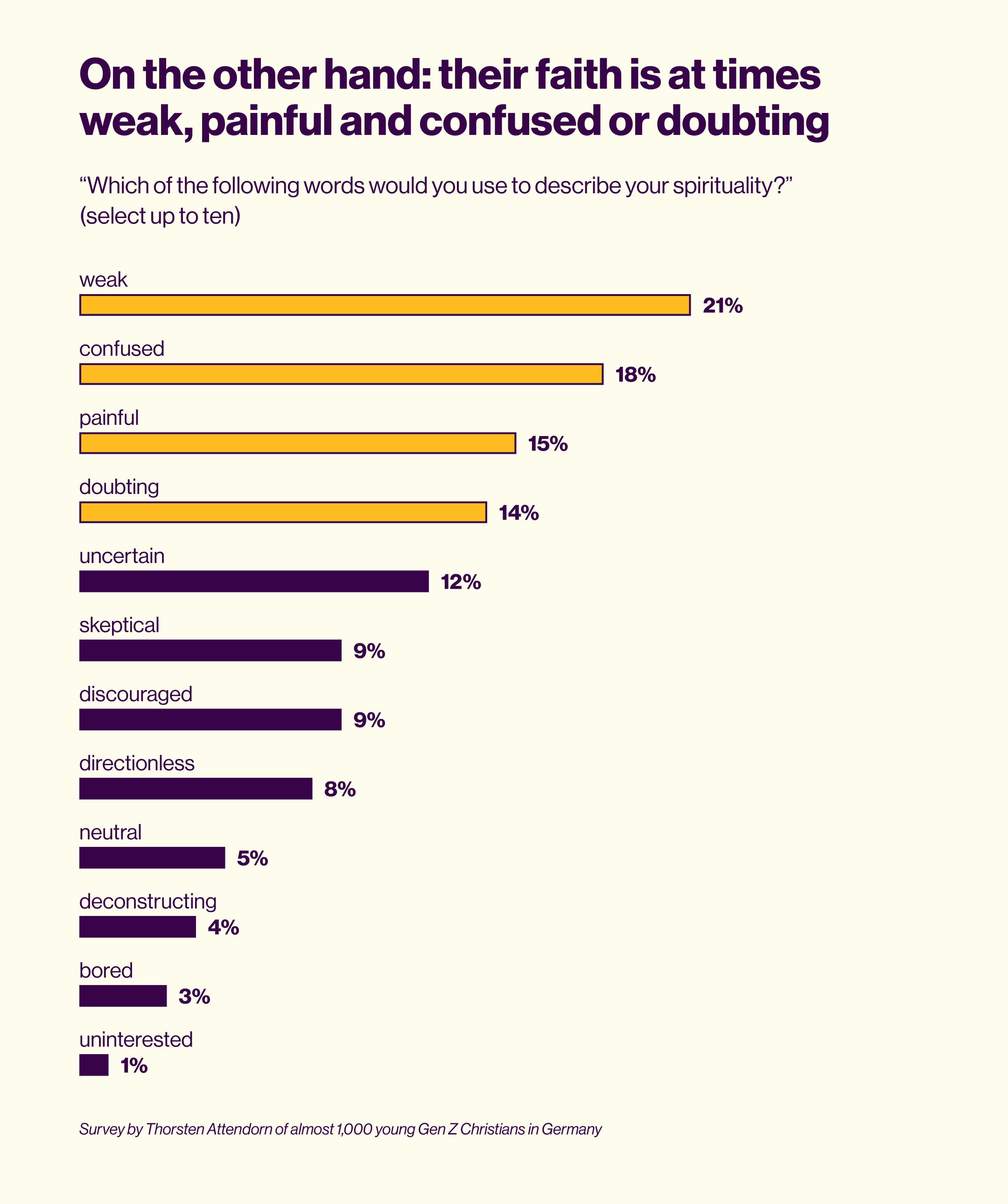
Another striking figure is the above-average score for “weak” (at about 20%, more than twice as high as among the nominal Christians of the Open Generation). What do people mean when they say their faith is “weak”?
- Is “weak” simply the natural flip side of “growing,” meaning the imperfection, the not-yet-mature side of faith? Then wouldn’t it be good to shift perspective from a deficit mindset to a growth mindset?
- Does it mean weakness in the face of temptations and attacks? After falling, you can get up again and stand in God’s strength; setbacks are part of it and shouldn’t shape your self-image.
- Could their “spiritual performance” be weak, measured against a model from the Bible, a real or supposed “best practice” from their faith community, or their own standards? This raises the cultural question of demands or reassurance, of how we understand forgiveness and growth, and of a relationship with God that rests not on performance, faithfulness or perfection but on grace, in which you can grow, change and make progress.
- Or should “weakness” be understood as a worrying generational trope, in which weakness rather than strength becomes a self-label, even a marker of identity? The Bible knows both sides: it encourages us to be strong in faith and in God’s power (1 Corinthians 16:13; Ephesians 6:10), but it also shows the example of Paul, who was honest about his personal weakness, which opens the channel for God’s power (2 Corinthians 12:10).
Core beliefs
Barna gave us the option of adding our own questions to the survey, so I asked about a few “core beliefs” that can also matter for emotional health.¹⁰ Most of these beliefs sit in areas of theological and pastoral tension. So it would be necessary to go deeper into each topic and, in personal conversation, to respond to the thoughts and feelings of each person. Here I only want to present the survey results and limit myself to a few suggestions:
- Almost all are clearly aware that God takes a personal interest in them.¹¹ This is fundamentally important: against the trend in society, God exists for the respondents, and not merely as a vague force; they know him as a person, have a personal relationship with him and are aware that God sees them individually, as someone he relates to personally (see Psalm 139; Genesis 16:13). God’s interest is kind, caring and protective; it encourages growth and sets healthy boundaries (see Psalm 23; John 10; 1 Peter 5:5-6).
- Given how important God’s love for people (John 3:16) and the Father’s love for his children (1 John 3; John 16:27) are, it’s surprising that “only” about half of respondents affirm that they are worthy to be loved.¹² Perhaps the problem lies less in knowing about God’s love than in a weak sense of their own worth.¹³ What God says about Israel, “Since you are precious and honored in my sight, and because I love you” (Isaiah 43:4), also applies to Christian Gen Z in Germany today. No one is “worthless”; as creatures (Psalm 139), as his handiwork called to good works (Ephesians 2:10), as the redeemed (Isaiah 43:1; Ephesians 1:5ff.), as God’s children (1 John 3:1-2) and so on, we all have an individual worth that God grants us and anchors in himself, and that is therefore independent of how others see us and how we see ourselves.
- Almost 40% don’t rule out that God might ask more of them than they can handle,¹⁴ about one in three is afraid of sinning (32%),¹⁵ and one in six thinks God will leave them if they don’t follow him.¹⁶ This is where principles come into play such as God’s acceptance in Christ (Romans 15:17; 1 John 3:1-2), his mercy, his protection and care, his comfort (Hebrews 4:16; 13:5-6; Psalms 18 and 118; Matthew 6; 2 Corinthians 1), forgiveness that can never be lost (Ephesians 1; Colossians 1) and God’s faithfulness (1 Corinthians 10:13): “if we are faithless, he remains faithful” (2 Timothy 2:13), and nothing can separate his children from him (Romans 8). Being called to holiness (1 Peter 1) doesn’t mean being afraid of sin; that kind of fear would have to do with punishment. Such fear has no place in love; instead, forgiveness, being God’s children and perfect love drive out fear, give us a home with God and make us bold (1 John 4; Hebrews 10; Ephesians 2:18ff.). Given respondents’ above-average pressure to be perfect,¹⁷ it may be that some pursue a standard of perfection but don’t give forgiveness and the idea of growth and maturing their rightful place. Perhaps fear, or demands and pressure, also spill over into social relationships and their self-image.
- Quite a few young Christians see themselves as failures (about 25%)¹⁸ or outsiders (about 15%);¹⁹ one in five needs others to be content with them in order to be happy;²⁰ (only) one in three says they “can make their own decisions.”²¹ Dependence on and connection with God, the Creator and Sustainer, can give his creatures the strength not to make themselves dependent on other people. Feelings of shame can be met with a firm identity in Christ. God’s unconditional acceptance isn’t called into question by our own weaknesses and mistakes either. God gives wisdom without finding fault when we bring our lack to him (James 1). In prayer with his Father, Jesus spoke very kindly about his fallible disciples, even if constructive criticism and clear correction were needed in certain situations (John 17). At the same time, each person is personally called to live their life responsibly, to grow and to mature (Colossians 1:28; 4:12). Each person has been placed in the body of the church with specific gifts (for example, 1 Corinthians 12) and called into a personal relationship and individual discipleship with Jesus: “What is that to you? You must follow me” (John 20; see Romans 14; etc.).
Many are convinced of God’s personal interest, but some also hold negative core beliefs about God’s love, mercy and faithfulness around topics like guilt, shame, perfection, self-worth and self-efficacy. (Thorsten Attendorn)
Strong in hope
I was also interested in how a crisis-battered generation relates to “hope.” In German society, hope is in decline: depending on the survey, optimism has dropped by twenty percentage points within a year, to 45% (the younger generations usually do a little better). Confidence that we will be better off in five years has plummeted from over 50% to 15% in two years. In September 2023, 81% were “rather worried” about the current state of affairs in Germany.
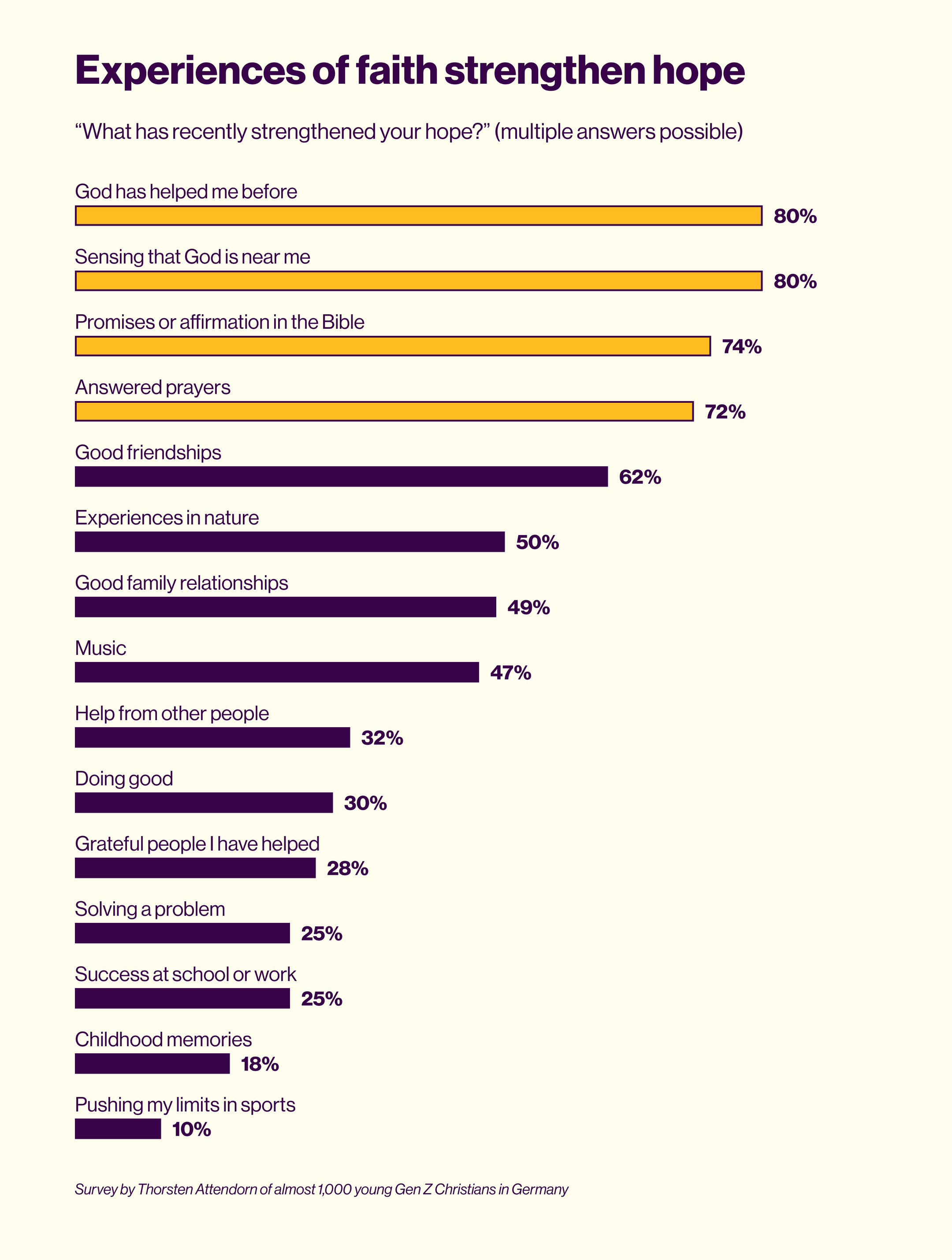
The answers to my five questions are encouraging:
- “Hope” is important for life: almost everyone says so, and they are also (very) hopeful (90%); hope is also among the highest-rated things people have or look for in their faith (84% affirm this)
- The young believers put their hope above all²² in God (98%), well ahead of friends (63%), parents (47%) and “themselves” (25%). What stands out is how weak the societal side of hope is: politicians and government, scientists, but also the young generation range between 0% and 4%.
- They put their hope into practice²³ by trusting God and praying (92%); this ranks well ahead of talking with friends and family (66%) and other activities such as thinking and analyzing (42%), reading and researching (36%) or taking responsibility and acting on it (33%).
- Respondents find their hope strengthened²⁴ above all through practical experiences of faith: experiences of God’s help (80%), the sense that God is near them (80%), promises or affirmation from the Bible (74%) and answered prayers (72%). Next come friendships (62%), family (49%²⁵), nature (50%) and music (47%). Social and altruistic dimensions matter less: doing good (30%), receiving gratitude from people you have helped (32%) or having experienced help from other people (32%). At the end of the list are experiences of self-efficacy, such as having solved a difficult problem (25%), success at school or work (25%) or having pushed past their limits in sports (10%).
Christian Gen Z in Germany is very strong in hope; their strong hope in God is rooted in the Bible and reinforced by experience; by contrast, self-efficacy and the social aspects of hope fade into the background. (Thorsten Attendorn)
I find it encouraging to see a strong hope that is anchored in the Bible, expressed through prayer and confirmed through experience. At the same time, I hope this trust in God doesn’t come at the expense of self-efficacy. In faith, both are important: trust and responsibility, God’s work and our own thinking and doing. That’s why it gives me pause that the “activity and motivation” components, and in part the social ones too, are so weak. This seems to fit the picture that also emerged for self-image and for the emotional and social aspects of faith.²⁶
Conclusion and next steps
In short: characteristics of Christian Gen Z in Germany, Episode 4
- For Christian Gen Z in Germany, faith very much means honesty, growth, curiosity and exploring, and, encouragingly, a good deal of certainty and maturity
- For quite a few, faith is also weak, painful, confused
- High expectations of faith (truth, hope, forgiveness, peace, growth); the focus on meaning falls behind
- Many are convinced of God’s personal interest, but some also hold negative core beliefs about God’s love, mercy and faithfulness around topics like guilt, shame, perfection, self-worth and self-efficacy
- Christian Gen Z in Germany is very strong in hope; their strong hope in God is rooted in the Bible and reinforced by experience; by contrast, self-efficacy and the social aspects of hope fade into the background
Springboard for your own youth ministry
The following questions can help you check the survey results in your own youth group and talk about the topics in more depth:
- What do you think: Are you worthy of love?
- What happens when you sin: is God still with you?
- Why is it important for faith to be “honest”? What questions and wishes about “honest faith” do you have for your church?
- Are you looking for truth in your faith?
- What do you understand by a “growing” faith? What concretely helps your faith grow? What holds growth back?
- How does an “open,” “curious” or “exploring” faith show itself? What is positive about it, and what might be negative?
- Is it worth striving for a “firm” faith? What can shake faith, and how do you find stability?
- If you see your faith as “weak,” what would Jesus say about that?
- How hopeful are you? What role does God play in that, and what role does your own responsibility for your future play?
⬅️ Back to Episode 3
➡️ Continue to Episode 5
Resources
- American Bible Society, State of the Bible, 2023
- ARD-DeutschlandTREND 2023 (monthly poll for German public broadcaster ARD, in German)
- Barna, The Open Generation
- Edelman Trust Barometer (Germany page, in German), 2023
- EY, Verbraucher in Deutschland (consumers in Germany, in German), January 2023
¹ See Episode 1.
² See Episode 2.
³ More on this in Episode 5.
⁴ See Episode 1.
⁵ Question: “Which of the following traits of your faith is most important to you?”; answers: “being honest,” “being knowledgeable/informed,” “being correct,” “being open to new ideas,” “being curious.”
⁶ Question: “As far as your beliefs are concerned, which of the two is more important to you personally?”; answers: “being certain about my own religious beliefs,” “being open to where my faith leads me.”
⁷ Question: “When you consider your beliefs, what would you say you are having or looking for? Select all that apply.”
⁸ Question: “Which of the following words would you use to describe your spirituality? Select up to ten.”
⁹ Question: “If a person knew everything about your spiritual beliefs, which of the following words would they be most likely to use to describe you spiritually? Select one.”
¹⁰ Question: “Do you agree with these statements? Select all that apply.”
¹¹ “God is personally interested in me.”
¹² “I am worthy to be loved.”
¹³ See Episode 2.
¹⁴ “God would not overburden or overstrain me.”
¹⁵ “I am afraid to commit a sin.”
¹⁶ “God is not with me, if I do not follow him.”
¹⁷ See Episode 2.
¹⁸ “I am a failure.”
¹⁹ “I am an outsider.”
²⁰ “To be happy, I need others who are content with me.”
²¹ “I can take my own decisions.”
²² Question: “Who gives you hope?”
²³ Question: “What are you doing in order that your hope is fulfilled?”
²⁴ Question: “What has recently strengthened your hope?”
²⁵ Memories of a happy childhood also strengthen hope for 18%.
²⁶ See Episode 2.
Unless otherwise indicated, Scripture quotations are taken from The Holy Bible, New International Version® NIV®, Copyright © 1973, 1978, 1984, 2011 by Biblica, Inc. Used with permission. All rights reserved worldwide.