About the series “What Makes Christian Gen Z in Germany Tick?”
Gen Z is on everyone’s lips, in the media and in Christian youth ministry too. If you want to know more about this generation based on data, you look to the US or the UK. Surveys often don’t focus specifically on the Christian world. What really makes Christian Gen Z in Germany tick? Thorsten Attendorn took part in the Barna Church CoLab “Discipling Gen Z” and ran his own survey of almost 1,000 young Gen Z Christians in Germany. In this series he shares insights and ideas from the CoLab and puts the results of his survey up for discussion.
- Episode 1: The Christian Gen Z in Germany: The Most Open Generation Ever
- Episode 2: The Christian Gen Z in Germany: A Vulnerable Generation
- Episode 3: The Christian Gen Z in Germany: Where Do They Stand on Culture, the Gospel and Justice?
- Episode 4: The Christian Gen Z in Germany: Honesty Is Everything
- Episode 5: The Christian Gen Z in Germany: Between Zeal and Guilt
When generations drift apart
It’s the moment you realize that the gap between you and the younger generation isn’t just getting wider, but that building a bridge might be difficult or even unwanted. Growing distance is nothing new for a 50-year-old who deals with younger people as a father, a youth leader or a professor. But something seems different with this generation, Gen Z. I’m excited by its openness, its authenticity, its desire for renewal. But it feels foreign to me when it becomes one-sided in its openness, moralistic in its commitment, disruptive in its drive for change. In politics, in personal life, and especially in faith.
Gen Z: a special generation?
What’s the deal with Gen Z? It usually includes those born between 1997 and 2012; in Germany, that’s about 11.5 million individuals. Thousands of them are my students, hundreds are participants at youth events. Five of them are my own children.
On one hand, this generation is certainly a “normal” generation going through development and adolescence. On the other hand, it is a special generation because of what it has lived through. In short: because of crises (from 9/11 to climate change), the world has become an unsafe place for them. As “digital natives,” they are constantly connected online, more global than local. This generation is seeing the breakthrough of LGBTQ, identity and self-determination, justice and inclusion. It is more political.
The future is in their hands: their own, the planet’s and society’s. That doesn’t just make them motivated, entrepreneurial and self-reliant; it also creates pressure and overwhelms them.
The mental health crisis and the growing awareness of mental health, both heightened by COVID, affect and move this generation in particular.
What about faith? Gen Z is probably the most diverse and the least believing generation. In its latest study (on the UK), Youthscape describes this generation’s attitude toward God as “warm apathy.” If one-third of Gen Z in Germany now even believe that religion is harmful to individuals and to society, then a-religiosity is joined by anti-religiosity.
I want to know more: What’s going on with this generation, especially with their faith? I sign up with Barna, the US research firm that specializes in the Christian world, for its Church CoLab “Discipling Gen Z.”
Gen Z worldwide: faith in retreat, “no faith” booming
At the Church CoLab, Savannah Kimberlin, who leads the Church CoLab as Associate Vice President of Church Engagement at Barna, presents the latest research in the first session. Reporting from the large Open Generation survey, she says the share of “no faith” among Gen Z in the US has risen to 25%. That’s an increase of 10 percentage points over the previous generation, the Millennials. If you look at the data for Germany, the Christian decline in Gen Z is even clearer: about 40% say they are nonreligious, atheist or agnostic, while about 50% still identify as “Christian.”
Gen Z: an answer to prayer?
Luke Lefevre (27) is the founder and director of Consecrate and the author of the book Holy unto the Lord: Rediscovering the Joy of Holiness. As he voices his firm, heartfelt conviction that this generation in America will experience revival, all of us feel his passion for this generation, for God and for his life-giving work.
“Gen Z is not a culture but God’s answer to prayer, a harvest we did not sow.” (Luke Lefevre)
I can’t listen to Luke’s stories and visions without rethinking my own view of Gen Z, which had lately become more skeptical. Explosive growth of “no faith”? He sees the most open generation there has ever been. A passionate generation that wants to influence the world? His mission: let’s channel that passion into action and give the impact a purpose that lies outside the person: humbly take up the calling and lift up Jesus!
But I still have questions: Is the “openness” perhaps more curiosity and noncommitment? Is this generation open to Christianity too? Or is there more disappointment: with the older generation, with institutions and especially with the Christian faith?
The survey: Christian Gen Z in Germany
Barna gives every participant in the Church CoLab the chance to run a survey with their own target group. I take part, because so far the data comes mostly from the US and the UK. Studies for Germany are often older, very broad and unspecific, or don’t cover the topics I’m looking for. Even the representative Barna survey on the “Open Generation” presented at the Church CoLab reflects a cross-section of society and so naturally includes many young people outside the churches. That’s why I’m running my own survey.
The respondents: committed to Jesus, loyal to their church, Bible-centered, growing in faith
Through various mailing lists, my survey reaches almost exclusively Christians: almost all of the 961 participants (about 60% of them female) are Christians (almost exclusively Protestant or “other Christian”).
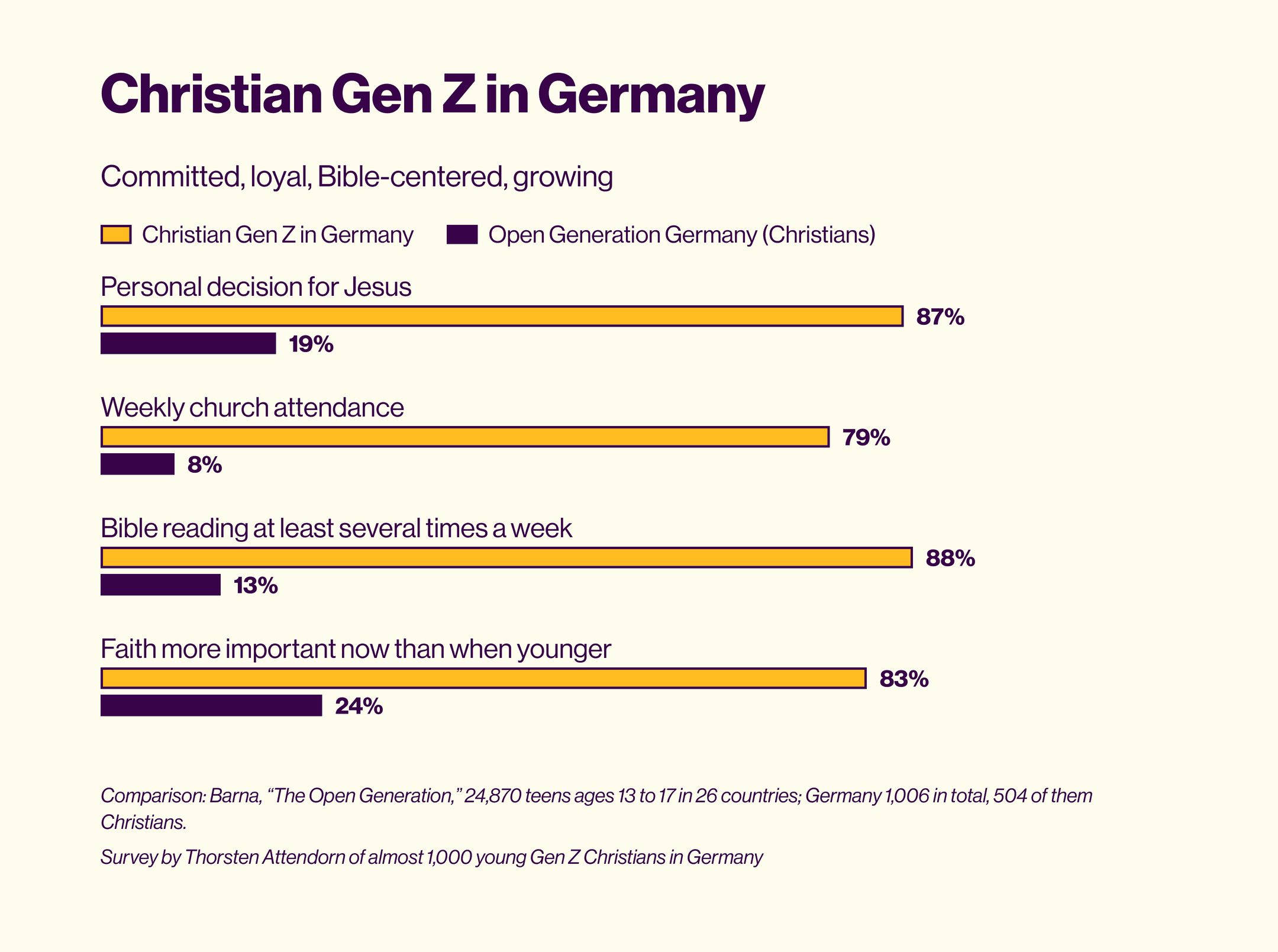
The respondents have a strongly Christian profile: 80 to 90% of them
- read the Bible at least several times a week,
- have made a decision for Jesus that still holds,
- attend church services weekly and
- consider faith increasingly important for their lives.
For comparison: if you focus on the “Christians” in the Barna Open Generation survey, the figures for these four characteristics range only from just under 10% to a little over 20%. So among Christians, my survey reaches a particular segment. Against the prevailing trend in their generation, the respondents believe intentionally, live a committed life with Jesus, read the Bible regularly and intensively and are loyal in attending their church.¹
What makes Christian Gen Z in Germany tick?
The rest of the survey results will show:
- In fact, the participants describe their faith above all as “growing” and as remarkably stable, but they are divided on how to position themselves in today’s culture.
- They are very hopeful and draw joy and motivation from their faith and from the Bible, but they also struggle with problems and guilt when it comes to reading the Bible.
- Their emotional state is fragile, their self-esteem weak, and quite a few hold unhealthy beliefs.
- They have good friendships and spiritual encouragers, but their social relationships are partly precarious, and quite a few are lonely.
This survey sheds light on potential and on areas that need work in Gen Z, but also in teaching and practice in church and youth ministry.
In the next episodes I’ll present the individual results.
What value do insights about a generation have for youth ministry?
Can a generational survey like this be useful for local youth ministry?
Understanding the times
Generational research is not uncontroversial. The Pew Research Center has recently been avoiding generational labels, in particular because of the risk of stereotypes and oversimplification, and because both the definitions of where generations begin and end and the possible causes of differences (or similarities²) between generations are not backed up by enough scientific evidence. In his book The Generation Myth, Bobby Duffy warns against stereotypes and advises identifying the causes of real differences as accurately as possible.
At the same time, it is a spiritual quality and responsibility of leaders to “understand the times.” The Church CoLab began with a reflection on the following Bible passages:
- 1 Chronicles 12:32: “men who understood the times and knew what Israel should do”: sound judgment in weighing the circumstances of the times, in order to draw the right conclusions for action
- Nehemiah 2:11 and following: “examining the walls of Jerusalem” (verse 13): a fact-based assessment of the situation on the ground before the spiritual work
- Matthew 16:3: “You know how to interpret the appearance of the sky, but you cannot interpret the signs of the times”: discerning what the moment calls for spiritually
Young Christians have traits they share with more or less all young generations. There are also traits specific to this generation. In the end, this survey produced insights: here are statements from young people whom I and others “work” with, are in relationship with and whose overall well-being we care about. These answers should be taken seriously.
Not whole generations, but individuals in your own setting
Even so: statistics don’t replace looking at the individual person. Before God and in personal relationships, what counts is the individual, not “a generation.” Individual Gen Zers can’t hide behind the label of a generation, and youth leaders or church leaders can’t simply point to generational phenomena.
These survey results can and should be raised, checked and discussed locally with your own target group. The insights need to be understood and evaluated in a way that fits; then action can follow, and our own attitudes can change too.
How? Ask good questions. Make space to listen. Open up the relevance and the goodness of the Bible. Put the living Jesus at the center. Model authentic discipleship and live it together. Find the right formats for this generation to take part.
The data not only shed light on where these young Christians stand; they also raise questions for teaching and practice in church and youth ministry.
In the end, what’s needed, perhaps more than ever, is the encounter with the individual person, namely Jesus’ encounter with the individual person.
For the survey, Barna provided a standardized online questionnaire on the Gloo platform, to which we added our own questions. The survey was carried out in April and May 2023. Through various channels, it targeted an age group from 15 to mid-20s in evangelical, Bible-centered youth ministry. Almost all of the 961 participants (about 60% of them female) are Christians (Protestant or “other Christian”; 1% are Catholic, 1% agnostic). Participants were not asked whether they were teenagers or young adults; we only know their status as students in school or school graduates (about 15% each), college or university students (30%) or “other” (40%).
Tip for evaluation: “Always go with the strongest answer”
For comparing results across its surveys, Barna recommends focusing primarily on the strongest answer (“always,” “strongly”), even if a more moderate answer (“usually,” “somewhat”) shows higher percentages.
Christian Gen Z in Germany in comparison
This series often makes comparisons with the Barna Open Generation study. The data of this representative global study of ages 13 to 17 are available online and can be sorted by various categories (countries, faith profiles …). Depending on the topic, the data available and how comparable the questions are, I looked at the “global” or the “German” respondents and showed “all” or only the “Christians” (Christian ID = self-identification with the Christian faith group), or further distinguished between “nominal Christians” on the one hand (who call themselves Christians without having made a decision for Jesus) and “committed Christians” on the other (who call themselves Christians and have made a decision for Jesus).
At the CoLab, Barna used a cohort of “US practicing Christians” for statistical comparison, with a similar profile but significantly lower figures for how often they read the Bible (under 50% use their Bible at least several times a week, compared with about 90%).
For comparison, I also used the “Bible-engaged” teenagers and young adults. This is a subgroup from the Open Generation study. Bible-engaged people in Gen Z have a high view of the Bible and read it several times a week. This definition applies to the vast majority of participants in my survey.
Whether these are “highly religious” young people as defined by Huber, the group studied in the 2018 empirica youth study, can only be guessed; for lack of an explicit question, in particular about the centrality but also the content of their religiosity, it can’t be determined with confidence.
Conclusion and next steps
In short: characteristics of Christian Gen Z in Germany, Episode 1
In a generation increasingly shaped by “no faith,” the respondents stand out for
- a lasting commitment to Jesus;
- strong loyalty to their church, expressed in regular attendance at worship services;
- a high regard for the Bible and regular use of it (several times a week);
- faith becoming more important for their lives recently.
Springboard for putting it into practice locally
For its Translating God project, Youthscape has put together general springboard questions that can be used for each of the following episodes.
General springboard questions for teenagers:
- Do you think these numbers accurately reflect how your generation thinks, feels and believes?
- Does anything surprise you?
- Does anything worry you?
- Do you find anything encouraging?
- What would be the key message that adults should hear from these numbers?
General springboard questions for youth leaders:
- Do you think these numbers accurately reflect how the younger generation thinks, feels and believes?
- Does anything surprise you?
- Does anything worry you?
- Do you find anything encouraging?
- How can this information help you in youth ministry?
Specific springboard questions for this episode
- What do you think about the fact that more and more teenagers and young adults identify as “no faith”? If appropriate: Where do you stand yourself? Do you know what it’s like to doubt your faith?
- How important do you think these things are for Christians: reading the Bible, going to church, being committed to Jesus, and faith becoming more and more important?
- Has faith become more important to you recently? What brought that about?
- Have you made a decision for Jesus? What does that mean for you in practice?
- Do you have contact (outside your family) with people from older or younger generations? What interests you about them? What do you find positive, what strange? What questions do you have for them? What do you think they think of you? How good is your relationship with them?
Resources
You can get the Barna study The Open Generation from Barna. The detailed survey results are available at Explore the Data, Barna Group. Alpha recently published the German translation of the Germany section of the report as “Die offene Generation” (in German). Part of my survey results on Christian Gen Z in Germany was published by Alpha at the same time under the title “Entdecke, wie die christliche Gen Z tickt” (“Discover what makes Christian Gen Z tick,” in German).
About Gen Z from a Christian perspective
- Alpha/Barna, Die offene Generation, 2024 (in German)
- Alpha, Entdecke, wie die christliche Gen Z tickt, 2024 (in German)
- Barna, The Connected Generation, 2019
- Barna, The Open Generation, 2022
- CVJM Hochschule, empirica Jugendstudie, 2018 (in German)
- das baugerüst, 1/20, Junge Erwachsene (several articles, in German)
- Pulse/SMD/Alpha, Gen Z erreichen, 2023 (in German)
- Siebald, Generation X, Y, Z: Was können Gemeinden von der Generationenforschung lernen?, Institut für Ethik & Werte, newsletter October 2019 (in German)
- SMD transparent, Generationengefüge, March 2024 (several articles, in German)
- Truestory, Gen Z meets Jesus, 2023 (in German)
- Youth Inside/OneHope, Generation Z, 2020 (in German)
- Youthscape, Translating God, 2023/24
General statistics and studies
- Schnetzer/Hampel/Hurrelmann, Jugend in Deutschland, trend study 2023 (in German)
- Shell, 18. Shell Jugendstudie, 2019 (in German)
- Statista, Generation Z in Deutschland, 2024 (in German)
¹ Some of these traits resemble those of the “highly religious” in the 2018 empirica youth study (there: Bible reading several times a week 58.7%; weekly church attendance 67.6%). Whether they fit this profile as a whole, however, can’t be said reliably from the data collected.
² Studies such as the “Jugend in Deutschland” trend study 2023 show remarkable stability of values across generations.
Unless otherwise indicated, Scripture quotations are taken from The Holy Bible, New International Version® NIV®, Copyright © 1973, 1978, 1984, 2011 by Biblica, Inc. Used with permission. All rights reserved worldwide.