1. Why Your Church Needs a Scout Group Right Now
2. What Does Your Church Need to Start a Scout Group?
3. What Do Scouts Actually Do?
4. Living Out Your Faith in Scouting
5. Scouting Glossary
Picture yourself sitting with your scout group around a crackling campfire. The stars are twinkling above you, smoke drifts through the night, and the flames dance back and forth. As time goes on, the conversations go deeper. One of the group talks about a hard experience and how that time helped him rediscover his faith in God. In that moment the campfire becomes more than a cozy get-together. It turns into a very special moment in which faith becomes something you can experience. It’s exactly moments like these that make Christian scouting so special.
Faith and life simply belong together. Not only in church, but right in the middle of everyday scouting. Romans 12:1 urges us “to offer your bodies as a living sacrifice, holy and pleasing to God” and calls this “your true and proper worship” (Romans 12:1 NIV). That means our faith isn’t limited to special times or places. It runs through every area of life: the highs and the lows, the everyday, and yes, the campfire in the woods too. In scouting we have a brilliant chance to live out our faith in a very practical, down-to-earth way and share it with each other.
When something really matters to us, we can’t keep quiet about it. The faith that fills our hearts shapes our lives, our decisions and our actions. And that is exactly what we’re invited, and called, to pass on to the next generation. The Bible often stresses how important it is to pass faith on to children and young people, for example in Deuteronomy 31:12-13 and Psalm 78:3-4. But how do we put that into practice in scouting? What makes sharing the faith special here? In the following sections, you’ll find out how to share faith in a way that speaks to young people, helps them discover God and lets them live out their faith fully.
1. Create holy scouting moments
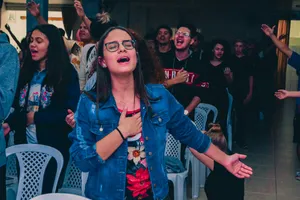
Special experiences leave an impression and shape faith. In scouting there are countless ways to create moments like these. A festive campfire evening with a message, maybe even a skit and an invitation to respond in faith, can make a real difference. Or you set up a prayer tent that’s open for prayer day and night: a place to step away, find rest and meet God. A devotional in a circle of torches at a special spot during a hike will also stay with people for a long time. Especially during Advent, an outdoor Christmas service in the woods is a great chance to celebrate faith together, not only for the scouts but also for your church and the neighborhood. Moments like these make faith something you can experience and let it carry over into everyday life.
2. Meet each participant where they are
Not all scouts come from a Christian background, and that’s important to keep in mind. Some have little connection to faith yet and need a gentle way into the topics. This is about going step by step, making room for questions and explaining patiently. Deeper conversations often come only once the foundations are laid. Teenagers in particular have different questions and need answers that fit their age. They want to understand, they question things, and they expect to be taken seriously. Walking alongside them on that journey is one of the most beautiful parts of Christian scouting.
3. Pick up the Bible
Reading the Bible shouldn’t be a burden or a duty, but something to receive as a gift: a chance to come into contact with God’s thoughts. Short, easy-to-understand Bible passages can become a regular part of your camps. Exciting questions and open conversations help you discover the Bible and understand it in a living way. Reading the Bible regularly grows not just knowledge but faith. It’s a journey of faith you take together, step by step, without pressure, but with lots of openness and room for discovery.
4. Make faith part of everyday scouting
Faith doesn’t only belong in special moments, but also in completely ordinary scouting life. Why not include a short prayer for the group’s concerns in your weekly meeting? You can also bring up faith topics again and again through the requirements your scouts work on. Set times for devotionals or Bible discussions make sure faith has a natural place in the program. That makes it clear: faith isn’t something lofty and far removed. It’s a normal part of our lives, just like making a fire or pitching a tent.
5. Be a role model
As a leader, you are always a role model, whether you realize it or not. The participants watch closely how you live and whether you really live what you preach. Sure, that’s a big responsibility, but it’s also a real opportunity. You can show young people how to live out faith in everyday life, with all the challenges and doubts that come with it. What you do often leaves a much stronger impression than what you say. Young people quickly notice whether your words and actions match. Be open about your own struggles in faith, because that shows them that faith isn’t a finished state but a process of growth. By living authentically, you motivate them to do the same.
6. Practice what matters to you
Faith shows itself not only in words, but above all in action. Without action, faith stays theory. Scouts learn especially well through hands-on experience: “learning by doing.” That’s why it’s important for you as a group to live out your faith in practical ways too. Organize service projects, take care of a park or visit older people. That’s how scouts experience what it means to put their faith into action. Projects like these don’t just build team spirit; they also shape the participants’ character and social awareness. Step by step, a culture of serving grows that reaches beyond camp into everyday life. Through this practice it becomes clear: serving others doesn’t just change the world around us, it changes our own hearts too.
7. Talk about your faith
Talking about your own faith is simply part of sharing the gospel. Whether through devotionals, sermons or conversations around the campfire, opportunities to share your own faith keep coming up. It’s not about being theologically perfect, but simply about telling honestly what faith means for your own life. A devotional at the end of a day at camp or testimonies around the campfire create space where faith comes up quite naturally. This also helps young people learn how to express their own faith and talk about it. Remember that faith grows when God’s word is preached: “Consequently, faith comes from hearing the message, and the message is heard through the word about Christ.” (Romans 10:17 NIV)
8. Let different people share
Sharing the faith shouldn’t always come from just one person. Give participants the chance early on to lead devotionals themselves or share their faith in short contributions. Your volunteers, or even parents, can bring in their experiences of faith too. It doesn’t always have to be the pastor or the head leader who talks about faith: anyone who walks with God can make much of him and bear witness. A campfire evening where different leaders share short thoughts can be inspiring and encouraging. That creates an atmosphere where no one feels solely responsible for sharing the faith, and everyone contributes together. This way, sharing the faith becomes a shared task in which everyone can play a part.
9. Think beyond your scout group
Faith doesn’t end when camp is over. It’s important for scouts to find a connection to the church and to other Christians their age. Use the opportunity to involve parents in their faith journey, and encourage relationships with other groups, whether in your church or beyond. That way, faith is lived not only within the scout circle but in a wider network. This network supports young people in going deeper in their faith after camp and living it out in their everyday lives.
Conclusion
The responsibility of passing on faith may seem big at first, but don’t worry: you don’t have to do everything perfectly. God works through you just as you are, with all your strengths and weaknesses. It’s not about always finding the right words, but simply about living your faith authentically. Often it’s the little things that have a big impact: an honest conversation or a simple gesture. You’re not alone on this path; you’re part of a community that pulls together and supports each other. Trust that God will use what you give to reach your scouts’ hearts.
English version: October 2026