1. Why Your Church Needs a Scout Group Right Now
2. What Does Your Church Need to Start a Scout Group?
3. What Do Scouts Actually Do?
4. Living Out Your Faith in Scouting
5. Scouting Glossary
You can spot scouts pretty easily by their matching shirt and their colorful neckerchief. But what do scouts actually do differently from other Christian groups, such as kids’ clubs at church? After all, scouting has been hugely successful around the world for over 100 years, and in Germany it’s currently capturing the imagination of many young people.
This article briefly explains what the heart of scouting really is. In a nutshell, Christian scouts do the following:
They have adventures outdoors, spend time in groups with others their age and live out scouting values and their faith. In the process, they take responsibility for themselves, for others and for the environment.
A central element of scouting is the Scout Law and the Scout Promise.
The Scout Law is a set of values and behaviors that guide how scouts live together in community and how they act in the world. It includes principles like honesty, helpfulness, respect for nature and tolerance toward others. One example: “A Scout is helpful.”
The Scout Promise is each scout’s personal commitment to live by this law. It’s a solemn moment in which the scout commits to doing their best to live up to the ideals of scouting and to live out their faith actively.
Scouting is organized by age
Grouping kids and teenagers with others their age makes it easier to take their stage of development and their needs into account. In Germany, there are typically these sections:
- Cubs (about 6 to 9): They discover the world around them through play and learn basic social skills.
- Junior Scouts (about 9 to 12): They have adventures and learn basic scouting skills.
- Scouts (about 13 to 16): They take on more responsibility by helping with the younger ones, deepen their skills and plan their own projects.
- Rovers (about 16 to 20): They act independently, lead younger groups and serve in their communities.
These sections encourage ongoing personal development that responds to the needs of each age group.
These are the typical things scouts do:
Camping in Kohte and Jurte tents
Scouts in Germany camp in traditional black tents, the Kohte and the Jurte. They have a smoke hole, so you can light a fire inside the tent. These tents don’t just offer shelter. They also create a special atmosphere and sense of community. Putting them up and taking them down together builds teamwork and practical skills.
Pioneering with wood and rope
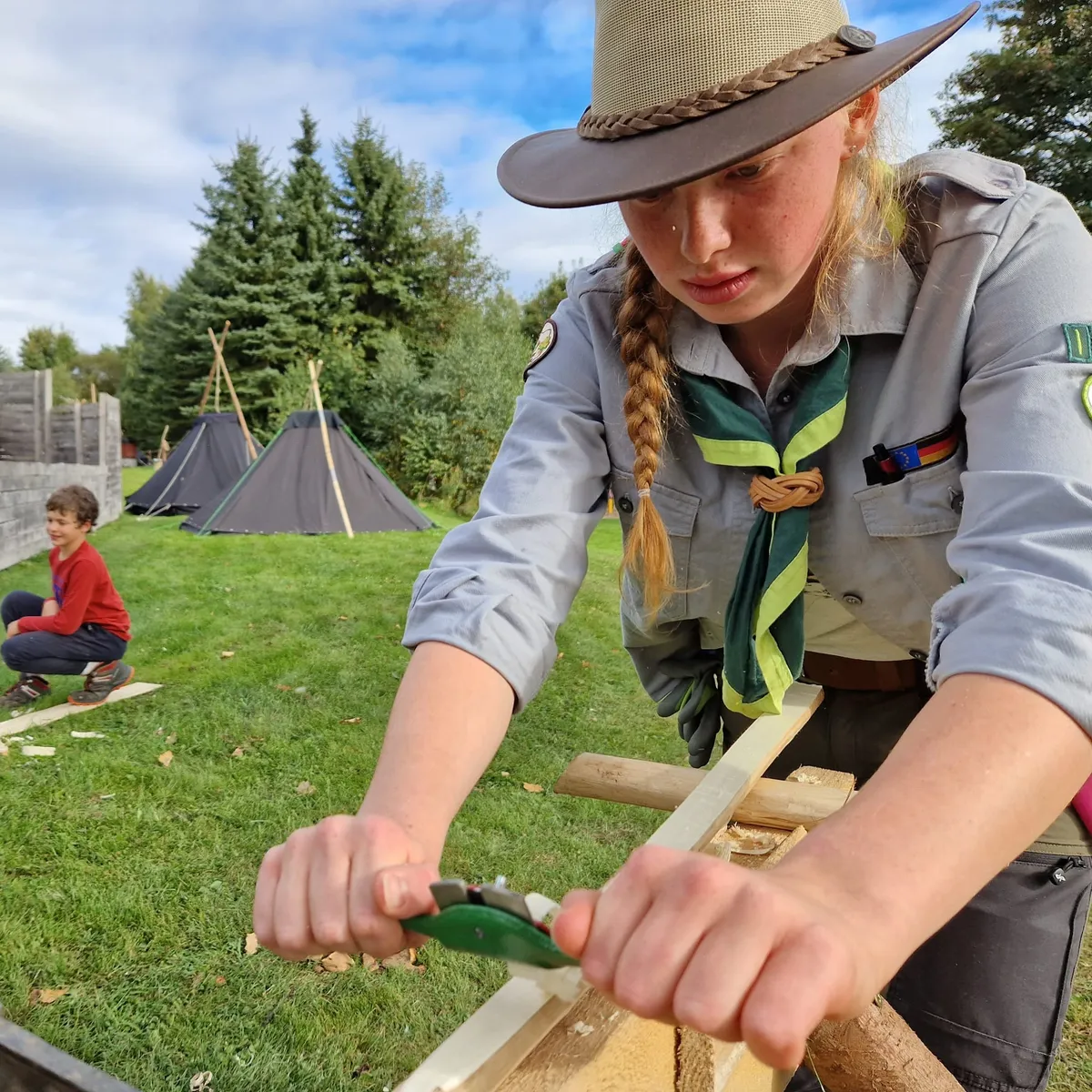
Using rope and wood, scouts build great camp structures, such as cooking tables, camp towers or elaborate seating. This pioneering builds practical skills, creativity and an understanding of physics. It’s impressive to see what can be built with just simple materials.
Cooking outdoors
Preparing delicious food yourself outdoors is a special experience. Scouts learn how to cook meals over an open fire or on simple stoves. Along the way, they don’t just develop their cooking skills. They also experience the value of shared meals. Planning the food also teaches responsibility and organization.
Learning and using first aid
Scouts learn first aid early on, so they can help themselves and others right away when someone gets hurt. Even the youngest can get help, put on a bandage or keep an injured person warm with an emergency blanket. This builds a sense of responsibility and the ability to act calmly and effectively in emergencies. Regular practice and training prepare them for different scenarios.
Life in and with nature
Understanding plants and animals and being able to find your way safely in nature are central. That also includes preserving nature and using resources sustainably. Scouts develop a close connection to the environment and learn to value and protect it. Environmental activities and conservation projects are a regular part of the program.
Finding your way with map and compass
Being able to find your way with maps, a compass and natural landmarks is an important part of scout training. It builds young people’s self-confidence and independence. Orienteering races and treasure hunts make learning navigation skills exciting and practical.
Community around the campfire
Lighting a campfire from natural materials isn’t only practical for keeping warm and cooking. It’s also an important act that strengthens community and connection. Around the fire, people tell stories, sing songs, drink chai and share experiences. It’s a place for reflection and conversation.
But scouts aren’t only defined by what they do. That’s just the most obvious part. What matters much more to scouts is being together, good character and simply sharing life with one another.
Community and responsibility
Scouts belong to small groups called patrols, troops or packs, in which they plan, make decisions and act together. This small-group work develops social skills, a sense of responsibility and teamwork. Each person contributes to the group’s success and takes on tasks and roles. Conflicts are resolved together, and everyone learns to be considerate of one another.
Serving others
Another important aspect is serving others. Scouts get involved in community projects, help out at church and support people in need. Whether through collection drives, visits to nursing homes or environmental projects, this involvement teaches them empathy, and they work actively for a better world. The slogan “Do a Good Turn Daily” points the way.
Connecting
Scouting is a worldwide movement. Scouts meet at national and international camps and make connections with others their age from other churches, cities, countries and cultures. These international encounters build intercultural understanding and friendships across borders. Knowing they’re part of a global community broadens their horizons and encourages tolerance.
Faith in scouting
For Christian scouts, faith plays a central role. They build faith into their activities, whether through devotionals, prayer or wrestling with ethical questions. Faith offers a foundation of values and direction in everyday life. Spiritual experiences strengthen each scout’s personal growth in faith and their responsibility for others.
The scout method
The scout method is a comprehensive educational approach that combines different elements to support the well-rounded development of kids and teenagers. It offers a unique learning environment built on hands-on experience, community and personal growth.
The role of leaders
In scouting, the older participants take responsibility for the younger ones right from the start and help them find their way. In many scouting associations, training to become a volunteer leader starts at around age 14. Many leaders are only a few years older themselves and get involved early. Adults and experienced leaders accompany the scouts as mentors and role models. They support young people in their development without telling them what to do at every turn. With this support, scouts can gain experience on their own and learn from mistakes. Leaders encourage independence and stand by as mentors to give advice, which strengthens personal growth.
Conclusion
Being involved in scouting has an impact on later life: many former scouts say the experiences and values from their time in scouting shaped them for good. Skills like teamwork, leadership, problem-solving and social responsibility matter a lot in adult life, too. What they learn helps them at work, in their families and in society.
All in all, scouts do much more than camp in the woods and tie knots. They have adventures, learn important life skills, serve others and grow as people. The combination of community, faith, experiences in nature and a sense of responsibility makes scouting a unique idea that has been inspiring and shaping young people for over a century.
Through scouting, kids and teenagers grow into confident, responsible and committed people. They learn to respect themselves and others, to value nature and to play an active part in shaping a better world.
English version: October 2026