This article was written by Heiko Metz and first appeared in the German edition of the Pulse newsletter, which supports youth leaders and parents on their way to better relationships with young people.
A country full of armchair coaches
Have you ever wondered how it is that the people who always know best are the very ones who have nothing to do with the matter at hand?
- The best parenting tips come from people without kids. They know how it’s done.
- All the barstool pundits in the world know exactly what “the politicians” should do differently and, of course, better. “But nobody asks us.”
- The best national soccer coaches sit on the couch at home and yell at the TV so loudly that the players might actually hear them.
- And of course the average Joe is also the best virologist. That’s especially obvious right now.
- The same phenomenon seems to be at work with the conspiracy theories running rampant right now: among others, a vegan chef and a musician in Germany have suddenly become experts in politics, economics, medicine and so on.
Why is that? Why do people apparently see themselves as incredibly competent in areas where they really can’t be? Why do people get the impression that they know more than others who have studied and researched the subject, or who have simply been doing the job well for a long time and have gained experience?
An incompetence bloodbath
Especially if you spend time on social media, you’ll find posts or comments practically everywhere that are simply wrong, meaning they wouldn’t stand up to any fact-check. Yet they’re delivered with a tone of absolute conviction that allows no contradiction, and the poster’s own infallibility (at least on this topic) gets proclaimed along with them. Anyone who has a different opinion, brings up facts or even just asks questions gets hit with rants, insinuations and insults, and the sparks really fly. When two people meet who hold opposite opinions but are both very, very, very convinced that only they can be the expert in this area, the result is virtual war. And it often ends in a bloodbath with lots of collateral damage.
Now of course you could object that freedom of speech is a truly precious thing. That’s why everyone has the right to their own opinion, no matter how weird and off base it may be. And they have the right to make that opinion known to everyone. I agree completely. I consider it absolutely essential that we can express ourselves freely, question things, give a hearing to different points of view and so on. That’s one of the foundations of our democracy.
Still, in my view we have a problem here when, again and again (and, it feels like, more and more), people fool themselves and act as if they were the absolute experts on a topic when all they really know about it is three buzzwords and a few slogans.
The Dunning-Kruger effect
In popular science, this combination of incompetence and ignorance is called the Dunning-Kruger effect. The term came out of a study on the relationship between self-assessment and abilities/skills.
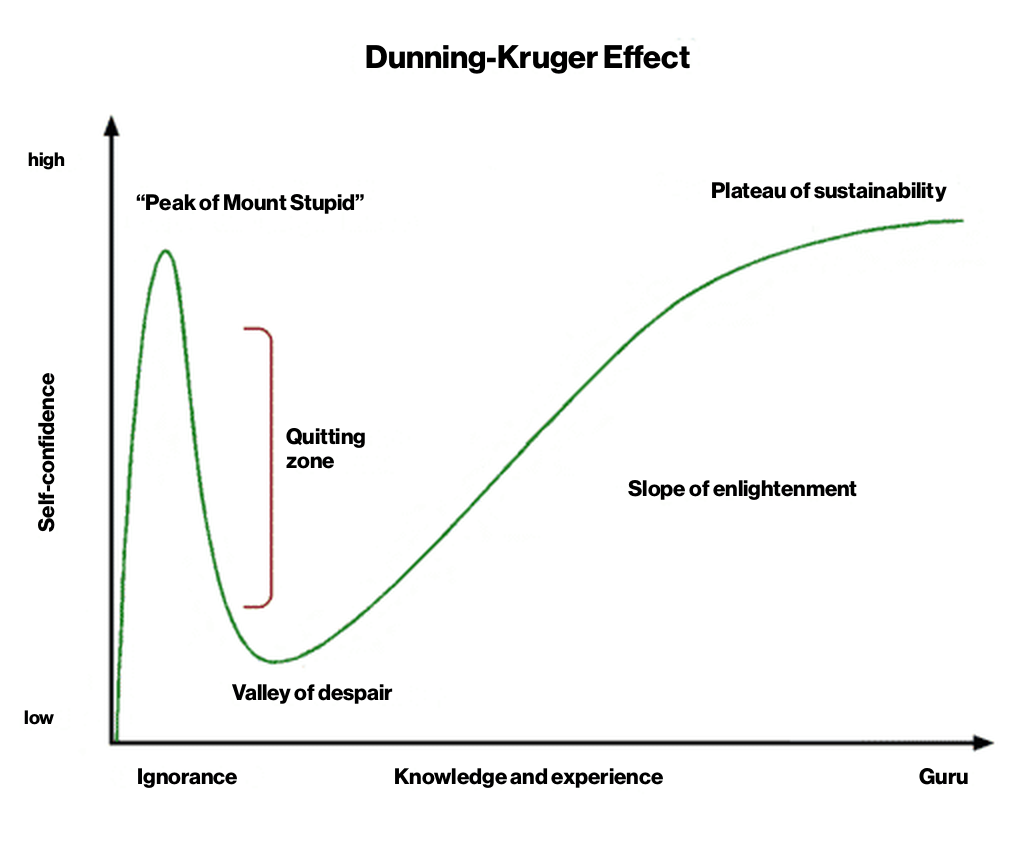
The participants were given tasks to solve. Afterward, they were also asked to estimate how well they thought they had solved them.
- The bottom 25% rated their performance as above average.
- The top 25% also rated their performance as above average, but as worse than it really was.
New round, new chance: in the next step, the participants could see the others’ results and then adjust their self-assessment accordingly.
- The top 25% revised their estimate upward: completely realistic and correct.
- The bottom 25% still rated themselves as above average.
Somehow I find that shocking.
“If you’re incompetent, you can’t know you’re incompetent. […] The skills you need to produce a right answer are exactly the skills you need to recognize what a right answer is. The fact that people are wired this way is at the core of many manipulation strategies, which are being used more and more today.” (David Dunning, last sentence paraphrased)
Typical behaviors of this effect include:
- Clearly overestimating your own skills and knowledge;
- As a result: blocking out your own incompetence
- And at the same time, failing to recognize or underestimating the superior skills/knowledge of others.
In other words, the Dunning-Kruger effect is “to blame” for quite a lot of strange, cringeworthy opinions voiced by our fellow human beings. Discussions then regularly fizzle out because at least one of the people involved can’t/won’t see arguments as arguments, and instead experiences them as an attack on their person and on their homemade expert status. And that’s why they aren’t willing to engage in a real discussion. The result is that other opinions get ridiculed, the only responses are irony/sarcasm and others get written off as incompetent, without allowing even the slightest hint of doubt about one’s own competence.
What I find especially bitter is that people who fall prey to this effect won’t grow, because they can’t see the need to. The fact that this often comes across at first glance as very self-confident, and therefore trustworthy, doesn’t make things any less problematic.
But I really am a better driver than other people
My son is learning to inline skate right now. At the very beginning, he had a healthy respect for it and, besides knee pads and wrist guards, would have liked to be wrapped in bubble wrap and held by me ALL THE TIME. After a few hours of practice, he can stand on the things pretty well and, inching along the wall, even move a few feet without falling. So far, so good and normal.
If you asked my son about his inline skating skills right now, he’d rave to you about how great he is at it, that he’s already got “tricks” down and that by tomorrow at the latest he’ll be able to keep up with the other kids outside (maybe even be a little faster than them).
Of course that’s nonsense and more a reason for me to smile quietly to myself, but right now it helps him. It keeps him motivated. He sticks with it and, sooner or later, he’ll really learn it! The effect will be that, on the one hand, he’ll keep getting better at skating and, on the other hand, he’ll be much better able to judge everything he still has to learn and how good the other kids really are.
So on a normal path of developing knowledge or skills, the Dunning-Kruger effect can even be helpful at the start, if it pushes us to stick with it, keep going and get better. But if it gives us the feeling that we’ve already got it, that we’re already experts, it paralyzes us and keeps us stuck at our level of incompetence, and we still think we’re great.
It’s the same with driving. Quite a large share of drivers are sure: “I drive better than average.” When asked (in German) “Are you in the better half of drivers?”, almost everyone answered “yes.” What stands out is that young male drivers, for example, are the most convinced of their driving skills. That’s why they like to make fun of women, who “can’t parallel park anyway,” and like to trash other drivers: “Where did he get his license? Out of a cereal box?” At the same time, they top the accident statistics.
“When it comes to the tendency to overestimate ourselves, early learning success seems to be a dangerous thing. Although beginners start out humble in how they see themselves, just a little experience is enough for their self-assessment to outrun their actual performance.” (Carmen Sanchez and David Dunning, paraphrased)
Competence develops in stages
The Dreyfus model describes five:
- Novice
- Advanced beginner
- Competent
- Proficient
- Expert
The road to the coveted status of expert is long. It may flatter my ego to think of myself as an expert when I’ve barely left the beginner stage. But in the end, that really doesn’t help anywhere or anyone. Quite the opposite.
If I want to follow someone, celebrate them, believe them and defend them, I should first check carefully whether they’re just a self-appointed expert or a real one.
Becoming competent
At first glance, the Dunning-Kruger effect seems to explain why so much incompetence gets courted in our world. At second glance, it’s sobering to see how hard it often is to get into real conversations with people, let alone convince them of something, when they’re pretty ignorant about their own incompetence. If you can’t see the problem, of course you don’t want to solve it either.
“Two things are infinite: the universe and human stupidity; and I’m not sure about the universe.” (Albert Einstein)
On top of that, you could fall prey to this very effect yourself and consider others less competent, even though you may be the one who is. Ultimately, you’d need quite a high level of competence to really “judge” others, but this especially high level of competence is exactly what those who absolutely don’t have it like to claim for themselves… tricky business!
All of us have no choice but to keep increasing our own competence, and in doing so to get better at assessing ourselves and others at the same time.
What helps me:
- Questioning myself again and again
- Regularly asking others for constructive criticism
- And truly being, and staying, an active learner for life.
Education and feedback are the key words for us, just as they are for our kids and teenagers.
Let’s help the young people in our groups
- have fun learning new things, and create a wide range of learning experiences in our work,
- dig deeper into topics and become real experts in particular subject areas,
- develop criteria they can use to assess themselves and their abilities, as well as criteria for assessing others in this regard. And apply these criteria regularly.
- build a culture of feedback,
- and grow in self-confidence apart from their competencies too. Let’s teach and show kids and teenagers that they’re valuable for who they are, so that they can look at themselves and their own competencies realistically and without fear.
“Democracy has to be born anew every generation, and education is its midwife.” (John Dewey)
A positive example of this is King Solomon in ancient Israel. He becomes king quite young and has many rivals/envious people eyeing the throne. One night God appears to him in a dream and grants him a wish. A Dunning-Kruger-effect king might have thought: “I’m the best king ever. Nobody is better for the country than I am. So I’ll wish for eternal life.” But Solomon doesn’t do that. He doesn’t wish for health or riches either. Instead, he says: “God, you have entrusted me with a great people and an even greater task. I need a great deal of wisdom to be a good king to this country. And that very wisdom is what I ask of you!”
The first wish would have given the country an incompetent king who lived forever; his actual wish produced an expert king who brought prosperity and peace to the whole country. We need more Solomons in our world!
Picture a world
“It is a different world, one in which people can’t tell ‘freedom’ from ‘free time,’ say ‘society’ and mean ‘target group,’ talk about a ‘concept’ without having so much as an ‘idea,’ talk about an ‘idea’ without having so much as a ‘thought.’” (Roger Willemsen, German writer)
A world with less of the Dunning-Kruger effect would have less pointless bickering. Fewer self-appointed experts and more influence for real experts instead. Fewer conspiracy theorists and even fewer groupies of theirs. But above all, more people with a healthy sense of self-confidence and the ability to reflect. More people on the way to truly becoming experts.
That seems to me like a world I’d love to live in. A world worth working for.
So let’s get to work!