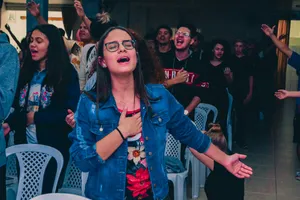
With the question “Would you be content to build a strong church that no one has ever heard of?” Pastor How set the tone for the talk.
Devotion and faithfulness: the true core of ministry
At the birth of Jesus, two groups of people showed up: the wise men and the shepherds. The wise men were educated, they recognized the signs of the times and followed the star; they were learned and clever. Yet in the end they unintentionally caused problems too, when they told Herod about the newborn king. The shepherds, on the other hand, were simple people who just followed the angels. Without much education or worldly wisdom, they simply listened to God and so found their way to Jesus.
And the Bible is full of people whose names we don’t even know, but who changed the world. Do you know the name of the little boy who brought the loaves and fish to Jesus, or the name of the widow with the two small coins? We don’t know their names, but God knows their names.
Ministry isn’t about being clever, educated or charismatic. It’s about having a simple, devoted and faithful heart that is ready to listen to God and follow him.
No room for ego and self-promotion
The problem is that our ego often gets in the way. Our ego is the greatest enemy of real discipleship. Pastor How warned against turning God’s work into a means of self-promotion or building a brand around our church. It’s not about us. It’s about God working through us while we step back.
Jesus commissioned us to make disciples. That means we have to multiply our character, not our charisma. If we want our teenagers to grow spiritually and become strong followers of Jesus, we have to set an example for them through our own character, not through our abilities or our influence.
It’s so easy to focus on the things that impress others: the way we preach, the way we run programs, the way we present ourselves. But we aren’t here to be the coolest or best-known leaders. That isn’t what really shapes young people. Our focus should always be on serving Jesus and reaching the hearts of the teenagers, regardless of whether anyone ever notices. They aren’t formed by our charisma, but by our character, by the way we live our lives and authentically model our love for Jesus.
The problem with charisma is that you can’t multiply it. Character, on the other hand, can be multiplied. Charisma is impressive, but it isn’t a strength, because it can’t be duplicated. (Pastor How)
Every one of us can love young people without being charismatic. Love is sustainable. Charisma isn’t. Just as Paul introduces it in 1 Corinthians 13: if we don’t have love, everything else is worth nothing. Love is the greatest gift we have received and can pass on. Love can be multiplied.
The individual counts: how we as shepherds see the one
In a culture that often puts numbers and statistics first, we can easily forget that every individual counts for God. Jesus left the 99 sheep behind to look for the one lost sheep, and we too are meant to focus on seeing and loving the individual.
In youth ministry we often face the challenge that the sheer mass of needs overwhelms us. We have programs, events and different groups to lead. But Pastor How encouraged us not to be distracted by the crowd, but to focus on the individual teenager who needs our love and attention.
Jesus left the 99 sheep to find the one. Let’s do the same. (Pastor How)
It isn’t about how many people are sitting in our youth groups, but whether we are able to reach the one who may be right in the middle of a broken family.
This image is powerful. It reminds us that the value of our work doesn’t lie in the size of the group, but in the depth of the relationship we build with individual young people. It’s easy to fall into the trap of measuring our work by numbers, but Jesus never oriented himself by numbers. He saw the individual.
Return to the simplicity of the shepherd. (Pastor How)
If we adopt this posture, God will use us, maybe not in a way the world sees, but in a way that touches the heart of God.
We may be building the strongest church no one has ever heard of.
So let’s return to this simplicity. Let’s be shepherds who leave the 99 to look for the one sheep. Let’s build deep, authentic relationships with young people. And let’s be faithful, no matter how big or small our flock is. Because in the end, it isn’t the size of our work that counts, but the depth of our love.
Working across generations: supporting your church’s vision
Every church has its own God-given calling. It isn’t the job of each new generation to throw overboard what has been achieved so far and start from zero or reinvent the wheel. The job of the following generations is to support the vision God has already placed in the church. It’s about building an army of young people who help make the existing vision a reality.
A generation is like the latest update of a phone’s operating system. It powers your church’s vision without replacing it. (Pastor How)
Just as every app on a phone serves a different purpose, every church has its own calling, whether that is planting new churches, working for social justice or focusing on youth ministry. The young people we train are the ones who will drive that vision forward.
The image of the operating system illustrates how important it is that young people don’t act in isolation, but are part of the whole vision of the church. Our job is to support them, help them discover their gifts and equip them for what God has already prepared in the church.
Revival instead of survival
It’s no longer about survival. It’s about revival. (Pastor How)
Many churches have fought in recent years just to survive. But God is now calling us into a new phase. Now is the time for revival.
We can no longer remain in survival mode, where we just try to make it from week to week. Now is the time to be bold, to dream and to pray that God brings a new revival among young people. We are already seeing the first fruits of this revival. All over our cities there are signs of spiritual awakening, and it often begins with young people who are hungry for God.
But this revival won’t be triggered by one person, but by a movement of the Holy Spirit in many hearts at the same time. Youth leaders and pastors, together with their churches, will be part of this movement, whether in big cities or small villages.
English version: September 2026