What’s the problem, anyway?
Fact or fake? Conspiracy theories weren’t invented in the time of COVID. Back during the great plague epidemics of the 14th century, for example, people spread the claim that Jews were poisoning the wells to cause the plague and so wipe out Christendom. That was about as absurd as claiming today that Bill Gates wants to wipe out most of the world’s population through forced vaccination, yet now as then, it finds a frightening number of followers.
The fake news running rampant right now isn’t a new invention of The Donald either; it has always been a tool of election campaigns, and of gossip and rumor. What would Germany’s BILD tabloid be without … but let’s not go there!
Even populism is old hat. There have always been those who used simple answers to complex questions to pretend that there was an “elite” and “ordinary people” who had to protect themselves against the elite, even fight back. Who act as if they belonged to these ordinary people and wanted to protect or free them. Who use this to try to fire up the masses and mobilize them (ultimately to the populist’s advantage).
So, same as always?
What has changed in recent years, though, is how fake news and the like can spread through social media, and society’s growing acceptance of such tactics.
There’s the President of the United States twisting the facts however it suits him, contradicting himself constantly, being caught lying practically every day … and his following keeps growing. When his campaign manager Kellyanne Conway then talks about “alternative facts,” on the one hand the nerve of it can hardly be topped, but on the other hand it somehow becomes normal too … the American president is just a liar and a fraud, so what?
That Trump may have come to power partly with the help of fake news campaigns on social networks (originating in Russia, which is also ruled by a skilled populist) unfortunately fits the picture all too well. It doesn’t bode well for this year’s presidential election.
Then there are, for example, members of Germany’s AfD party (Alternative for Germany) who twist historical facts so confidently that my blood regularly runs cold with horror. But here, too, people are slowly getting used to the constant breaking of taboos and the shifts in discourse to the right (in German).
And these are all just individual examples. Especially when it comes to manipulating and forming opinions online, terms like echo chamber, filter bubble, hate speech and shitstorm are everywhere.
What are filter bubbles and echo chambers?
As you call into the chamber, so it echoes back: What exactly are a filter bubble and an echo chamber? The term “filter bubble” comes from internet activist Eli Pariser (The Filter Bubble: What the Internet Is Hiding from You, 2011, Penguin Press). In short, he uses it to describe the following phenomenon: because there’s simply too much information on the internet crashing down on poor me, the user, completely unfiltered, search engines and social networks work with more and more, and better and better, algorithms. These are meant to pre-sort things so we can handle the information better.
What does it sort by? By my preferences, past interests, my location and so on. That means if I google “ice cream,” my wife sees the nearest ice cream shop around the corner at the top of the list, while I get recipes for making your own ice cream. For me, too, our favorite ice cream shop always used to be at the top (probably because we searched for its opening hours often enough). But lately I’ve been looking for recipes, and presto, the algorithm switched things around for me to deliver the most fitting information possible. Music streaming services do this too. If you keep listening to Schlager, Germany’s sentimental pop music, in the end you’ll only be shown Schlager … I know, you’d never do that. But just as an example 😉 So far, so convenient.
But if I apply this to politics, ideologies, important social movements and opinions, I run the risk that in the filter bubble I’m only shown news, opinions and so on that match not only my interests but also my opinion. Google does this very successfully, and so does the personalized Facebook news feed. If I had a critical view of Islam (even though there’s no such thing as one single Islam, but let’s not make it more complicated than it is), I would be shown more and more reports, again and again, that confirm this view.
“The personal universe of information that you live in online, unique and built just for you by the personalized filters that now power the web.” (Eli Pariser, paraphrased)
The deeper I immerse myself in this filter bubble and connect with people (or bots) who share my opinion or political views, the less I’m “bothered” by other opinions, possible studies, facts and so on. Then I’m in the echo chamber: I only hear and see what I already knew, liked and thought was right (in German). In my fictional “fear-of-Islam echo chamber,” I would then hear only negative things about Islam, both from news reports, politicians’ posts and so on, and from my many contacts on the various social media channels, who would only tell me and share negative things about Islam.
“Communication environments in which people keep getting their own opinion back as an echo.” (Cass Sunstein, paraphrased)
That way I stay limited to my own horizon. And if that was rather limited to begin with … in the end, you’re left with a lot of opinion and not much of a clue. But held with completely unquestionable conviction.
Worse still: If I’m deep enough in my echo chamber, my critical feeling toward Islam won’t just be confirmed, it will grow. Into real fear, for example, or into the view: if Islam is sooo bad, then I have to vote for a party that finally does something about it. Then I have to take to the streets, demonstrate … or worse.
And then hundreds of people in Germany turn up at demonstrations against the “Islamization of the West.” With real fear of this Islamization, in areas where there are hardly any people of foreign origin or of the “corresponding religion.” There, people wonderfully confirm to each other how great the danger is and go home more frightened and angrier than before … which in turn makes sure they come to the next demonstration.
It would be funny if it weren’t so sad. Against all this, the following holds true:
“The mind is like an umbrella. It functions best when open.” (Walter Gropius)
Too many “minds” in the echo chamber: that could be a danger. For individuals, but also for our society and democracy. For opinions to form in a sound and balanced way, it’s essential that we hear other arguments and opinions, think about them, discuss them and wrestle with them. We need “engagement with the agenda of the general public” (Bernhard Pörksen, in German). Truths that are only felt aren’t truths in the end.
So what exactly is this, and what does it have to do with “my” kids and teenagers?
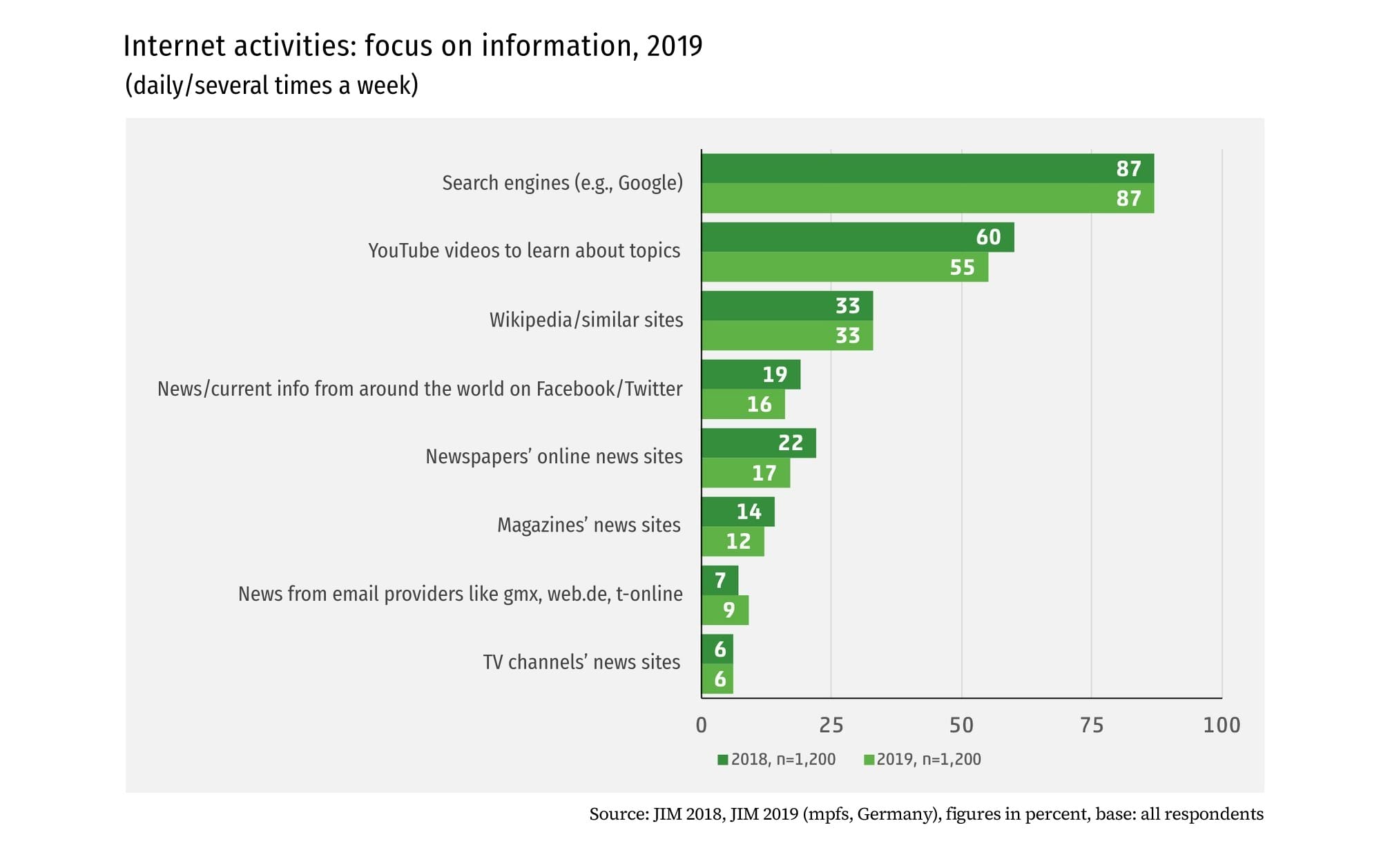
Echo chambers are reserved mainly for teenagers: Even though the strength of these effects in adults is quite disputed, the danger for teenagers is especially high (in German). Because teenagers …
- get their information almost exclusively online,
- on top of that, get their “news” almost entirely from social media channels,
- usually limit their sources of information there to just a few.
On top of that, as digital natives, teenagers tie a large part of their identity to social media and the like. You’re only someone if you post. Life is staged and shared with lots of photos in stories or on Snapchat, where everything only lasts a day. People like and comment for all they’re worth …
The possibilities are countless, and the urge to develop and present myself in a completely individual way is strong. But the pressure to do the “Instagrammable” thing, and to keep getting faster at it, is also quite a challenge.
That makes it hard for teenagers to develop their identity, because identity can’t be produced in a dazzling, fast way with special effects.
In the end, all the fake news, populism and conspiracy theories are about exactly this: in an ever faster, more uncertain world that seems to be slipping away from you, getting a sharply defined, certain answer I can hold on to, one that confirms me, lets me belong to a group and so also clearly sets me apart from “the others.”
That’s why teenagers are especially vulnerable to filter bubbles and echo chambers, and they are at risk of losing autonomy, of no longer being able to evaluate information for themselves (or never learning to), or of knowing neither where to get reliable information nor how to debate it effectively in any way.
So now what?
First, echo chambers don’t come out of nowhere: They have to do with my settings on search engines, social media channels and so on, the way I get information and the people I let into my network.
In other words: Which pages get a “like” from me? What are my sources of information? Who’s in my digital “circle of friends”? How do I interact with (which) posts?
All of this either helps inflate a filter bubble or takes away the basis for one to form. Just being aware that this problem exists and how it works helps me to deliberately look for other opinions and arguments, to broaden my sources of information and so on.
Above all, talking directly with other people who aren’t part of my closest circle helps me notice other opinions and deal with them. That opens up other perspectives and does a great deal for the ability to engage in discussion.
In times of uncertainty like right now, these conscious decisions and the skills for discussion and openness are needed more than ever. I believe youth ministry can make an important contribution here!
Second, the big question for work with children and teenagers is:
How can we help children and teenagers develop an identity that holds an open mind and is just as open to all kinds of relationships with the world? With other people, with nature, with themselves and with God. An identity that is ready to be questioned and to discuss things in a critical and constructive way. That knows it is a person whose life is worth living, a valuable person, and that can bear the fact that the world is sometimes contradictory, cold, incomprehensible or simply too fast.
How do we walk with children and teenagers on the way to an identity that doesn’t feel at home in echo chambers and doesn’t need filter bubbles to cope with the diversity and ambiguity of the world? If that isn’t a worthwhile and especially demanding challenge for us as youth leaders, I don’t know what is!
Third, as Christians, we actually have it especially good on this question: Above everything else, our identity also depends on God. The God who created us and loves us. Who finds us valuable, just like that.
Who needs, or rather who wants, an echo chamber that tries to pin me down politically on the far right or left, feeds and magnifies my fear and uses my insecurity to exclude others … when I can also hear and experience what Psalm 8 in the Bible says:
“LORD, our Lord, how majestic is your name in all the earth! You have set your glory in the heavens. Through the praise of children and infants you have established a stronghold against your enemies, to silence the foe and the avenger. When I consider your heavens, the work of your fingers, the moon and the stars, which you have set in place, what is mankind that you are mindful of them, human beings that you care for them? You have made them a little lower than the angels and crowned them with glory and honor. You made them rulers over the works of your hands; you put everything under their feet: all flocks and herds, and the animals of the wild, the birds in the sky, and the fish in the sea, all that swim the paths of the seas.” (Psalm 8:1-8 NIV)
In this spirit, completely free of filter bubbles, I wish you good conversations and experiences with your teenagers on this topic!
PS:
You can dig deeper into teenagers’ media use with the JIM study (in German), Germany’s regular study of media use among 12- to 19-year-olds.
Photo by Alexandra Mirgheș on Unsplash
Unless otherwise indicated, Scripture quotations are taken from The Holy Bible, New International Version® NIV®, Copyright © 1973, 1978, 1984, 2011 by Biblica, Inc. Used with permission. All rights reserved worldwide.