

The neurobiology of puberty for everyone who walks alongside teenagers
“The Art of Hugging a Cactus”¹: this subtitle on a book on the living room shelf at my parents’ house caught my eye and set off two reactions in my 14-year-old brain:
- Defense: “Oh, so my parents are looking for a strategy to get through to me. But I won’t let anyone control me, not even with strategically deployed love!”
- Understanding: “Cactus doesn’t sound nice, but somehow it fits …”
My adult brain still remembers this so vividly because, for the first time, it put a mixed feeling inside me into words: I look at myself critically and see things I don’t like at all (spines). At the same time, I can’t swap myself out for someone else, and I sense the task of learning to love everything about myself (hugging).
The teenage years are a fascinating time: sudden, strong, mixed emotions, unpredictable and dramatic mood swings, a back-and-forth between wanting company and shutting others out, all the way to undreamed-of heights of creativity and much more. Teenagers aren’t just a passing phase between children and adults. They’re more than “young people on hormones with new information about sex” or “half-finished bodies.” In a sense, they’re a species of human all their own, and an enormously important one.
Maybe that’s why spending time with teenagers can be so fulfilling, irritating, instructive and frustrating all at once. For a bit more understanding and direction on this journey, in this article I’ll look at three questions, one after the other:
- What happens in the teenage brain?
- What explanations do these findings offer for teenage behavior?
- What does this mean for those who build a trusting relationship with young people?
Since I’m not a neurologist myself, the following findings should always be seen as provisional. It’s good that even brain researchers put this provisional nature in front of their results. Because much about the control center between our ears is still unknown to us.
What happens in the teenage brain?
Between the ages of 10 and 20, a rapid, comprehensive and profound development takes place in the young body: puberty. When it begins can’t be pinned to a certain age. The mechanism in the brain that sets it off is a complex chain of commands that is now well researched.
The starting signal comes from the oldest part of our brain in evolutionary terms. It sits in the middle of the head, more precisely on the underside of the brain, is about the size of a grape and is called the hypothalamus. Here a hormone is produced that controls the entire reproductive system: “gonadotropin-releasing hormone” (GnRH for short). There are substances in the brain that inhibit GnRH production (during childhood) and others that promote it (during puberty). Over time the balance between them shifts, eventually it “tips,” and puberty begins. One of these promoting substances is the metabolic hormone insulin². This could be a sign that puberty only begins once the young person’s metabolism is mature enough.
The GnRH that is now released is taken up just millimeters away by the cells of the pituitary gland, which in turn produces further hormones and releases them into the bloodstream: so-called gonadotropins³. Male and female sex glands⁴ register these and begin releasing a wide range of sex steroids⁵. Their interplay causes almost all the changes typical of puberty: hair growth, maturing of the genitals, growth spurt, first ejaculation (spermarche) and first menstrual period (menarche), growth of muscles or fat deposits and so on. The different directions in which male and female bodies develop come from the relative amounts of these steroids and from how many cells in the male and female body can respond to them.
We see that this chain of commands in the brain sets a slow, multistage process in motion. It doesn’t only affect outward appearance, but also, very heavily, an important sex organ: the brain.
While the brain’s gray matter (the number of neurons and synapses) increases during childhood, puberty sets off two highly exciting processes in the teenage years (more on this in “10 things you should know about brain development”):
Pruning the overabundant synapses. The “overgrown” brain is cut back massively and remodeled efficiently. The most important messages are supposed to travel faster. In the process, connections that are rarely used or only reach a short distance are removed. The prefrontal cortex is especially affected; it is responsible for logical thinking, weighing consequences and delaying gratification.
Speeding up connections that used to be slow. “Messengers on horseback” are replaced by fiber-optic cables. A white layer of fat (myelin) forms around the synapses that are used most often and insulates them electrically. This is how people learn, form habits or develop dependencies.
These changes affect the limbic system (the main seat of emotions, needs and the reward system) first, and the prefrontal cortex only later and secondarily. The entire reward system (the dopamine pathways) gets completely rewired in the process.
We can understand why so many new developmental tasks break open during puberty. The massive growth in neural capacity unlocks more and more abilities, like looking at yourself critically or acting independently. These in turn make it possible, and necessary, to understand the world and your own self in it in a completely new way and to take your place in it. Puberty is a high-performance phase!
What explanations do these findings offer for teenage behavior?
When it comes to specific, individual effects, caution is always needed. We are far from knowing everything. Cause-and-effect relationships haven’t been proven here.
Puberty is also a high-risk phase!⁶
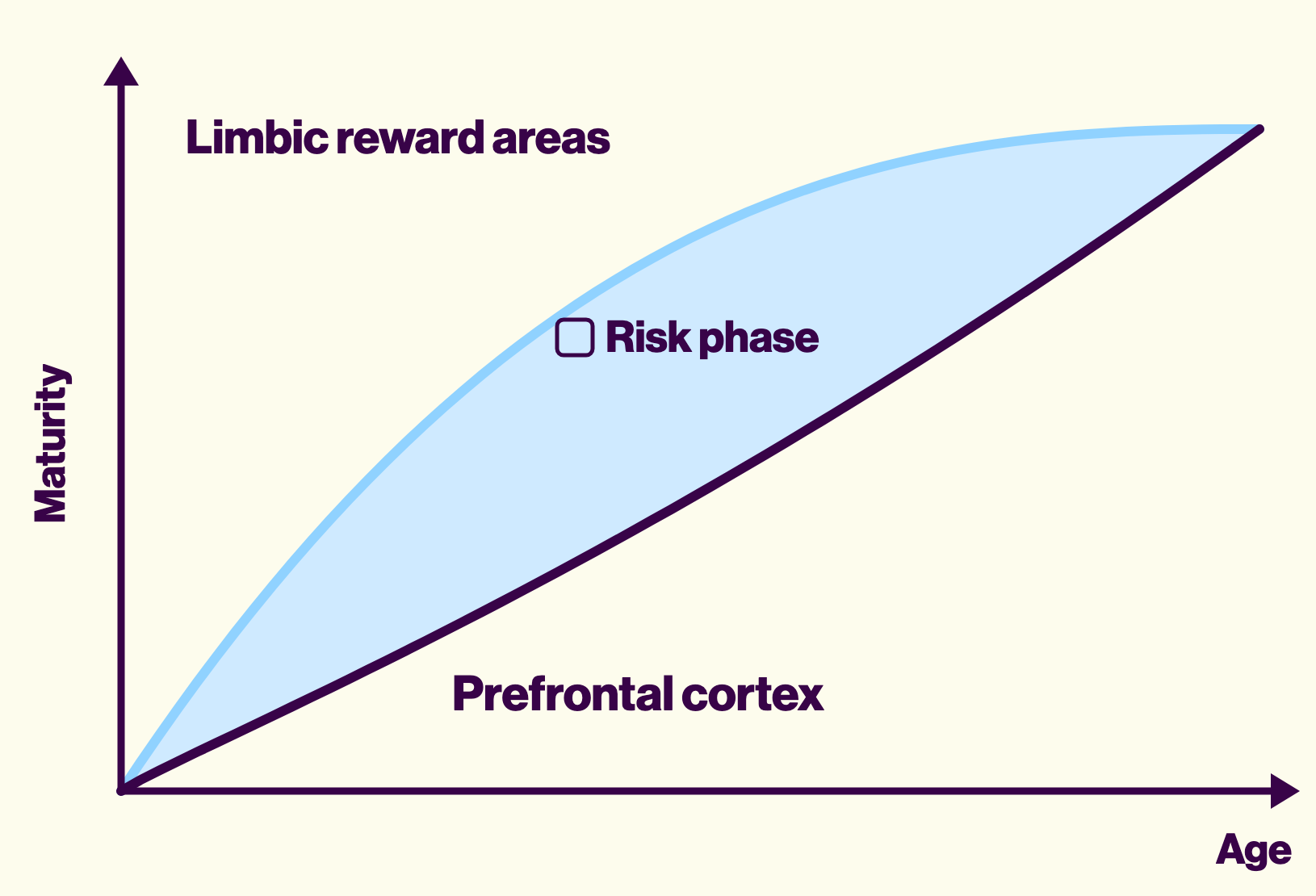
Because the prefrontal cortex and the limbic system develop at different times, decisions tend to be made on the basis of emotions. This is especially true when peers are present and when there’s a reward in view. In this process young people learn to deal with risk. For a big payoff, they’re more willing to accept losses or rejection. That’s an important and meaningful step in development, and at the same time it holds enormous potential for danger. Because it also means teenagers are able to take on too much risk, with consequences they can feel for a long time.
And yet this phase makes sense in terms of human development: the brain keeps up with outside demands that are changing faster and faster. We keep developing our operating system. Boundaries that apply to adults are questioned “automatically” and so don’t stay set in concrete.
That’s hopeful in many areas. In others, like sexuality, some of us may feel a knot in our stomach: “Here immature young people are messing around with one of the strongest forces of nature there is!” Of course sexual ethics get questioned too, while at the same time many of the abilities needed to live them out are still developing: delaying gratification, impulse control, weighing consequences. Teenagers are a mix of critical curiosity and carefree recklessness.
Still, when it comes to sex, teenagers are flooded with hormones, but they aren’t controlled by hormones. From a neurological point of view, we have to put that model into perspective. Hormones build a body that is sexually receptive and very likely give a nudge to start thinking about sexual contact. From that point on, sex is mostly a matter of the brain. Hormones are a proven factor in teenage sexual behavior, but not the only one. Social, psychological and cultural influences play a much bigger role. Teenagers talk, play, tease, experiment, try things out and practice in contact with their crush.
What does this mean for those who build a trusting relationship with young people?
If the brain’s high-performance phase and its high potential for risk coincide with sexuality reawakening in the teenage years, and if the teenage brain on principle sets itself apart from outside input, is it simply hopeless to pass on advice or boundaries about sex to teenagers?
In a way, yes, because the path that seems easiest and fastest for adults is a dead end from the start. Simply proclaiming standards of sexual ethics (however often we dress them up with the word “guidance”), anxiously watching over whether they’re kept and enforcing harsh consequences when they’re crossed suggest a control that doesn’t exist. Indifference, creativity in finding ways around things, and hiding things seem to be programmed into the developing brain. So it seems hopeless, even though deep emotional crises and despair are at the same time crying out for an adult to walk alongside.
What can we older people, who care about young people growing up, contribute? How do we make sure our words and our experience carry weight and can prove helpful to teenagers?
We could ask ourselves: What kind of healthy closeness does our more mature brain look for when we ourselves are lost, desperate and overwhelmed? Some of us will find that our coping strategies, if they involve escaping into digital worlds, numbing substances or casual sex, aren’t worth recommending at all. When we look for advice from people, we look for it from those with whom we feel safe: You’re for me. You know me. You have experience and I trust you.
For Christians who walk alongside young people in their sexuality, this means: telling teenagers that God’s vision of love and sexuality, as we find it in the Bible, can hold up their lives and should guide their decisions is true. Whether young people will stand on this truth depends on whether they recognize God’s character: You’re for me. You know me. You have experience and I trust you. In this sense it’s more important that teenagers get to know Jesus first, before they get to know my standards of sexual ethics.
A helpful question in dealing with teenagers can be this one:
What can I do so that teenagers will look for my closeness, encouragement and questions again with their next question or their next conflict?
The currencies that earn you the right to be heard are presence and trust, not negotiating skill and persuasiveness. Theological and scientific truths are important. But much more important is the person who represents them: Is this person for me? Does this person know me? Do they listen to me? Can I trust them? Or do they want something from me? Do they make demands? Do they watch and judge me? Relational youth leaders start right here.
What do I mean by presence? It’s an inner attitude that is fully in the here and now, neither in the past (with your own pain) nor in the future (with your own hopes for the other person). It offers perspectives and personal experiences, explains where they come from, makes a case for the insights that follow from them and allows the other person to make their own decisions.
Presence asks questions and encourages people to think for themselves. It promises the relationship will hold, even when decisions are made that feel anything from tiresome to painful. Because in the end, a present attitude leaves the other person in the ongoing care of the Creator. It does this while being willing to be used for that care, and in the certainty that everything is still provided for without me.
Whoever knows what the spines are for can hug a cactus, and takes them less personally.
Notes
- ¹ Subtitle of the book Suddenly They’re 13 by Claudia and David Arp
- ² See David Bainbridge, Teenagers: A Natural History (2009)
- ³ Luteinizing hormone (LH) and follicle-stimulating hormone (FSH)
- ⁴ Testes, ovaries, and also the adrenal glands
- ⁵ Progesterone, androgens and estrogens
- ⁶ See Kerstin Konrad et al., “Brain Development During Adolescence” (2013)
Gabriel Kießling is a religious and social education specialist and works as a specialist speaker and youth speaker at Weisses Kreuz, a German Christian organization focused on sexuality and relationships.
This article first appeared in “Wie wir ticken,” the magazine of Weisses Kreuz (issue 105). More on the cover topic there (in German).