
The orange: an example
Four people are fighting over an orange. It escalates.
It could have been avoided if the four of them had simply talked about their needs. Because two of them each wanted to eat half an orange, and the other two each wanted some of the peel for their cakes.

Why can some arguments be settled easily, while other discussions escalate into conflicts that seem completely over the top to others?
To respond confidently in conflicts as parents or youth leaders, we need to understand conflicts and learn to recognize what stage a conflict is at, so we can choose the right strategy for dealing with it.
Overview of the conflict stages
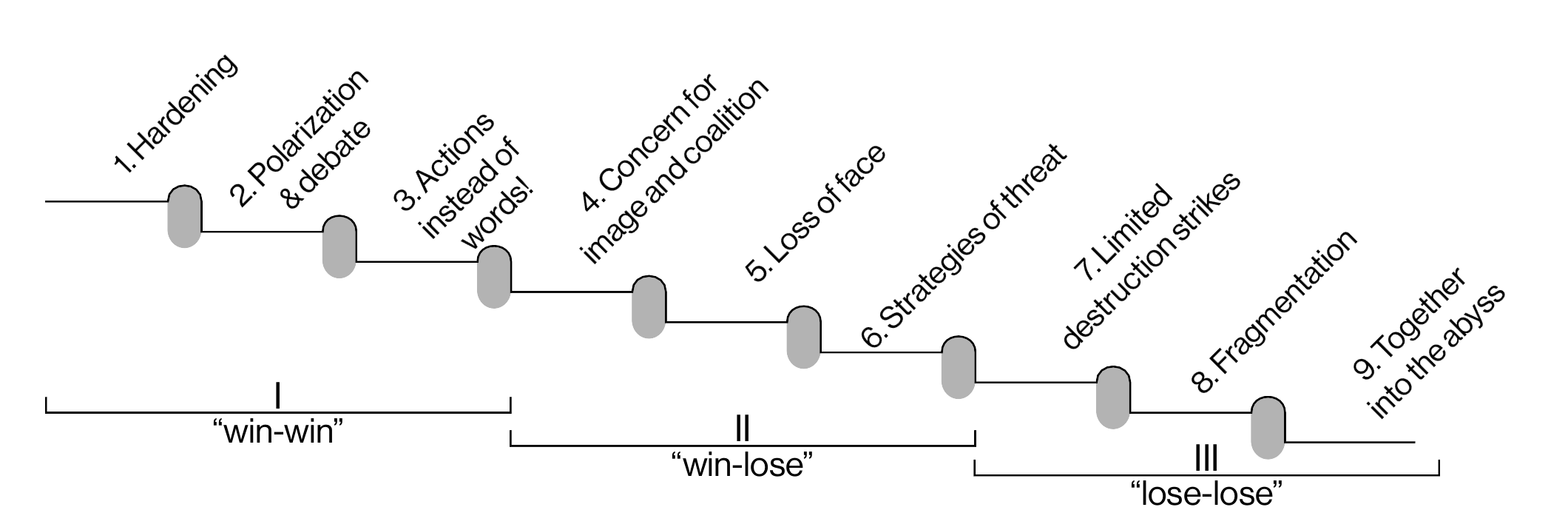
- The development of conflicts is described in 3 phases with 9 stages of escalation.
- The intensity increases from stage to stage and “keeps getting worse.”
- It starts with a conflict that can still be resolved (conflict phase 1: win-win), moves into a phase in which one party loses out (conflict phase 2: win-lose) and ends with total escalation (conflict phase 3: lose-lose), in which the fronts have hardened so much that all parties involved can only lose.
3 tips for resolving conflicts
- Communicate needs. Many conflicts arise or flare up because people don’t really say what they need and don’t listen to what others need.
- Conflicts develop. The earlier a conflict is tackled proactively, the more likely it can (still) be resolved.
- Some conflicts escalate unexpectedly fast “for me.” That can be because the conflict already has a history and isn’t just starting right now. In that moment, the parties are already starting at stage X, and “I didn’t catch the backstory” at all.
Phase 1: win-win
- A factual exchange is still possible. The conflict can still be resolved.
- Both parties are still interested in a solution, even if the mood is getting tense. The discussion stays factual.
Stage 1: Hardening
The first verbal slips happen:
“Sorry, but that’s just nonsense.”
“I really can’t believe that.”
“You’re not serious, are you?”
Opinions and moods harden because the parties are annoyed with each other. But the mood is still under control. The two sides are still talking to each other. By clarifying things and learning to listen to each other, the conflict can be cleared up (with a facilitator if needed) and de-escalated.
Stage 2: Debate
“The conflict picks up speed.” The debates get sharper and more emotional. Arguments easily slip into black-and-white thinking. People listen less well and pay less attention to the other person and their needs. “You hear what you want to hear,” and so your own opinion becomes more entrenched. What’s been said is often no longer qualified or taken back. “Something’s in the air.”

Stage 3: Actions instead of words
People create facts on the ground and do things they wouldn’t do or say in a calm moment. A confrontation and a clash are accepted as part of the deal. The parties brace themselves for a fight and no longer see the other side without bias. The conversation gets more heated or even breaks off and shifts to a different level. What couldn’t be achieved with words is now attempted with facts on the ground: somehow improving and strengthening your own position.
A conflict can still be resolved at this point, because “nothing has really happened yet.” On their own or with the help of a facilitator, the parties can bring the conversation back to the factual level and see the needs and the actual issue again.
Phase 2: win-lose
In conflict phase 2, the conflict really starts to escalate. The atmosphere is noticeably tense, and it doesn’t look as though the parties are still interested in a constructive solution. Etiquette and decency are still observed for now.
If a conflict reaches this second phase, at least one party usually comes out as the loser.
As a leader, you can no longer wait and see. You’d be well advised to step in actively now, mediate and take steps so that the conflict can still be resolved with as little damage as possible.
Stage 4: Coalitions
It gets personal. That’s why the parties look for allies and supporters for their own side. It’s about real power relations and the feeling of not being alone. “You all see it the way I do, right?!” Each party sees itself as in the right and looks for people to back up its opinion.
The other side is called the opponent, and people talk about “being right” or “walking off the field as the winner” and so on.

Stage 5: Loss of face
The conflict reaches this stage because the parties’ measures so far haven’t produced a “victory.” People denounce each other and resort to harsher means. Opinions become black and white. Not everything is checked for truth anymore. The other side is deliberately shown in a worse light, half-truths are preached, and thinking becomes absolute. The opponent is exposed until they “lose face” and become impersonal to the others. Attacks on their moral integrity and misrepresentations push the other person into a corner.
Both sides no longer shy away from going public to find even more supporters for their cause. Resolving the conflict is no longer the goal for either side; the only goal is to win and not lose face themselves. People think in terms of “we’re the good guys and the others aren’t.”
Stage 6: Strategies of threat
Threats are made, and each side tries to gain the upper hand. A factual solution is no longer possible, because it’s no longer a goal worth striving for. A power struggle breaks out over who has the authority. Even though many threats are exaggerated and unrealistic, they have an intimidating effect, because one party may now be standing in the corner “faceless and alone.” Things get explosive when the threatening party is eventually forced to carry out its threat so as not to lose credibility.
If a conflict isn’t somehow ended at this stage, it can lead to devastating damage on both sides.
Conflict stage 6 is basically the stage where the rulers of two nuclear powers have their fingers on the launch button of the nuclear missiles. One of them must be prevented from pressing the button. (Targetter)
Phase 3: lose-lose
All inhibitions are gone, and the parties lose their self-control and are willing to take hits themselves.
The goal is no longer to find a solution but to do the other side as much damage as possible, even if it means going down yourself.
At this point “the famous last straw (a wrong word, a nod or something like that) can break the camel’s back,” and it escalates.
As a leader: the only thing that matters now is limiting the damage and protecting people.
Stage 7: Limited destruction strikes
The actual issue doesn’t matter anymore. Nobody talks about it now. It’s about inflicting maximum damage on the other side. All that matters is that “the other one has to take more hits than I do.”
Stage 8: Fragmentation
The conflict spreads. The other person’s circle and supposed allies are attacked and dragged in regardless of the casualties. The conflict splinters across many faces.
Stage 9: Together into the abyss
This stage is like a volcanic eruption that spews lava nonstop and causes limitless damage. Both sides go “all in” with their biggest guns. No one knows how far-reaching the negative consequences will be.