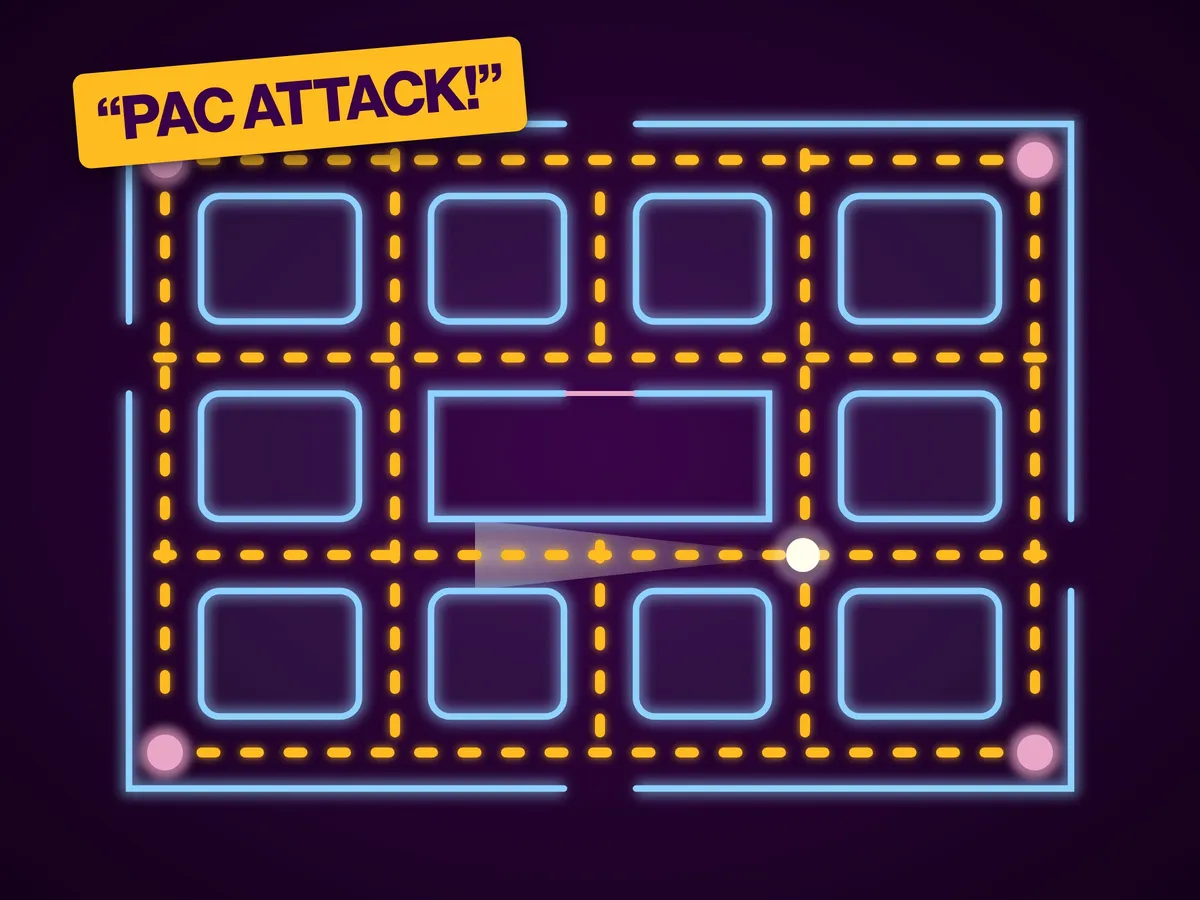
Alternative: If you’re not playing in the dark, use tables, chairs or ropes for the maze, ping-pong balls, marbles, stones or paper balls as Pac-Man dots, and costumes or jerseys for the ghosts.
Setup
- Build a maze with several entrances (starting points) for the teams.
- The ghosts start in the middle.
- The teams’ starting areas are around the outside of the maze.
- Spread the Pac-Man dots throughout the maze.
How to play
- Divide all players into teams (for example, 4 teams).
- Each team has a starting point in the maze.
- Start a countdown (for example, 3 minutes, on a projector or counted out loud).
- Only one person per team may be in the maze at a time.
- This person may only move by hopping on one leg. Or you can tie their legs together (sack race style).
- Inside the maze are “ghosts” (leaders or other players). They may only walk, and they try to catch the PAC-MANs (the players).
- If a ghost tags a PAC-MAN, that player is out for the round right away, brings the dots they’ve collected back to the team, and the next player from the team may start.
- As soon as time runs out or there are no dots left, count how many dots each team has collected.
- After each round, every team switches to a different starting point so conditions are fair (some entrances are easier).
- Play several rounds (for example, 3).
- After each round, count the collected dots and write the score down.
- The team with the most dots at the end wins.
PAC ATTACK mode
To bring the game closer to the original PAC-MAN, you can add a special power-up phase:
- Besides the Pac-Man dots, place some extra objects in the maze.
- When a player picks up one of these objects, they shout: “PAC ATTACK!”
- From that moment on, special rules apply for 15 seconds.
Special rules:
- The lighting changes (for example, black light off, regular lights on).
- The music switches to the classic PAC-MAN tune.
- All other players and ghosts freeze (they may not move anymore).
- Only the PAC-MAN may keep moving (still hopping).
- During this time, they may collect more glow dots and/or tag the ghosts.
- A ghost who gets tagged has to go back to the middle of the playing area and stay there until the 15 seconds are up.
- During this phase, no other player may collect dots or enter the maze.
• Play a practice round first to test how the game runs and how the setup works.
• Use team colors to tell the teams apart.
• The game thrives on music, atmosphere and suspense: use light effects, fitting sounds and costumes to make it feel even more like the game. And if you have more creative ideas for bringing the PAC-MAN world to life: go for it!
• If you want to reflect on the game and go deeper, these themes work well: 1. light and darkness; 2. being lost and being found; 3. staying focused on a goal despite distractions and danger.
Game reflection: How to use games as conversation starters
Games are a great way to start conversations with your group.
Set aside time on purpose to reflect together with the group after the game, ideally sitting in a circle with drinks and snacks, or just relaxing on the floor.
Sometimes this can also happen in the middle of the game, especially when it makes sense to stop for a moment and ask: “What just happened there?”
Ask questions that build bridges
Ask questions that help connect the game with life. Here are some possible questions:
- How was the game for you?
- What was the biggest challenge for you?
- What was the goal of the game? How well did you reach it?
- Which parts of the game are like our lives?
- What might have nothing to do with real life?
- What parallels are there to life with Jesus?
- What can we learn from the game for our life with Jesus?
- What is completely different in the game than in life with Jesus?
It’s not the number that counts, but the depth
Resist the temptation to collect as many answers as possible.
Less is more.
Instead, pick up one or two thoughts from the group and go deeper: Why do you think that? Have you experienced that yourself? What does Jesus say about it? What does the Bible say about it? That’s how a real conversation happens, not just churchy small talk.
Use their language
Try to pick up their words and take them seriously. If someone says, for example, “That was …,” you can follow up: “Do you know that from real life too? Where …? How do you deal with it, and how does God deal with it?”
Stay flexible
Not every game has a deep spiritual truth in it. And that’s fine! Sometimes a spiritual thought simply comes out of a conversation that grows out of what you experienced together. Use it. And if no connection fits, that’s okay too: then it was just a good game for building community.
Games open the door to heart-level conversations.
Don’t use them only to fill gaps in your program; use them as a bridge into life and into a relationship with Jesus.