A story starts out harmless. Then something goes wrong. Then a lucky break saves the day. Then even more goes wrong. In “Fortunately, Unfortunately” you tell a story together, one sentence at a time, switching back and forth between good luck and bad luck. A few rounds in, someone is sitting in an inflatable raft on the way to Greenland, and the whole group is laughing. You don’t need anything but your ideas. That’s why the game works just as well in your youth room as on the bus, on a hike, or at the kitchen table.
How to play
- Sit in a circle.
- One person starts the story with a perfectly ordinary sentence, for example: “I was walking down the street, and the sun was shining.”
- The person on their left continues with a sentence that starts with “Unfortunately …” and makes something go wrong.
- The next person saves the day with a sentence that starts with “Fortunately …”.
- Keep going around the circle, always switching between “Unfortunately” and “Fortunately,” until the story is completely crazy or you’re laughing too hard to go on.
Each sentence picks up where the last one left off. It can sound like this:
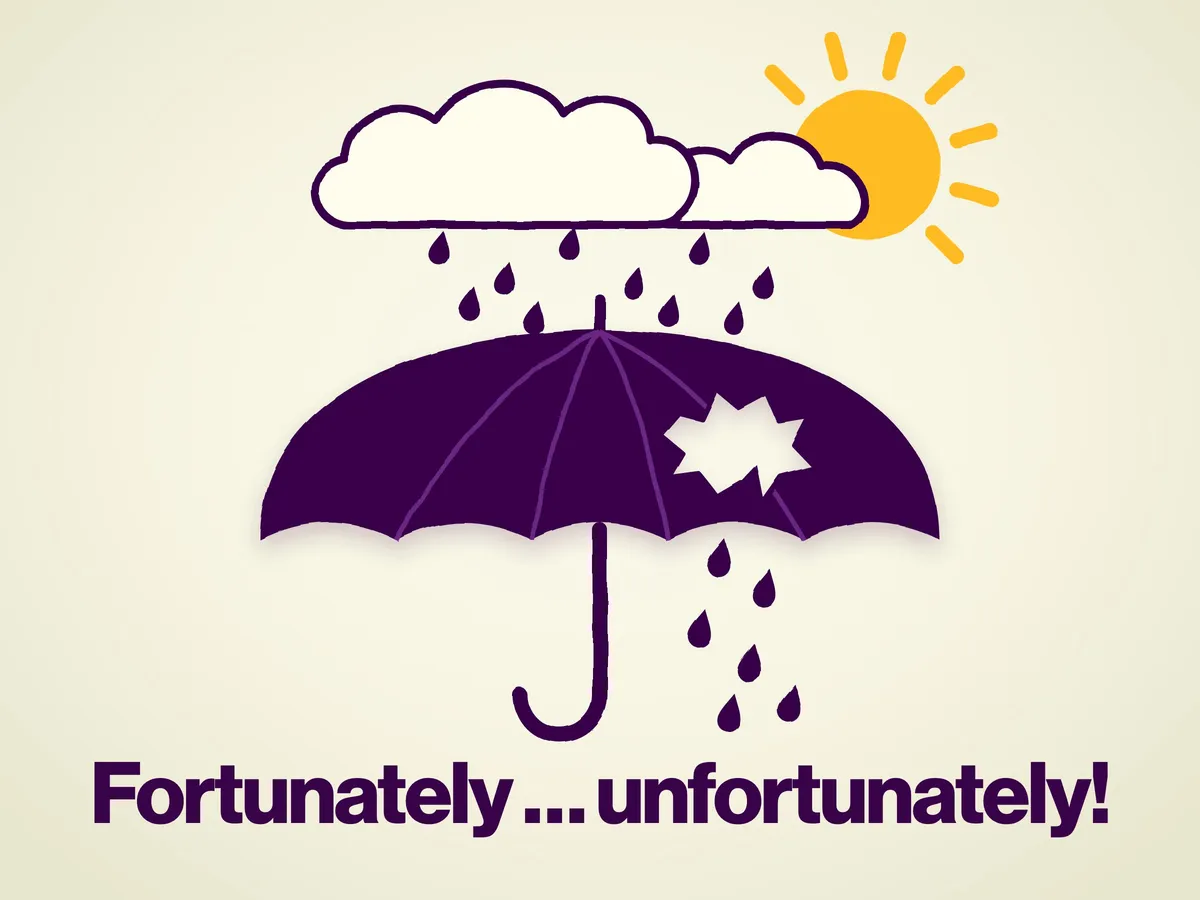
Unfortunately, it started to rain. Fortunately, I had an umbrella. Unfortunately, the umbrella had a hole in it. Fortunately, a bus pulled up right next to me. Unfortunately, the bus was going to Greenland …
Variation: Team vs. team
Split into two teams and line up in two rows facing each other. Team A only tells the “Fortunately” sentences, Team B only the “Unfortunately” sentences. The leader opens with a story starter from the list below, and then Team B begins. The teams take turns, and each time it’s the next person in line.
Anyone who can’t come up with a sentence that fits is out. To count, a sentence has to start with the right word and pick up where the last one left off. The leader decides. The team that still has someone left at the end wins.
Story starters
- I was walking down the street, and the sun was shining.
- This morning my alarm went off an hour early.
- Our group took a trip to the zoo.
- For my birthday I got a dog.
- In the basement I found an old treasure map.
- We were playing soccer, and the ball flew onto the school roof.
- We wanted to make pancakes at camp.
- My grandma just bought a motorcycle.
- I got to be mayor for a day.
- Suddenly the bus driver turned onto a dirt road.
Variation: A Bible story
As a bridge to your talk, retell a story from the Bible with “Fortunately” and “Unfortunately.” Joseph and Jonah work well, because in both stories good and bad fortune keep trading places. You start the story, and the group carries on around the circle. When someone gets stuck, the leader helps out with the next part of the story.
Joseph (Genesis 37-50): “Joseph’s father gave him a beautiful robe. Unfortunately, his brothers got so jealous that they sold him as a slave. Fortunately, he ended up in the house of Potiphar, one of Pharaoh’s high officials. Unfortunately …”
Jonah (Jonah 1-4): “God sent Jonah to the city of Nineveh. Unfortunately, Jonah did not want to go there at all. Fortunately, he found a ship in the harbor that was sailing in exactly the opposite direction. Unfortunately …” Here the “fortunately” is only good luck from Jonah’s point of view. That’s worth talking about afterward.
Then ask: Where was God when the story said “unfortunately”? At the end, Joseph tells his brothers that God brought good out of the evil they did to him (Genesis 50:20). If you want to keep going with these stories, Paul Martin’s INSPIRE books have ready-made sessions on Joseph and on Jonah: “INSPIRE: A Resource for Busy Youth Workers”.
Talk about it
Tip from Paul Martin, author of INSPIRE