
In a rapidly changing world, where generations are changing faster and faster, we as the church, as God’s family, face the challenge of reaching the people of our time.
We don’t want to limit ourselves to serving the ideas of those who lived before us. At the same time, their ideas are somehow our cruise control: “Yes, it’s always been that way, so it has to stay that way.” That isn’t bad or wrong in itself. But this way of thinking often keeps us from looking closely and seeing where we’re putting the brakes on ourselves. After all, we want people to become part of the church who are just as much God’s children but don’t yet live in a vibrant relationship with him.
How can we make a difference in a changing society and build an intergenerational church? If we focus only on the people who are already in our churches when we ask this question, we hit the brakes and struggle to move forward. But if we lift our eyes, look around and start to see the people who don’t belong to our church yet, but whom Jesus wants to bring into it, things start moving. This takes constant looking and listening. Why? Because new people keep coming, and we want to keep our eyes and our doors open for everyone Jesus is preparing.
“That takes enormous strength of character, because you have to have both feet on the ground, be as close to people as possible and at the same time ask: What is needed now, for this time? Where is it good to speak with clarity, and where is it good to endure the tensions that keep arising in politics and society, but also in our churches?” (Stefan Hänsch)
Changing generations
Today, generations renew themselves every 10 years, while earlier generations renewed themselves roughly every 30 to 35 years. This development challenges us to keep rethinking and adapting our approaches, programs and content so that they are relevant and appealing to each generation. This requires a deep understanding of current social and cultural trends as well as the needs and expectations of the different generations.
If you look at the life stages of the different generations, you see a clear shift. In the past, development ran in a straight line from childhood through the teenage years to adulthood. Today, by contrast, new life stages have emerged, and the transitions between them are becoming more and more fluid. Childhood is followed by the tween or preteen years, then adolescence, the teenage years. Next come the young adult years, followed by the “kippers”: Kids In Parents’ Pockets Eroding Retirement Savings. Then adulthood begins. After that come the career-changer stage and the downager stage of late adulthood, both of which challenge and redefine our traditional ideas of retirement. These life stages are tied less to a specific age and are more an adaptation to the changed social and economic conditions that shape the younger generations.¹

These indicators help us sharpen our lens for who the people in our church are. That way we can see more clearly how we can meet each other better, at the level of leadership but also at the level of preaching. Because there are clear differences here too.
Changing leadership styles
The generations of our time are the Builders (the Silent Generation, traditionalists), the Baby Boomers, Generation X, Generation Y, Generation Z and Generation Alpha. We can tell from the cars, toys, music players and so on which generation we grew up in. We can also see which historical events and technological achievements shaped each generation. With each generation, the learning and leadership style changes too, and so does the way influence is exercised. The graphic shows the ideal leader, the ideal leadership structure and the ideal learning environment for each generation.
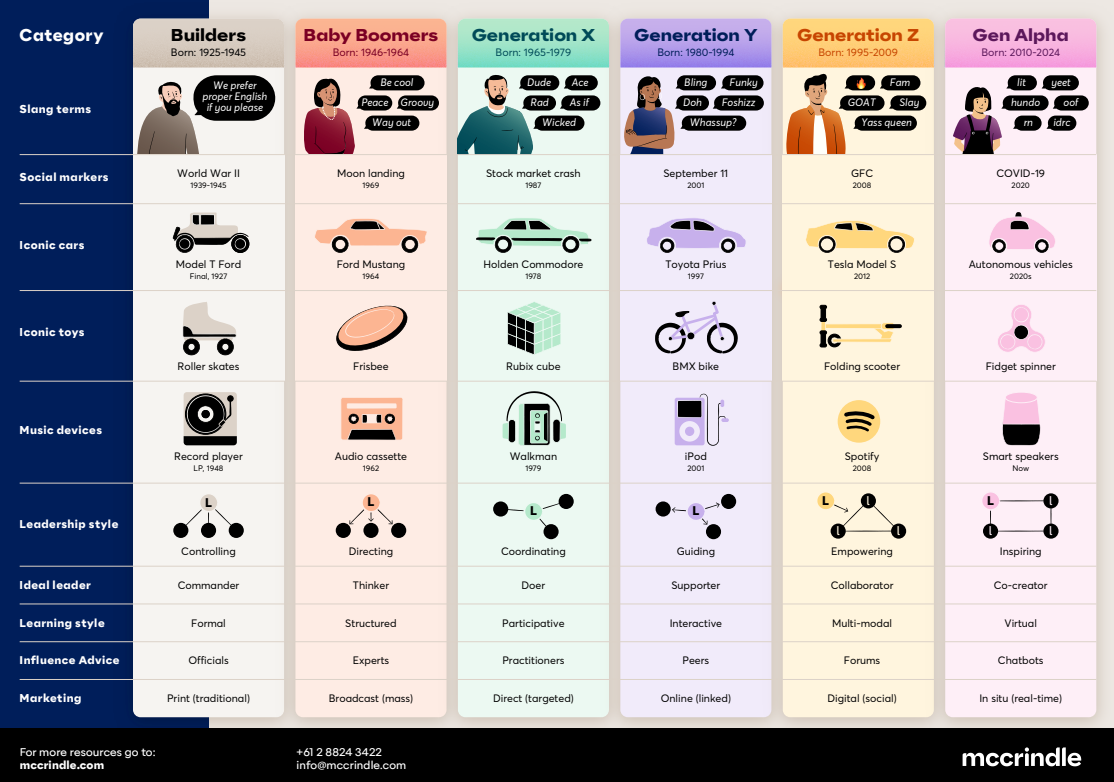
The generations from 1946 on (Builders) tend to have a controlling leadership style. They learn best in a formal learning environment, with lecture-style teaching. Among the Baby Boomers, this developed into a directing style, where concrete guidelines and instructions are given. This changed again with Generation X, those who are 45 to 59 today. This generation lives out a coordinating leadership style, where the leader is at the center and coordinates the different teams, such as the coffee team, the worship team and so on. Generation Y no longer wants just to be coordinated but to be led more again. In the graphic, the leadership structure of Generation X and Generation Y hardly differs, but in Generation X the leaders are the doers. They need room to move. Micromanaging doesn’t exist for them. It’s enough for them if someone coordinates and they themselves are free to shape things. Generation Y, on the other hand, needs concrete direction again (guiding).
And with Generation Z, this has developed into a kind of empowerment. Empowering people is a biblical principle: “So Christ himself gave the apostles, the prophets, the evangelists, the pastors and teachers, to equip his people for works of service, so that the body of Christ may be built up” (Ephesians 4:11-12 NIV). With empowerment, the team works together and the leader stands outside it. The leader is like a coach or mentor. The leader is the spiritual mother or father who gives input from the outside, encourages, cheers the team on and walks alongside. The leader deliberately hands responsibility over to the team. And with Generation Alpha, young people born in 2010 or later, the leader is an inspiring part of the team. The leader is one of them. Everyone travels together on an equal footing, and they inspire one another.
You only need to look at the learning environment and leadership structure of a university, a school or a church to see which generation is shaping it. The form and structure show it clearly. For example, we only need to look at our education system to understand why universities and schools teach the way they do. Then we also understand why church services have a particular form. And since we all tend to become traditionalists as we age, we get stuck in a system that serves the aging generation, unless we step out in time and pass the baton to the next generation.
I often hear comments from older people like “You don’t have to jump on every trend” or “You young people still have a lot to learn.” Yet they seem to have forgotten that they, too, once questioned the status quo and brought about change. Because their generation really did need a different leadership structure and a different learning environment to live out and develop its potential. And now they feel comfortable in their structures because they helped shape them. That’s completely normal, and it’s nothing bad. At the same time, the next generation needs different structures and forms again to live out its potential and grow.
“It’s not only the different age groups that often face each other from such a distance; sometimes it’s also longtime Christians who struggle with those who are new to faith, and vice versa. In both cases, the divides can become very deep.” (Markus Wenz, in German)
If Jesus wants to build the church with all generations, then it’s also important to notice each other and really see each other. It requires us not only to be considerate of one another but to actively work at shaping things and journeying together. And that’s work. But it’s fulfilling and enriching.
These days I sometimes go into the teams and say, ‘I just want to sit in.’ I sat with our musicians in a songwriting workshop like that. And they said, ‘Oh, what’s the pastor doing here? Are you here to check up on us?’ ‘No, I just want to be part of the team and maybe write a line for the next worship song that comes out of this.’ And for me the meeting was incredibly inspiring, because I noticed how these people have a love and a passion for Jesus that they try to express in songs and bring into the kingdom of God.” (Stefan Hänsch)
An inclusive community of faith
God’s family doesn’t work like an assembly line, where different shapes arrive at the start and all come out the same at the end. No, God’s family is more like a workshop where everything is handmade. Each piece is worked on individually. And that takes much more time and focus. But that time and attention are worth it. And that’s why the structure and form of a church can never stay the way it is. We’re making a big mistake if we believe that and then live that way. We don’t just miss opportunities for growth; we actively close the door on those who want to grow. If those people are wise, they leave. And that’s a good thing.
Personally, I don’t want to support a church that closes its doors to people who want to grow just because others are clinging to old forms and structures.
Maybe that’s why I love working with young people who question everything. At least that way we get to the core. We take things apart and rebuild them, take them apart again and rebuild them again. And I absolutely love that in every generation there are people who think exactly the same way. I’ll call them “generational migrants.” They’re able to find their way around the culture of other generations, live contextually and build bridges between the generations. And we need these people in leadership to actively help shape the church’s DNA. In my opinion, these are the evangelists, apostles and pastors (Ephesians 4:11-12).
I’m not speaking out against prophets and teachers by saying this. Not at all. But prophets and teachers have different gifts and abilities, and we need them too. They shape the church’s teaching and direction. They help us set the boundaries and keep the goal in sight.
Shaping an intergenerational church culture
So what can shaping an intergenerational church culture look like in practice?
First, we need to realize that an intergenerational church is also God’s idea and goal for his family. We aren’t supposed to make distinctions or show favoritism (see the letter of James). In practice, though, an intergenerational church isn’t possible in every phase. When a church is planted, for example, usually only the generations of the people planting it are represented. So it’s usually a homogeneous group.
Experience shows that church planters or church planting teams automatically reach people who are ten years older and ten years younger than they are. If you want to reach people who are much older or much younger, you have to work very hard at it.
That’s why it makes sense for church planting teams to be made up of several generations. That way the planting team has the different generations in view from the very beginning and can plant the church with different generations in mind from the start.
If your church has been around for a while and only a few generations are represented in its leadership teams, find ways to bring other generations into leadership teams or processes.
Another factor is the principle of discipleship. It runs through the entire New Testament. The Gospels give us a very clear picture of it. Paul’s letters are completely saturated with this principle. But don’t think I’m talking about a program here. No. Discipleship is a lifestyle, the heartbeat of a disciple of Jesus. When I see an intergenerational church, I see a church that makes disciples who make disciples.
Jesus modeled this for us. For three years he shaped his disciples intensely. They ate together, traveled a lot, experienced successes and failures, went through highs and lows together. Jesus deliberately reflected on these moments. He took a great deal of time for them. Even when the disciples went out on his behalf to drive out demons, heal the sick and proclaim the good news, they kept learning. Here, too, Jesus used the opportunity to reflect. He wasn’t primarily concerned with the doing, but with what happened in their hearts through it.
What mattered to Jesus was the heart and what was going on inside it, so he could draw it out, change it and make it more like him.
The doing wasn’t the goal; it was a tool. Because under friction, under stress, in conflict, what’s inside us comes out. That’s why it’s important that we take time to look at it and don’t just carry on with the program. That’s how the disciples became more and more like Jesus.
David as a role model
Theodore Roosevelt reminded us:
“People don’t care how much you know until they know how much you care.”
This principle is reflected in the story of King David. He served the people of his time and invested his life in serving them according to God’s will. “Now when David had served God’s purpose in his own generation, he fell asleep” (Acts 13:36 NIV).
When David realized his life was coming to an end, he gave his son Solomon crucial instructions for the future (1 Kings 2). He didn’t focus only on the end of his era, but also on how he could strengthen and bless the next generation. He left a legacy of about 300 million euros for building the temple, trained 300 elite soldiers for battle and created a loyal upper class. David understood what he could do to empower and support the generation of his time. He organized resources, trained people and fostered a culture of loyalty that supported the next generation.
This loyalty and support are what shape and define a culture, whether in the church, in the family or in the youth group.
It’s about how we live out leadership, how we talk about others and how we shape the generation of our time.
This loyalty arises where three concentric circles intersect:
- First, the timeless truths of the Bible;
- Second, the personal concerns and basic life questions of the generation, such as “Who am I?” “Where do I belong?” and “What difference can I make?”; and
- Third, the current topics of debate in our society.
The key to an intergenerational community that is both real and relevant lies where these three areas overlap.
Let’s have the courage to shape our churches and communities so that they don’t just reach the generations coming after us but shape them deeply. Let’s find ways to empower and support the teenagers and young adults of our time so they can bring themselves fully into God’s bigger story. That way we can create a community marked by mutual respect, understanding and deep care for one another: a community that embraces and enriches all generations.
Reflection questions for leaders and teams
- Which of these points spoke to you?
- What challenges you?
- How can we make sure that the way we shape our church life is also relevant and attractive to younger generations?
- To what extent have we as leaders taken into account the needs, expectations and cultural characteristics of the different generations?
- What concrete steps can we take to foster a culture of discipleship, inclusion and empowerment for all generations?
- How do we as a leadership team deal with resistance to change?
9 steps you can take
- Feedback and ideas from younger generations: Set up regular meetings or forums where younger church members can share their ideas and feedback on church life. Use surveys or focus groups to better understand their ideas and wishes.
- Intergenerational planning groups: Involve representatives of all generations in planning events, services and projects. This builds understanding and appreciation for the needs and perspectives of every age group.
- Cultural sensitivity training: Offer training for the leadership team and church members to develop a better understanding of the cultural differences and needs of the different generations.
- Mentoring and discipleship: Encourage discipleship relationships in which older church members pass on their life experience and spiritual knowledge to younger ones. At the same time, younger generations can help older members with new technology and current trends.
- Flexible service formats: Experiment with different service formats to accommodate different preferences and styles. This could include, for example, modern and traditional times of worship or themed services.
- Conflict management training: Train the leadership team in dealing with conflict and resistance to change. Develop strategies to encourage open discussion and respect different opinions.
- Innovative communication channels: Use modern means of communication such as social media, apps or online platforms to reach younger generations and involve them in church life.
- Service and project groups: Encourage the formation of service or project groups made up of different generations. That way, different age groups can work toward goals together and learn from each other.
- Introduce change carefully: Communicate planned changes transparently and build understanding of why they’re needed. Make room for questions and concerns, and actively involve the church in the change process.
¹ McCrindle, Mark. (2014). Scouts Australia: Youth Program Review Phase 3. McCrindle. Retrieved August 23, 2019, from https://mccrindle.com.au/app/uploads/pdf/blog-archive/Scouts-Phase-3-YPR-Scoping-Study.pdf
Recommended reading
English version: October 2026