
The elements described below offer different ways to engage with the topic of this session. It’s up to you whether you use all of them or just one. They are tools for you; you decide how to use them. What matters:
- Be flexible and adapt the activities to the group dynamic and your time budget. You won’t be able to fit all the elements into one session.
- Make sure all participants are included and feel comfortable.
- Offer enough room for personal reflection and stress the importance of honest and open feedback.
- Be sensitive to emotional reactions, especially when it comes to personal topics.
Experiential activity “Stone Fist”
⏱ 20 minutes
How to play
- You play in teams against each other (2 to 4 teams, depending on the group size).
- The goal is to build the tallest stable tower out of the chairs together. It has to stand freely for at least 10 seconds, without anyone holding it and without external support (a wall, for example).
- Every person holds their stone in their hand for the whole game.
- The hand with the stone may not be used for building. If someone uses that hand (even just the fingers), they have to put the stone down and the other team gets 1 point. The same applies if the stone is dropped by accident.
- The team with the tallest tower gets 10 points.
- For every stone your team “loses,” the other team gets 1 extra point.
- Secret rule (don’t give it away): Whoever has to put the stone down or puts it down on purpose may use both hands for building, but gets 1 penalty point. If the whole team puts their stones down, the team gets 20 extra points.
Safety notes
- Use sturdy, stackable chairs
- Keep space between the teams
- No throwing or ramming chairs
- Stop the exercise immediately if there is any danger

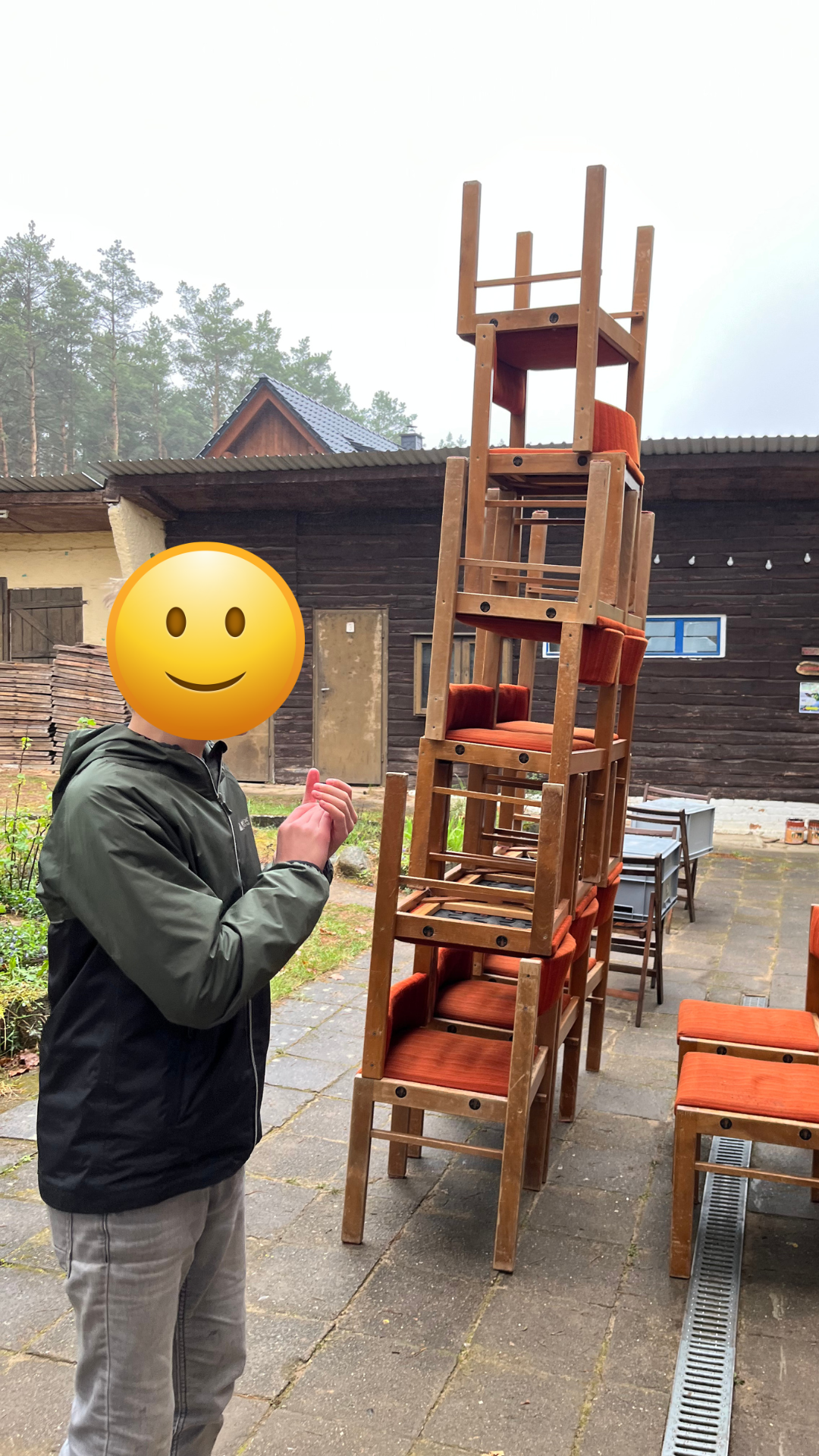
What happened in our group: Some people reflexively used the hand with the stone to protect themselves and others from falling chairs. They were disappointed at first, but then they experienced the freedom of building and were able to help their team in a special way because the stone no longer held them back. That was good and helpful for the reflection afterward.
Sometimes we think we lose when we let go.
But what if letting go is exactly what sets us free?
In the game, you could have let go of something, to be free, to build faster, to achieve more. But many of you held on to the stone. Maybe because you wanted to win? Maybe because you didn’t want to give the others too many points?
The stone in your hand is like the guilt we sometimes hold on to. It’s the pain we feel when others hurt us and wrong us. We often hold on to that pain and that guilt. Peter, a friend of Jesus, once asked him what he should do with that kind of guilt.
Let’s watch a video about it.
Video “The Parable of the Unforgiving Servant”
⏱ 3 minutes
Going deeper
⏱ 10 minutes
📖 Read Matthew 18:21-35
The king forgives an unimaginably large debt.
But the servant holds on to the small debt of his fellow servant.
The servant acts without mercy, either because he has no appreciation or gratitude for the king’s mercy, or because in his heart he hasn’t understood what it really means.
Maybe his heart is still not free, still holding on to his own guilt inside, and that’s why he can’t forgive his fellow servant’s debt.
We often don’t understand how great the forgiveness and mercy is that we have received through the death and resurrection of Jesus. Maybe we think we can pay our debt back with good deeds, and we expect the same from the people around us.
Jesus and the Father (the king) forgive us everything without us having to pay it back, because they know we can’t. But sometimes we think we still owe something, even though we are walking with Jesus, and we are unmerciful toward others because we haven’t understood what Jesus has done for us. We carry our guilt to the cross and take it back with us again, and that’s why we hold on to other people’s guilt: because we ourselves haven’t experienced what it means to let go of guilt.
But what if letting go is exactly what sets us free?
In Southeast Asian countries like Vietnam, Laos or the Philippines, there has been a trick for catching monkeys for centuries. The macaques that live there love ripe, sweet bananas more than anything. So the farmers take a large coconut, hollow it out and put a sweet banana inside. They also cut a hole in the coconut just big enough for a monkey to reach its hand in. Then they hang the monkey trap in a tree and wait. Usually it doesn’t take long until a macaque comes along, smells the sweet scent of the banana and pushes its hand through the narrow hole into the coconut. The monkey grabs the banana, and now it’s caught. The hole in the coconut is so narrow that it can’t pull its arm out while it’s clutching the banana. Basically, all the monkey would have to do is let go of the banana to free itself. But the monkey can’t do that. It loves the banana too much to let go and pull its arm out of the trap. (Axel Ebert, Evangelical Church in Baden, Germany, translated)

The simple principle behind the monkey trap: without letting go, the monkey can’t get away.
It could be free if it let go.
We don’t stick our hands into coconuts to greedily devour a banana. Bananas don’t have that kind of effect on us.
But we hold on to guilt.
So what happens when we hold on to other people’s guilt?
This is how my heavenly Father will treat each of you unless you forgive your brother or sister from your heart. (Matthew 18:35)
We lose our freedom. We will find that we keep taking our own guilt back from the cross, because we don’t leave other people’s guilt with Jesus.
Paul calls us to do the following in Colossians 3:13-14: Bear with each other and forgive one another if any of you has a grievance against someone. Forgive as the Lord forgave you. And over all these virtues put on love, which binds them all together in perfect unity.
In the exercise, you experienced how the stone got in your way. It was much harder to stack the chairs. The risk of your teammates or you yourself getting hurt was greater, because you had fewer hands to hold the chairs.
Whoever holds on to guilt endangers what is supposed to grow or be built.
Relationships, trust, team spirit: they become shaky when we don’t let go of guilt.
What you hold on to doesn’t just affect you. It affects the whole.
Unforgiveness is never just “my thing.” It affects my community.
Maybe you were afraid to give the other group a point.
When we don’t forgive, we often sabotage ourselves.
We hold on out of principle, and in the process we lose the freedom Jesus gives us.
Those who let go of the stone could stack more freely, more steadily, more purposefully.
Whoever lets go regains the ability to act. You can act more constructively.
Next step
⏱ 3 minutes
Take your stone. Look at it. Ask yourself: What do I find hard to forgive? What am I holding on to?
In your mind, write it on your stone, and bring the stone to the cross (or lay it down symbolically in front of you).
Tell Jesus:
Jesus, thank you for forgiving me.
Remind me of what you have done for me.
Help me to forgive …
Here is my stone, the guilt of … that I have been holding on to until now. I lay it down with you at the cross. I leave this guilt with you and I forgive …
Because I have been forgiven, I can let go, and I become free.
Amen.
Small groups
⏱ 20 minutes
Talk about these questions in small groups:
English version: September 2026