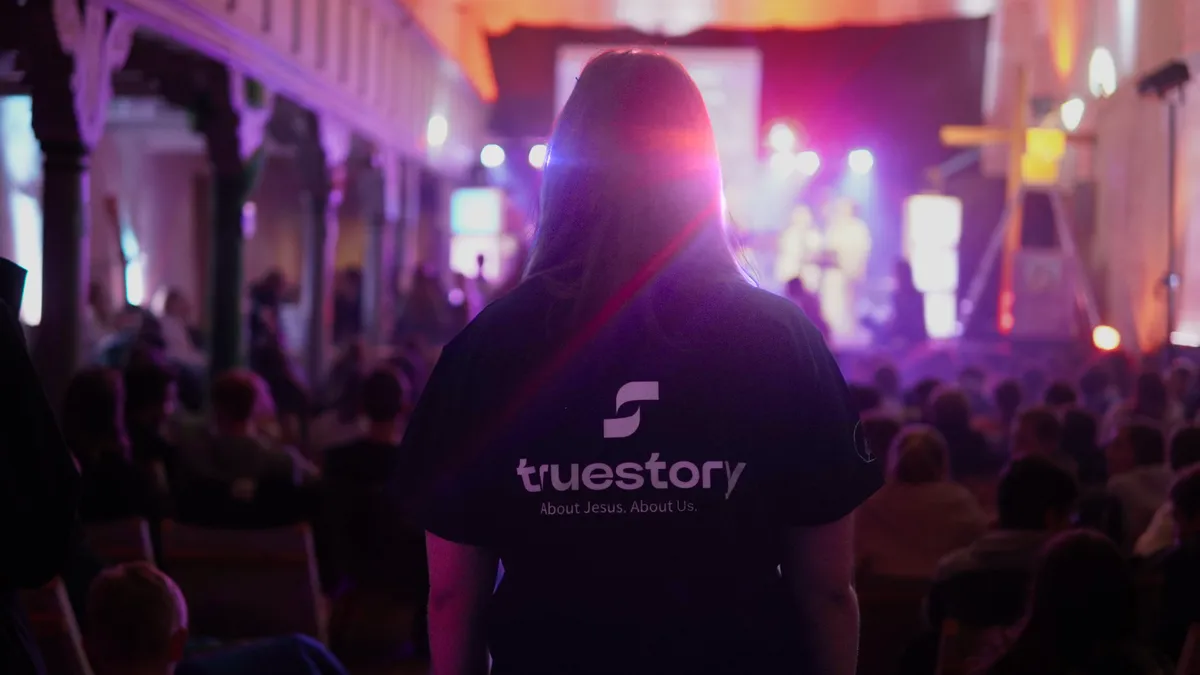
What is this post? From the truestory evangelist handbook: the craft behind the invitation to faith. Why truestory extends this invitation, the prayer of commitment and three ways to shape the invitation. To go with it, there are the series’ ready-made youth night outlines, which apply this material to specific themes.
Bringing the evening to a point where visitors can respond in a concrete, personal way is one of the hallmarks of truestory. At these evenings, teens hear things that are mind-blowing to them, and they need help knowing how to deal with them. With the prayer, we offer them a way to put their thoughts and feelings into words. It is moving again and again to meet people who decided at truestory to start a new life with God. How good it is when being able to respond concretely to what they heard helps people.
More about truestory and its material: truestory.eu (in German)
Why we invite people to faith at truestory
1. The response to God’s invitation
The gospel is a personal invitation. Our wish and prayer is that people accept this invitation. When we invite people to respond publicly, for example by coming forward to meet at the cross, we offer them the chance to give a personal answer. This opportunity is an essential part of a truestory evening.
2. Confessing faith in public fits the nature of the Christian faith
In our society, religion is often seen as a private matter. That is a result of the history of ideas in Europe, shaped in part by the wars of religion in the 17th century and the Enlightenment in the 18th and 19th centuries. But the gospel shows: Following Jesus is always a social and therefore public matter too. It doesn’t belong only in the personal sphere, and it is certainly not a private matter. We are convinced that this step of confessing faith publicly helps many people to anchor themselves in faith and encourages others to take their stand for Jesus Christ as well. That’s why at all truestory Nights we offer teens the chance to pray the prayer of commitment out loud.
3. Confessing faith in public leads into community
Faith in Jesus is always something we share with others. Whoever follows Jesus needs community with other believers to do so. Faith is strengthened in the shared life of a Christian church. We offer teens conversations with volunteers who are prepared and trained for this. These conversations are also meant to open up contact that helps teens become part of a church.
4. We trust in the power of the Word
In the end, only God’s Spirit can lead people to follow Jesus. To do this, he also uses our words. Jesus has commissioned and authorized us to extend the invitation in his name, and he promises us his authority: “Whoever hears you hears me!” (Luke 10:16) We can’t and don’t want to force anything in evangelistic preaching either. God wants to use our speaking in order to speak to the teens himself. We count on the work of the Holy Spirit and want to make room for teens to express their response to God speaking to them.
5. truestory: one opportunity among others
We do this knowing that direct evangelistic preaching is (only) one way and that God can use many other opportunities to reach teens. We are grateful that many young people have responded to the preaching again and again in the past. Some came forward in response to the invitation. Some prayed the prayer with us from their seats. Some looked for a conversation after the event. Others signed up for the follow-up faith course and in that way made their decision to follow Jesus visible.
6. What happens during the public invitation?
In our preaching, we explicitly invite people to see the prayer as the beginning of a relationship with God. At the events we find that about a third of those who come forward see this step as the beginning of faith in Jesus. Another third see it as a renewal of their faith. The last third come to talk about specific questions in their lives, to sort out particular problems or conflicts, or simply to be prayed for.
Prayer of commitment
Jesus, today I heard about you, and I sense what that means for me. Thank you for loving me like this. I have been hurt. Please heal my heart. I have hurt others. Please forgive me. I want to live my life with you. Thank you for being with me on the way. Amen.
Many forms, one goal
truestory offers very special opportunities. Local situations are very different. In rural areas especially, the setting often looks very different than in cities. It’s necessary to respond to these differences. That also affects the form in which we extend the invitation to faith.
At truestory, the concrete invitation to faith should also be at the center. But we deliberately want to look at different forms in which this invitation is extended. Specific suggestions for shaping the invitation are made together with each program outline. Here we want to name three basic forms that we can imagine at truestory:
1. The prayer
The same prayer of commitment is prayed every evening. Visitors who come more often become familiar with the words. They have the chance to think about the prayer several times and to consider seriously whether they want to pray it.
It is meant to lend words to teens whom God has spoken to, so that they can express their yes to Jesus. Taking a first step in faith means putting your trust in Jesus, even if you haven’t understood everything yet. To make it easier for teens to understand, you can explain individual sentences again when you introduce the prayer.
The prayer is a beginning. After it, teens are invited to become part of the Christian community. There are helpful local programs for this. However, teens often find it hard to take up these offers. As the evangelist, you can encourage them by having someone from the local area introduce the follow-up program after the prayer.
Teens are invited to approach the volunteers. From them they get suggestions of where they can get involved, so they can live as Christians in a helpful community. truestory also offers the chance to talk in a trusting setting about things there is usually little room for. That’s why it’s important to have volunteers available who are ready to talk and willing to engage with the guests’ questions and needs.
Here’s what this form of invitation could look like in practice:
- Explain what is about to happen and introduce the prayer of commitment in advance
- Invitation to faith
- Prayer of commitment (spoken line by line, with a few explanatory thoughts)
Jesus, today I heard about you, and I sense what that means for me.
Maybe you heard about Jesus for the first time today and still have lots of open questions. Starting a life with Jesus means putting your trust in Jesus. You don’t have to have understood everything to do that.
Thank you for loving me like this.
Jesus knows us and loves us, even when we sometimes feel we don’t deserve it at all. He goes through thick and thin with us. No matter what we do, he stands by us.
It is our experience that we get hurt and that we hurt others. We suffer from wounds, and we become guilty ourselves. That’s why the next sentence goes like this:
I have been hurt. Please heal my heart. I have hurt others. Please forgive me.
I want to live my life with you. Thank you for being with me on the way.
Team Jesus is colorful. He warmly invites you to belong. It’s about nothing less than your whole life. This is the beginning of your journey with Jesus.
Amen.
- Words of encouragement, blessing and an invitation to talk
2. The invitation to the cross
The invitation to meet at the cross is a helpful way for teens to step out of the crowd and confess their yes to Jesus Christ publicly and joyfully. The cross is Jesus’ hallmark. Especially for young people who are already part of Christian circles, this form can help them get clear about where they stand with Jesus. Some teens move in Christian circles without ever looking at their own relationship with Jesus. This form can be a good way to change that.
Here’s what this form of invitation could look like in practice:
- Explain what is about to happen and introduce the prayer of commitment in advance
- Invitation to faith
- Invitation to the cross: read the prayer of commitment aloud
- Invitation song (with a chance to respond)
- Prayer of commitment (spoken line by line)
- Words of encouragement, blessing
- Goodbye and transition into personal conversations
3. Symbolic actions
For some teens, a symbolic action is a good way to anchor their own decision. Maybe it’s a ribbon at the cross that I symbolically use to tie myself to Jesus. Maybe it’s a piece of broken pottery I can lay at the cross as a picture of handing my hurts and my guilt over to Jesus. Maybe it’s the little heart I receive that makes it clear to me: I am infinitely loved by God. There are many creative possibilities here. They can also be adapted to the theme of the evening. What matters is keeping the goal in view: We want to give teens a way to express their yes to Jesus.
Here’s what this form of invitation could look like in practice:
- Invitation to faith
- Invitation to respond at the prayer stations
- Time to respond (two or three songs)
- Words of encouragement, blessing, goodbye